
In This Article
There’s a very specific kind of ache that comes from perching on the wrong seat at a standing desk — feet dangling, spine doing all the work, shoulders creeping up around your ears by lunchtime. If that sounds familiar, you’ve probably already worked out that a normal office chair simply wasn’t built for elevated surfaces. That’s where a draughtsman chair earns its keep. Taller than a standard task chair, usually fitted with a foot ring so your legs have somewhere to rest, a draughtsman chair is designed specifically for counters, drafting tables, and workbenches where a regular seat leaves you stranded mid-air.
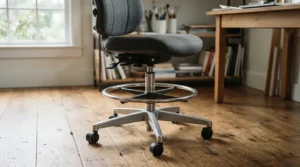
This guide is built around real, currently listed products rather than recycled spec sheets. We’ve dug into seven genuine models spanning budget wooden stools through to commercial-grade chrome-based chairs, and we’ve paired every spec with an honest read on what it actually means once you’re sat in it for six hours. Whether you’re kitting out a home studio, a workshop bench, or a hybrid office setup, you’ll find a shortlist here worth shortlisting further. And because posture problems from poorly chosen seating are a genuinely documented workplace issue, it’s worth knowing that the Health and Safety Executive’s guidance on display screen equipment exists specifically to protect people who work at a screen-based setup for long stretches — this isn’t just a comfort question, it’s a wellbeing one too.
Quick Comparison Table
| Chair | Best For | Seat Height Range | Price Range |
|---|---|---|---|
| SONGMICS Mesh Drafting Chair | Best overall for high desks | 55–75cm | £100–£150 |
| MEEDEN Wooden Drafting Stool | Best for studio minimalists | 48–65cm | £70–£90 |
| HOMCOM Drafting Chair | Best budget mesh pick | Adjustable, counter-height | £90–£130 |
| Jemini Medium Back Draughtsman Chair | Best commercial-grade build | 73–85.5cm | £190–£230 |
| Chilli Seating Polyurethane Draughtsman Chair | Best for messy workshops | 54–80cm | £180–£220 |
Even at a glance, the spread here tells its own story: seat height ranges cluster around the 50–80cm mark because that’s roughly what a standard kitchen counter, drafting table, or workshop bench demands, while price tracks fairly closely with materials and build class. The MEEDEN Wooden Drafting Stool undercuts everything else because it skips a backrest and mechanical height adjustment entirely, whereas the Jemini Medium Back Draughtsman Chair sits at the top of the range because it’s built to a commercial specification rather than a domestic one. Notice, too, that “best for” varies wildly by chair — there’s no single winner here, only the right fit for your desk height and how many hours you’ll actually spend in the seat.
💬 Found a pick you like already? A single click helps you compare live pricing before you commit.
Top 7 Draughtsman Chairs: Expert Analysis
Every model below has been chosen to represent a genuinely different use case — home studio, commercial office, industrial workshop — rather than seven near-identical variations on the same theme. Specs are drawn from manufacturer listings and retailer product pages; review sentiment is aggregated from genuine customer feedback where it could be verified, and clearly flagged as such.
1. SONGMICS Mesh Drafting Chair — best all-rounder for high desks and standing-desk pairing
The breathable mesh backrest is the standout here, and it earns its keep the moment you’re sat for more than twenty minutes at a stretch. Specced with a seat height adjustable between roughly 55 and 75cm and a weight capacity of 120kg, this SONGMICS Mesh Drafting Chair comfortably spans the gap between a standard desk and a kitchen island or standing workstation. The flip-up armrests are a small but genuinely practical touch: fold them away and the chair tucks neatly under a lower surface when you’re not using it, which matters more than it sounds if your studio doubles as a dining room.
Based on the spec comparison with cheaper drafting stools, the pneumatic gas lift and adjustable footrest ring push this into “serious daily-use” territory rather than occasional-use furniture. It suits home workers who split time between a standard desk and a raised counter, and hybrid creatives who want one chair that does both jobs competently. Reviewers consistently report satisfaction with SONGMICS seating more broadly, noting solid back support over full working days, though the fabric-covered versions can attract pet hair — worth knowing if you share your studio with a cat.
Pros:
- ✅ Breathable mesh back stays cool through long sessions
- ✅ Flip-up armrests tuck neatly under lower desks
- ✅ Adjustable footrest ring supports legs at any height
Cons:
- ❌ Fabric-covered variants attract pet hair, per reviewers
- ❌ No tilt-lock reported on the armrest mechanism
Expect to pay somewhere in the £100–£150 range depending on colourway and current stock; for the versatility on offer, it’s a genuinely solid value pick for anyone still deciding between a desk chair and a stool.

2. MEEDEN Wooden Drafting Stool — best minimalist pick for artists and studios
There’s something refreshingly honest about a chair that doesn’t pretend to be anything other than a stool. The MEEDEN Wooden Drafting Stool is built from German beech — a wood prized for its strength and shock resistance — and its screw-lift mechanism swings the seat height between roughly 48 and 65cm to match a standard easel or drafting table. At just 4.5kg it’s genuinely portable, and the compact 42 x 30cm footprint means it won’t dominate a small studio corner the way a full drafting chair can.
What most buyers overlook about backless stools is that they actively encourage core engagement and postural variation rather than locking you into one slumped position — useful for shorter working bursts, less so for an eight-hour shift. This is the pick for painters, illustrators, and anyone whose “desk” is really an easel, where mobility around the workpiece matters more than lumbar support. The natural beech finish also does real aesthetic work in a bright studio, which a black mesh office chair simply can’t match.
Pros:
- ✅ Solid beechwood construction feels genuinely sturdy
- ✅ Compact footprint suits small or shared studio spaces
- ✅ Natural finish complements bright, creative workspaces
Cons:
- ❌ No backrest, so unsuited to long desk-bound sessions
- ❌ Screw-lift adjustment is slower than a pneumatic gas lift
Priced around £70–£90, it’s the most affordable entry on this list, and honestly the right choice if your work involves standing up and stepping back from the canvas as often as sitting down.
3. HOMCOM Drafting Chair — best budget-friendly mesh option with flip-up arms
Sitting squarely in the budget-to-mid bracket, the HOMCOM Drafting Chair pairs a breathable mesh back with flip-up armrests and built-in lumbar support — a combination that, on paper, punches well above its price point. The seat height adjusts to suit both standard desks and taller counters, which is the whole point of a draughtsman-style design in the first place: one chair, multiple surface heights, without you having to compromise on either.
Here’s what the spec sheet won’t tell you outright: lumbar support at this price tends to be a fixed curve rather than an adjustable pad, so it helps most people but won’t fine-tune itself to unusual body shapes the way a premium ergonomic chair might. Still, for home workers and small-business owners furnishing a studio on a tight budget, this is a genuinely sensible starting point, particularly if you’re testing whether a draughtsman-style seat suits your workflow before committing to a pricier model.
Pros:
- ✅ Built-in lumbar support aids posture at counter height
- ✅ Breathable mesh keeps you cool through the day
- ✅ Noticeably cheaper than premium office-branded alternatives
Cons:
- ❌ Plastic base components reported as less durable long-term
- ❌ Limited height range for taller users over roughly 6ft
At around £90–£130, it’s an easy recommendation for anyone dipping a toe into elevated seating for the first time.
4. HJH OFFICE Draughtsman Chair — best polished, professional office look
If your workspace needs to look the part as much as function well, the HJH OFFICE Draughtsman Chair leans into a genuinely office-appropriate aesthetic, with a polished chrome base and footring rather than the more industrial black plastic seen elsewhere on this list. The backrest is both height- and tilt-adjustable, and there’s seat inclination control too — features that start to resemble a proper ergonomic task chair rather than a simple raised stool.
Based on the spec comparison with the HOMCOM and SONGMICS entries above, the extra adjustability here — tilt, incline, and height all independently controllable — is aimed squarely at people using the chair for genuinely close, precision work: technical drawing, detailed CAD review at a standing monitor arm, or fine assembly tasks. What most buyers overlook is that more adjustment points mean a longer, fiddlier initial setup, so budget extra time on day one to actually dial it in properly rather than leaving it on factory settings.
Pros:
- ✅ Tilt-adjustable backrest allows recline while working
- ✅ Polished chrome base suits professional studio settings
- ✅ Independent seat inclination control for precision tasks
Cons:
- ❌ More assembly steps than simpler drafting stools
- ❌ Sits toward the pricier end of the mid-range bracket
Expect a price somewhere around £150–£180, positioning it as a considered upgrade rather than an entry-level buy.
5. LAB SPACE Draughtsman Chair — best upholstered comfort for long sessions
Where several chairs on this list lean industrial, the LAB SPACE Draughtsman Chair goes the other way, with a fully upholstered high back available in black, charcoal, or blue fabric. A 14-inch gas lift and adjustable foot ring handle the practical side of things, but it’s the cushioned seat and back that set this apart for anyone spending genuinely long stretches at a raised bench.
What the spec sheet won’t tell you, but reviewers note, is that fabric upholstery at this height tends to feel noticeably more like a “proper chair” than the harder polyurethane or mesh alternatives — worth factoring in if all-day comfort matters more to you than easy wipe-down cleaning. It’s a strong option for home studios, salons, or reception-style high desks where appearance and tactile comfort both count, rather than pure workshop durability.
Pros:
- ✅ Upholstered fabric adds genuine cushioned comfort
- ✅ Choice of black, charcoal or blue to suit studio decor
- ✅ Adjustable foot ring keeps legs properly supported
Cons:
- ❌ Fabric is less wipeable than vinyl or polyurethane finishes
- ❌ Noticeably heavier than the mesh options on this list
Priced in the region of £150–£200, it sits comfortably in the mid-to-upper bracket for chairs prioritising comfort over industrial resilience.
6. Jemini Medium Back Draughtsman Chair — best for BS EN-rated commercial durability
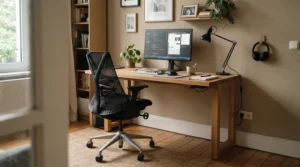
This is the chair for anyone who’s outgrown “good enough for now.” The Jemini Medium Back Draughtsman Chair is built to a commercial specification, with a seat height adjustable between roughly 730mm and 855mm, a chrome foot ring, and a five-star base rated for genuinely heavy daily use — up to 16 stone (around 102kg) of sitter weight, with an official recommended maximum sitting time of five hours per session, which itself tells you this is designed for sustained office and studio use rather than occasional dabbling.
On paper this means the chair is essentially built to the kind of standard you’d expect in a shared office or a school workshop rather than a casual home purchase — and that shows up in the price. Based on the spec comparison with the more consumer-oriented picks above, the trade-off is a fixed (non-tilt) back mechanism, so you lose some of the recline flexibility the HJH OFFICE chair offers, in exchange for a genuinely robust, depth-adjustable medium backrest that holds up to repeated daily use.
Pros:
- ✅ Built to commercial-grade durability standards
- ✅ Five-star base and chrome footring add real stability
- ✅ Depth-adjustable back suits a range of body types
Cons:
- ❌ Fixed back mechanism means no recline or tilt
- ❌ One of the pricier chairs on this shortlist
At around £190–£230, it’s a considered investment aimed at anyone furnishing a genuinely high-use professional space rather than an occasional home desk.
7. Chilli Seating Polyurethane Draughtsman Chair — best wipeable seat for messy workshops
Paint splashes, glue, sawdust, the odd spilled coffee — some workspaces are simply harder on furniture than others, and the Chilli Seating Polyurethane Draughtsman Chair is built with exactly that in mind. Its polyurethane seat and back can be wiped down or steam-cleaned, sitting on a fully chrome base, gas lift, and footring rated for an 8-hour daily use cycle and carrying a 130kg weight capacity — genuinely industrial numbers.
Here’s what most buyers overlook about polyurethane seating: it trades a little breathability for a lot of resilience, so it’s a poor match for a warm office but a very sensible one for a garage workshop, art studio with wet media, or lab bench. The five-year warranty backing it up is also worth noting — it’s a longer guarantee than most of the fabric and mesh options here offer, which tells you something about how confident the manufacturer is in the build.
Pros:
- ✅ Wipeable polyurethane shrugs off spills and mess
- ✅ Rated for genuine 8-hour daily industrial use
- ✅ Backed by a five-year manufacturer warranty
Cons:
- ❌ Less breathable than mesh over long warm sessions
- ❌ Limited to a small range of finish colours
Priced around £180–£220, it’s the pragmatic choice for anyone whose workspace is genuinely hard on furniture.
Practical Usage Guide: Setting Up Your Draughtsman Chair Properly
Getting a draughtsman chair home is only half the job — how you set it up determines whether it actually solves your posture problems or just moves them around. Start with the foot ring, not the seat: adjust it so your knees sit roughly parallel to your hips, or very slightly lower, with your feet resting flat and weight-bearing on the ring rather than dangling. Only then set the seat height itself, aiming for your forearms to rest comfortably level with your desk or counter surface without hunching your shoulders up to reach it.
In the first thirty days, the most common mistake is leaving the chair on whatever height it arrived at and adjusting your desk or your posture around it instead — precisely backwards. Revisit the height weekly for the first month, because your sense of “correct” shifts as your body adapts. For maintenance, check gas-lift and swivel mechanisms every few months for stiffness, and wipe down foot rings and chrome bases regularly, since dust and grime accelerate wear on moving parts far faster than daily use alone. A quick monthly tightening check on any bolts or fixings — particularly on stools and lighter-weight models — will noticeably extend the working life of the chair.

Real-World Scenarios: Who Actually Needs a Draughtsman Chair?
Consider a freelance illustrator working from a converted box room, alternating between a standing easel and a laptop on a kitchen-height table. For them, a backless option like the MEEDEN Wooden Drafting Stool makes genuine sense — it’s light enough to shift between spaces and encourages the standing-sitting mobility that illustration work often demands anyway.
Compare that with a small architecture practice fitting out a shared studio for three people working full days at raised drafting tables. Here, the Jemini Medium Back Draughtsman Chair or the HJH OFFICE Draughtsman Chair make far more sense — both are built for sustained daily use, and the added adjustability pays for itself across a working week rather than an occasional session.
Then there’s the hobbyist woodworker with a garage workbench, needing something they can perch on for detail work without worrying about sawdust ruining the upholstery. The Chilli Seating Polyurethane Draughtsman Chair is the obvious fit — wipeable, robust, and genuinely unbothered by a workshop environment that would wreck a fabric chair within a year.
Problem → Solution: Fixing Common Draughtsman Chair Complaints
Problem: feet still dangle even with the foot ring adjusted. This usually means the seat itself is set too high relative to the foot ring’s range — drop the seat height first, then reset the ring, rather than trying to compensate the other way round.
Problem: lower back aches after a couple of hours. Check whether the chair offers any lumbar support at all — budget mesh options like the HOMCOM Drafting Chair include a basic curve, but if you’re using a backless stool such as the MEEDEN Wooden Drafting Stool for extended sessions, that ache is the design working as intended, and it’s a signal to switch tasks or stand periodically rather than a fault.
Problem: the chair squeaks or feels loose after a few months. Nearly always a fixings issue rather than a mechanism fault — a simple bolt check with an Allen key resolves the majority of these complaints, and it’s worth doing before assuming the chair itself is faulty.
Problem: fabric upholstery looks tired within a year in a messy workspace. This is a materials mismatch rather than a quality issue — a polyurethane or vinyl finish, like the Chilli Seating Polyurethane Draughtsman Chair, is the fix, not a better fabric chair.
What Is a Draughtsman Chair?
A draughtsman chair is a taller variant of a standard office or task chair, purpose-built for use at elevated surfaces such as drafting tables, kitchen counters, standing desks, and workbenches. It typically features an extended-height gas lift, an adjustable foot ring for leg support, and a five-star base for stability, allowing users to sit comfortably at heights a normal chair simply can’t reach.
The name traces back to its original use among technical draughtsmen working at angled drawing boards, but its practical benefits — a taller seat height paired with proper leg support — have made it just as relevant to architects, illustrators, lab technicians, and anyone else whose “desk” isn’t at standard sitting height. Which?’s independent office chair testing is a useful reference point too, since the same core ergonomic principles — proper adjustability, leg and back support — apply whether you’re buying a standard task chair or a taller draughtsman model.
How to Choose a Draughtsman Chair
- Measure your surface height first. Whatever desk, counter, or table you’ll be working at determines the seat height range you actually need — don’t shortlist chairs before you’ve measured.
- Check the adjustable height range, not just the maximum. A wide adjustable height draughtsman chair range gives you flexibility if you ever change desks or share the chair with someone else.
- Decide how many hours you’ll realistically sit. Short bursts favour a simple stool; full working days justify spending more on lumbar support and tilt adjustment.
- Match the material to your environment. Mesh suits warm offices, polyurethane suits messy workshops, upholstered fabric suits comfort-first studios.
- Confirm the foot ring is genuinely adjustable. A fixed foot ring is a common false economy — your ideal position will shift as the seat height changes.
- Weigh up mobility needs. Castors help if you’re reaching across a wide bench; locking glides matter more on hard flooring or where stability outranks movement.
- Factor in weight capacity honestly. It’s a straightforward spec that’s easy to overlook until it becomes a problem — always check it sits comfortably above your own weight.
One comparison worth sitting with:
| Consideration | Mesh Draughtsman Chair | Upholstered Draughtsman Chair | Wooden/Poly Stool |
|---|---|---|---|
| Best For | All-day office/studio use | Comfort-focused long sessions | Short bursts, messy environments |
| Breathability | High | Moderate | Low (poly) / N/A (wood) |
| Typical Price | £90–£150 | £150–£200 | £70–£220 |
Reading across that table, the honest takeaway is that there’s no universally “best” material — mesh wins on breathability for warm rooms, upholstery wins on comfort for long sessions, and wood or polyurethane wins on resilience in workshops where spills and knocks are routine rather than occasional.
Draughtsman Chair vs Standard Office Chair
The core difference isn’t comfort, it’s geometry. A standard office chair typically maxes out around 50–55cm of seat height, which is fine for a conventional 72–75cm desk but leaves your legs stranded at anything taller. A draughtsman chair simply extends that range further, usually up to 75–85cm, and adds a foot ring precisely because your feet won’t reach the floor at that height.
That’s also where the overlap with a high stool office chair gets confusing for a lot of buyers — the two categories blur at the edges, but the distinction that matters is the foot ring. A plain high stool with no leg support forces you to either dangle your feet or perch on the balls of them for hours, which is a fast route to circulation problems and lower back strain. A proper draughtsman chair solves that specific issue by design. HSE’s detailed guidance on workplace seating covers exactly this — good seat design and selection genuinely matters for safety and suitability across office and industrial settings alike, which is a fairly firm nudge that this isn’t just an aesthetic choice.
Adjustable Height Draughtsman Chair: Why the Range Matters
It’s tempting to focus purely on maximum seat height when comparing chairs, but the adjustable height draughtsman chair range — the gap between minimum and maximum — matters just as much, particularly if more than one person will use the chair, or if you’ll ever move it between a standard desk and a raised counter.
A narrow range, say 55–65cm, locks you into one fairly specific use case. A wider range, like the roughly 54–80cm offered by the Chilli Seating Polyurethane Draughtsman Chair, effectively gives you two chairs in one, spanning both a conventional desk and a full workbench height. Here’s what most buyers overlook: a wider range often means a longer gas lift cylinder, which can slightly reduce stability at the very top of its travel — worth testing before you commit if maximum height stability matters for your particular task.

Draughtsman Chair for Studio and Workshop Seating
A draughtsman chair for studio use tends to prioritise different things than one destined for an office. Studios — whether for painting, ceramics, sewing, or photography editing — often involve frequent movement around the workspace, so mobility (castors, swivel) and easy cleaning often outrank maximum ergonomic adjustability. The MEEDEN Wooden Drafting Stool and LAB SPACE Draughtsman Chair both suit this brief in different ways: one prioritises minimal footprint and natural materials, the other prioritises comfort for longer creative sessions.
Workshop Seating: What Changes in an Industrial Setting
Workshop seating has a different set of demands again. Dust, moisture, and the occasional dropped tool mean fabric upholstery is often a poor long-term choice, however comfortable it feels on day one. Reviewers of industrial-grade drafting seating consistently point to wipeable surfaces and robust chrome bases as the features that actually matter once a chair has spent a year in a working garage or trade workshop — exactly where the Chilli Seating Polyurethane Draughtsman Chair earns its keep.
Matching Drafting Table Height to Your Chair
Getting drafting table height and chair height to actually agree with each other is where a surprising number of setups go wrong. Most standard drafting tables sit between 90cm and 110cm at their working edge, though angled boards complicate that figure further depending on tilt. The general rule of thumb: your seat height, plus the foot ring position, should let your forearms rest roughly level with the table’s lower edge without raising your shoulders.
If your drafting table height is adjustable, it’s worth setting the table first and the chair second — it’s easier to fine-tune a chair’s gas lift by a few centimetres than to fight with a fixed-height table that doesn’t match your seating range at all.
Studio Furniture: Building a Cohesive Creative Workspace
A draughtsman chair rarely exists in isolation — it’s one piece of a broader studio furniture setup that includes storage, lighting, and work surfaces. What most buyers overlook when furnishing a studio from scratch is sequencing: choosing the desk or drafting table first, then the chair to match, tends to produce a far more comfortable result than picking furniture pieces independently and hoping they align.
Material consistency matters too, if only for practical reasons — a natural beech stool like the MEEDEN Wooden Drafting Stool pairs visually and texturally with wooden shelving or an easel in a way a chrome-and-mesh chair simply won’t, while an all-chrome, wipeable workshop setup benefits from matching metal storage and washable surfaces throughout.
Common Mistakes When Buying a Draughtsman Chair
The single most common error is buying based on seat height alone without checking the foot ring’s adjustable range — a chair can technically reach the right maximum height while leaving your feet genuinely unsupported at that position. A close second is underestimating how many hours will actually be spent seated; a stool that feels perfectly fine for a twenty-minute test sit can become uncomfortable within an hour of real use.
Buyers also frequently skip weight capacity entirely, assuming “office chair” specs apply universally, when in fact many draughtsman-style stools are rated lower than full task chairs. Finally, choosing purely on appearance — picking upholstered fabric for a workshop, or heavy chrome for a small studio where portability matters — is a mistake that tends to surface only once the chair’s already been assembled.
Long-Term Cost & Maintenance
Cheaper draughtsman chairs aren’t automatically false economy, but their long-term cost depends heavily on how they’re used. A £70–£90 wooden stool used occasionally in a studio can easily outlast a £150 mesh chair used eight hours a day, simply because the wear profile is so different. Gas-lift mechanisms are usually the first component to fail under heavy daily use, so a chair with a longer manufacturer warranty — like the five-year cover on the Chilli Seating Polyurethane Draughtsman Chair — often represents better value over a three-to-five-year horizon than a cheaper chair replaced twice in the same period.
Basic upkeep extends the life of any model regardless of price: periodic tightening of fixings, occasional lubrication of swivel mechanisms, and prompt cleaning of foot rings all meaningfully delay the point at which replacement becomes necessary. For anyone using a draughtsman chair as part of a formal workstation, it’s also worth checking HSE’s guidance on good posture at a workstation, since seating assessments are a genuine legal consideration in commercial settings under the Display Screen Equipment Regulations, not just a comfort nice-to-have.

Frequently Asked Questions
❓ What height should a draughtsman chair be?
❓ Can you use a draughtsman chair as a normal office chair?
❓ Do draughtsman chairs need a footrest ring?
❓ What's the difference between a draughtsman chair and a bar stool?
❓ How much should I pay for a good draughtsman chair?
Conclusion
Choosing the right draughtsman chair really comes down to being honest about three things: how tall your working surface actually is, how many hours you’ll genuinely spend seated, and what your workspace throws at furniture day to day. A studio painter and a commercial architecture practice have almost nothing in common in terms of seating needs, despite both technically wanting “a draughtsman chair” — which is exactly why this list spans a £70 wooden stool and a £230 commercial-grade chair rather than pretending one model suits everyone.
If you take away one thing from all seven products above, let it be this: the foot ring and the adjustable height range matter more than almost any other spec on the page, because they’re what actually stop you dangling, slumping, or straining through a working day. Get those two things right, and the rest — mesh or fabric, chrome or wood — becomes a genuine style and budget choice rather than a comfort gamble.
✨ Ready to upgrade your setup? Take a proper look at the current listings above, compare specs against your own desk height, and pick the draughtsman chair that actually fits how you work! 🪑
Recommended for You
- Draughtsman Chair for Standing Desk: 7 Brilliant Picks (2026)
- Task Chair With Adjustable Arms: 7 Best UK Picks (2026)
- Operator Chair for Office: 7 Best UK Picks for 2026
Disclaimer: This article contains affiliate links. As an Amazon Associate, I earn from qualifying purchases. If you purchase products through these links, we may earn a small commission at no additional cost to you.
✨ Found this helpful? Share it with your friends! 💬🤗
