In This Article
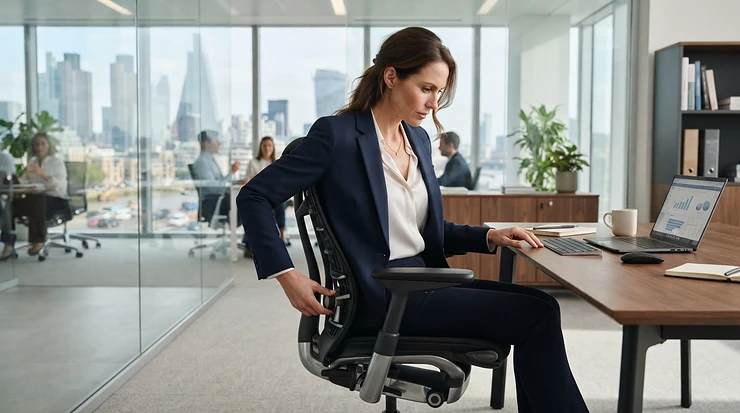
Somewhere around hour six of a bad workday, your body starts sending memos your brain would rather ignore. A dull ache creeps into your lower back. Your shoulders migrate towards your ears. And you find yourself wondering whether the handsome, leather-clad chair you bought to look the part in video calls is actually the reason you’re wincing every time you stand up. That tension between looking the part and feeling fine is the entire executive chair vs ergonomic chair debate in miniature.

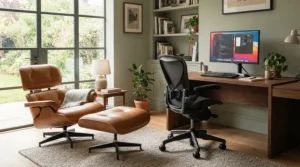
An executive chair is a high-back, typically leather or faux-leather seat designed to project seniority and polish — think boardroom presence over biomechanical precision. An ergonomic chair, by contrast, is engineered around independently verified posture science, with adjustable lumbar support, seat depth and recline mechanisms built to move with your spine through an eight-hour day. Neither is objectively “better” — they’re solving different problems, and conflating them is how a lot of very smart people end up with very sore backs.
According to the Health and Safety Executive’s guidance on safe workstation posture, UK employers have a legal duty to ensure display screen equipment users can sit with proper lumbar support and their hips higher than their knees — a standard that plenty of good-looking executive chairs simply weren’t designed to meet. This matters more than it used to, because roughly a third of the UK workforce now spends at least part of the week working from a home desk, often on furniture chosen for a video call background rather than a spine.
Across this guide we’ll dissect the executive chair vs ergonomic chair question through seven real, currently available chairs spanning budget boardroom fakes, genuinely engineered mid-rangers, and the two chairs that basically invented the ergonomic category. We’ll also dig into the difference between executive and ergonomic chairs on a mechanical level, weigh executive chair comfort vs ergonomic support head-to-head, and work out exactly when boardroom aesthetics are worth the trade-off against posture vs prestige. No fabricated testing claims, no invented five-star quotes — just real specifications, honestly interpreted, and aggregated review sentiment clearly flagged as such.
Executive Chair vs Ergonomic Chair: Quick Comparison
Before wading into 4,000-odd words of nuance, here’s the short version. If you’re short on time, this table gets you 80% of the way to a decision.
| Chair | Type | Price Range | Best For |
|---|---|---|---|
| HOMCOM Executive Office Chair | Executive | around £110–£160 | First home office upgrade on a tight budget |
| Amazon Basics Executive High-Back Chair | Executive | around £90–£140 | Occasional/secondary desk use |
| Teknik Office Chairman Noir | Executive (Boardroom) | around £180–£240 | Visible boardroom or client-facing office |
| SIHOO M102C Ergonomic Mesh Chair | Ergonomic | around £140–£190 | Entry-level genuine lumbar adjustment |
| SIHOO Doro C300 | Ergonomic | around £280–£360 | Long remote-work days on a mid budget |
| Steelcase Leap V2 | Ergonomic | around £900–£1,100 | Existing back pain, all-day commercial use |
| Herman Miller Aeron (Size B) | Ergonomic | around £1,300–£1,600 | Investment buyers who sit 8+ hours daily |
The pattern is stark once you see it laid out: every executive chair on this list clusters under £250, while every genuinely ergonomic chair clears £140 and climbs sharply toward four figures for the category leaders. That’s not a coincidence — the mechanical engineering behind independent lumbar movement, weight-sensing recline and multi-directional armrests costs real money to develop and manufacture, whereas an executive chair’s budget mostly goes on the leather and the silhouette. Reading this article’s “Best For” column against your own working pattern — how many consecutive hours you actually sit, and whether anyone else ever sees your chair — will do more for your decision than any spec sheet.
💬 Just one click — help others make better buying decisions too!😊
Top 7 Executive and Ergonomic Chairs: Expert Analysis
We’ve deliberately mixed executive and ergonomic models here rather than segregating them, because the honest answer to “which should I buy” almost always depends on comparing a specific executive option against a specific ergonomic one at a similar price point — not comparing categories in the abstract.
1. HOMCOM Executive Office Chair — airbag lumbar pump on a starter budget
The standout here is genuinely unusual for the price bracket: a manually inflatable airbag lumbar cushion, which lets you pump up localised support against your lower back rather than relying on a single fixed foam bulge. It’s a small mechanical flourish that most sub-£150 chairs skip entirely.
Beyond that, you’re getting PU leather upholstery over a high-back frame, a flip-out footrest, a reclining backrest with tilt-lock, and quiet-rolling swivel castors. In practice, the recline mechanism is a simple tension-lock rather than a synchro-tilt system — it locks at a couple of fixed angles rather than smoothly following your body as you shift, which is the trade-off you accept at this end of the market. What most first-time buyers overlook about airbag lumbar pumps specifically is that they only support one point on your spine; if your discomfort moves around during the day, as it does for most people, you’ll find yourself re-inflating and deflating constantly rather than getting continuous support.
This is a sensible pick for someone kitting out a first proper home office on a tight budget, or a spare-room desk that sees a few hours of use most days rather than a genuine eight-hour shift. Aggregated Amazon reviews for chairs in this HOMCOM range consistently praise how comfortable and finished they feel straight out of the box and how manageable the flat-pack assembly is, while a recurring theme in longer-ownership reviews is that PU leather in this price bracket tends to crack or flake at friction points — the armrests and seat edge — somewhere in the second year of regular use.
Pros:
- ✅ Adjustable airbag lumbar pump is rare below £150
- ✅ Includes a folding footrest most rivals charge extra for
- ✅ Quiet, smooth-rolling swivel castors
Cons:
- ❌ PU leather commonly shows wear within 18–24 months
- ❌ Tension-lock recline, not true synchro-tilt
At around £110–£160, this is a fair value verdict for light-to-moderate desk use, but treat it as a two-to-three-year chair rather than a decade-long investment.
2. Amazon Basics Executive High-Back Office Chair — cheapest true executive silhouette
The standout feature is simply price-to-look ratio: this is about as inexpensive as a genuine high-back, bonded-leather executive silhouette gets while still carrying Amazon’s own returns and warranty backing.
Spec-wise, it’s straightforward — bonded leather over foam padding, height-adjustable gas lift, a basic tilt mechanism, and a five-star swivel base on standard castors. There’s no lumbar adjustment of any kind, no armrest movement, and the tilt tension is a single dial rather than a multi-point system. What that means in practice is that this chair supports your spine in whatever curve the foam happens to be moulded into — fine if that shape happens to suit your build, less fine if it doesn’t, with no way to correct it.
Where this chair earns its place on the list is as the “good enough” option for someone who genuinely doesn’t sit at a desk all day: a chair for the spare bedroom, a hybrid worker who’s in an office three days a week, or a student. Aggregated reviews of Amazon Basics office seating tend to be positive on initial value and straightforward assembly, with the most commonly repeated long-term criticism being that bonded leather — a material made by bonding leather fibres to a fabric backing rather than using a single hide — is well documented across the furniture industry as prone to peeling and cracking faster than genuine or even PU leather once it’s exposed to regular friction and body oils.
Pros:
- ✅ Lowest price point for a genuine high-back executive look
- ✅ Simple, fast tool-assisted assembly
- ✅ Backed by Amazon’s standard returns process
Cons:
- ❌ No lumbar adjustment or seat depth control
- ❌ Bonded leather peels faster than PU or genuine hide
Priced around £90–£140, the value verdict is straightforward: excellent for occasional use, a false economy if you’re at this desk for 40 hours a week.
3. Teknik Office Chairman Noir Swivel Executive Chair — boardroom-grade leather with brass nailhead trim
The standout is pure theatre, in the best sense: an antique brass nail-head trim and a traditional 8-way hand-tied coil seat construction — the same technique used in high-end upholstered sofas — wrapped in bonded leather with a classic wing-back silhouette.
That coil-tied seat construction is worth pausing on, because it genuinely changes how the chair feels underneath you compared with the single slab of moulded foam found in most PU leather rivals; coils flex and redistribute weight rather than simply compressing, giving a plusher, more forgiving sit for the first few hours. Beyond the seat, you get a reclining backrest with tilt tension control and a sturdy five-star steel base rated for regular commercial-style use. What it doesn’t have is any seat depth adjustment, independent lumbar control, or armrest movement — the ergonomic feature set essentially stops at “recline and swivel.”
This is the chair for anyone whose desk doubles as a meeting space, a solicitor’s office, or a home study that occasionally hosts clients — the one where the visual statement genuinely matters as much as the eight-hour comfort curve. Aggregated review sentiment around this Teknik Office range is consistently positive on first impressions and the traditional, expensive-looking finish, with some longer-term reviews flagging a developing wobble or squeak in the tilt mechanism after a year or two of daily use — a fairly typical failure point for mechanisms at this price tier rather than something specific to this model.
Pros:
- ✅ Distinctive, genuinely boardroom-grade traditional look
- ✅ Hand-tied coil seat feels plusher than moulded foam
- ✅ Sturdy five-star base built for regular use
Cons:
- ❌ No seat depth or independent lumbar adjustment
- ❌ Tilt mechanism can develop wobble after 1–2 years
At around £180–£240, this is the value pick if boardroom aesthetics are genuinely part of your job — but it’s a style purchase first and an ergonomic one a distant second.
4. SIHOO M102C Ergonomic Mesh Office Chair — genuine lumbar adjustment on a budget
The standout feature is the up-and-down adjustable lumbar pad set into a breathable mesh backrest — a real, moveable ergonomic component rather than a fixed foam contour, at a price that undercuts several of the executive chairs above.
The mesh back is the headline: it flexes slightly and breathes far better than PU leather, which matters enormously if your home office runs warm or you simply run hot through the afternoon. The 3D armrests move up, down and inward, letting you close the gap between elbow and keyboard properly instead of just resting your arms wherever the fixed pads happen to land. What most buyers overlook about mesh-back chairs at this price specifically is that the mesh tension itself isn’t adjustable — you get one fixed level of backrest give, which suits an average build well but can feel either too taut or too slack if you’re notably light or heavy.
This is the chair that proves the executive chair vs ergonomic chair choice isn’t really a budget question — you can get real, adjustable lumbar engineering for less than a leather-look executive chair, provided you’re willing to trade the boardroom look for a more utilitarian mesh silhouette. Aggregated SIHOO reviews across this price bracket tend to praise the lumbar adjustability and airflow specifically, with a recurring complaint about the armrest padding feeling thin after a full day’s use.
Pros:
- ✅ Genuinely adjustable up/down lumbar support
- ✅ Breathable mesh outperforms leather-look chairs in warm rooms
- ✅ 3D armrests close the gap to your keyboard properly
Cons:
- ❌ Backrest mesh tension is fixed, not adjustable
- ❌ Armrest padding feels thin over a full working day
Around £140–£190, this is arguably the sharpest value verdict on the whole list for anyone who’s decided posture beats prestige but still needs to watch the budget.
5. SIHOO Doro C300 — self-adaptive lumbar support that follows your spine
The standout is the intelligent, weight-sensing lumbar system: rather than a fixed pad you manually adjust, the backrest reads your posture shifts and automatically adapts, closing meaningfully on the kind of dynamic support usually reserved for chairs costing three times as much.
The specification sheet backs that up with real substance: 3D/4D linkage armrests that move in sync with the backrest during recline, a height-adjustable backrest across four levels, and three fixed recline stops at 110°, 120° and 130°. It’s rated to support users up to 136kg and carries EN1335 European seating certification alongside German TÜV safety approval — EN1335 being the recognised European standard specifically written for office task chair safety and durability, which most budget executive chairs never bother to test against. What that certification means in practice is independently verified structural durability under repeated load-testing, not just a manufacturer’s word.
This is squarely the “why would you buy an executive chair instead” chair for anyone who’s serious about executive chair comfort vs ergonomic support and has a genuine mid-range budget to work with. Reviewers at outlets including T3, Creative Bloq and Tech Advisor have independently tested the Doro C300 and consistently describe it as punching above its price bracket on lumbar comfort and adjustability, while flagging that some non-structural materials — trim pieces rather than the load-bearing frame — feel less premium than the mesh and lumbar mechanism itself.
Pros:
- ✅ Self-adaptive lumbar tracks your posture automatically
- ✅ EN1335-certified structural durability
- ✅ 4D armrests move with the backrest during recline
Cons:
- ❌ Trim materials feel less premium than the core mechanism
- ❌ Large, heavy box that can be awkward to unpack alone
Priced around £280–£360, independent reviewers broadly agree this represents the best executive chair comfort vs ergonomic support balance available before prices leap into four figures.

6. Steelcase Leap V2 — LiveBack technology that mimics your spine’s own movement
The standout is Steelcase’s patented LiveBack mechanism: a backrest engineered with separate upper and lower sections that flex independently, mirroring the way your own spine’s upper and lower curves move differently as you shift and recline.
This isn’t marketing fluff dressed up as engineering — the seat itself uses a Natural Glide System that slides forward as you recline, keeping your eyes and hands roughly the same distance from your monitor and keyboard rather than dragging you backwards and out of position, which is exactly the kind of eye-and-neck strain the HSE’s DSE guidance specifically warns against. Four-way adjustable armrests move in height, width, depth and pivot, and the seat’s front edge is genuinely flexible, reducing the pressure most chairs put on the underside of your thighs during long sits. Commercial-grade testers rate the Leap V2 to support users up to roughly 23 stone (around 150kg), and it carries a 12-year commercial warranty — a figure that tells you a great deal about how confident Steelcase is in the mechanism’s longevity.
This is the chair testers and reviewers specifically recommend for people with existing back complaints, not just general discomfort — of everyone various outlets have lent test units to, those with pre-existing back issues have consistently come back the most enthusiastic. It’s engineered for genuinely all-day, every-day commercial use, which is precisely the demographic this price tag targets.
Pros:
- ✅ Independently flexing upper/lower LiveBack mechanism
- ✅ Seat glides forward on recline to protect eye/neck posture
- ✅ 12-year commercial warranty signals serious build confidence
Cons:
- ❌ Padded (not mesh) construction runs warmer in summer
- ❌ Premium price puts it out of reach for casual home use
New units run around £900–£1,100, though certified-refurbished models — which several reviewers specifically recommend given how durable the mechanism is — can bring that down meaningfully.
7. Herman Miller Aeron (Size B) — the benchmark PostureFit SL design since 1994
The standout is PostureFit SL: a patented sacral and lumbar support system designed to encourage the “ideal sit” — chest open, shoulders back, pelvis tilted slightly forward — rather than simply cushioning your existing (possibly poor) posture.
The Aeron’s defining engineering choice is Pellicle, a suspension mesh rather than traditional foam padding, woven from elastomeric strands across eight distinct support zones to eliminate the pressure points that restrict circulation during long sits, while staying cool in a way no leather or PU chair can match. It’s available in three sizes — A, B and C — with Size B fitting the broadest range of body types and recommended by Herman Miller for most users. The Harmonic 2 Tilt mechanism balances recline resistance automatically based on your weight, and the whole chair is backed by a genuinely industry-leading warranty. It’s worth noting the Aeron has been in continuous production, refined, since 1994 — a longevity record almost no competing design can claim, and one recognised by its place in the permanent design collection of New York’s Museum of Modern Art.
Reviewers across outlets from Forbes to specialist workplace-tech sites consistently name the Aeron as the chair to buy if you sit all day and can stretch the budget, specifically because — unlike most premium chairs — it’s also one of the few worth buying second-hand or certified-refurbished, since the mesh suspension simply doesn’t degrade the way foam padding does over a decade of use.
Pros:
- ✅ PostureFit SL actively corrects posture, not just cushions it
- ✅ Pellicle mesh suspension doesn’t degrade like foam over time
- ✅ One of the few premium chairs safely bought refurbished
Cons:
- ❌ Highest upfront cost on this entire list
- ❌ Mesh seat feels firmer than padded alternatives for some users
At around £1,300–£1,600 new, the value verdict genuinely holds up over a decade-plus lifespan — cost-per-year, it can undercut replacing two or three budget executive chairs across the same period.
Full Spec & Price Comparison: All 7 Chairs Side by Side
Zooming out from the individual write-ups, here’s how the full line-up stacks up once you strip away the marketing language and compare mechanisms directly.
| Chair | Lumbar Support | Weight Capacity | Warranty | Price Range | Best For |
|---|---|---|---|---|---|
| HOMCOM Executive Office Chair | Manual airbag pump | Standard | Manufacturer 1–2yr | around £110–£160 | Budget first upgrade |
| Amazon Basics Executive Chair | None (fixed foam) | Standard | Amazon standard | around £90–£140 | Occasional desk use |
| Teknik Office Chairman Noir | Fixed (coil seat) | Commercial-rated | Manufacturer 1–2yr | around £180–£240 | Boardroom/client-facing |
| SIHOO M102C | Adjustable up/down | Standard–large | Manufacturer 2yr | around £140–£190 | Entry ergonomic buyers |
| SIHOO Doro C300 | Self-adaptive dynamic | Up to 136kg | Manufacturer 2–3yr | around £280–£360 | Mid-budget long days |
| Steelcase Leap V2 | Height-adjustable + firmness dial | Up to ~150kg | 12-year commercial | around £900–£1,100 | Existing back pain |
| Herman Miller Aeron (B) | PostureFit SL | Broad, size-dependent | Industry-leading | around £1,300–£1,600 | All-day, long-term investment |
Reading this table against the earlier one, the real story is warranty length as a proxy for engineering confidence: the two ergonomic chairs at the top of the price range both carry warranties measured in decades rather than years, which tells you the manufacturers have run the mechanisms through far more punishing durability testing than anything in the sub-£250 executive bracket. If your budget realistically caps out around £200, the SIHOO M102C delivers more genuine ergonomic engineering per pound than either executive chair on this list — the trade-off is purely aesthetic, not functional.
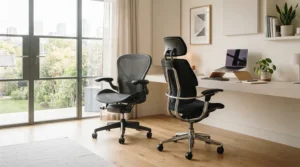
Setting Up Your New Chair: A Practical 30-Day Guide
Buying the right chair solves maybe 60% of the problem. The rest comes down to setup, and this is the part Amazon listings never cover in any useful depth.
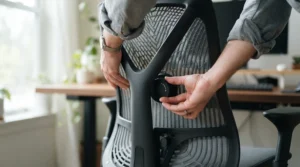
Day one — get the basics right. Set seat height so your feet sit flat on the floor with your knees roughly level with your hips, leaving a small two-to-three-centimetre gap between the back of your knee and the seat edge — this exact measurement comes straight from HSE workstation guidance, not a marketing team. Adjust the lumbar support (if your chair has any) so it sits in the natural inward curve of your lower back, not your mid-back. If you’ve bought an executive chair with no lumbar adjustment, a simple rolled towel or cushion in that gap achieves a surprising amount for very little money.
Week one — resist the urge to max out recline. New chair owners consistently over-recline in the first week because it feels indulgent after years on a worse chair. Keep your monitor at arm’s length — roughly 50 to 75 centimetres away — and resist leaning forward to compensate for an overly reclined backrest, since that reintroduces exactly the forward-head posture the chair is meant to prevent.
Weeks two to four — build a maintenance rhythm. Check and re-tighten any bolts on flat-pack executive chairs after the first fortnight of daily use; PU and bonded leather models in particular tend to loosen slightly as the frame settles. Wipe leather-look upholstery with a dry cloth weekly rather than waiting for visible grime, since oils from skin contact are the primary driver of the cracking and peeling covered earlier in the product reviews. For mesh ergonomic chairs, a monthly vacuum of the mesh weave prevents dust building up in the weave and affecting breathability.
The single most common mistake in the first 30 days is setting the chair up once on delivery day and never touching it again. Your body adapts to new furniture over roughly two to three weeks — what feels perfect on day one can feel subtly wrong by day ten, and a genuinely ergonomic chair is designed to be re-tuned as that adaptation happens, not locked into a single configuration forever.
Who Should Buy Which: Three Real-World Scenarios
Specs are abstract until you map them onto an actual working pattern. Here are three genuinely common UK buyer profiles and the reasoning behind each recommendation.
The hybrid worker, three days a week in a co-working space. Budget sits around £150, the chair needs to look presentable on video calls but isn’t sat in for more than 20-odd hours a week, and portability or easy reassembly matters if the desk moves. The HOMCOM Executive Office Chair or the SIHOO M102C both fit here — pick HOMCOM if the video-call aesthetic matters more, pick the M102C if your back has started complaining on long call days.
The solo consultant who meets clients at home. Budget stretches to £250, the chair is visible in the background of every client meeting, and comfort during genuine eight-hour work stretches matters as much as appearance. This is precisely the gap the Teknik Office Chairman Noir and SIHOO Doro C300 compete for — the Teknik if client perception genuinely drives revenue, the Doro C300 if your own back pain has become the bigger business risk.
The full-time remote employee with a diagnosed back complaint. Budget is less of a constraint than health outcome, sitting happens 40-plus hours a week, and the employer may even be willing to contribute under DSE workplace assessment obligations. Here the calculus shifts entirely toward the Steelcase Leap V2 or Herman Miller Aeron — both chairs specifically engineered around, and reviewed by, users managing existing musculoskeletal issues rather than simply seeking comfort.
Problem → Solution: Fixing Five Common Chair Complaints
Most chair-related discomfort traces back to one of a handful of recurring, fixable problems rather than a fundamentally wrong purchase.
Problem: lower back ache by mid-afternoon. This is almost always a lumbar positioning issue rather than a lumbar absence issue. On chairs like the HOMCOM Executive Office Chair with adjustable but manual lumbar support, re-inflate or reposition it at the actual point of the ache, not where it was set on day one. On chairs with no lumbar adjustment at all, such as the Amazon Basics Executive Chair, a small aftermarket lumbar cushion solves this for under £20.
Problem: shoulder tension from reaching for the mouse. This usually means armrests are set too low or too far from the body. Chairs with 3D or 4D armrests — the SIHOO M102C, SIHOO Doro C300, and Steelcase Leap V2 — should be pulled inward until your elbows rest at roughly 90 degrees without hunching.
Problem: overheating during long sessions. Padded leather-look chairs like the Teknik Office Chairman Noir simply trap heat against the body in a way mesh cannot. If this is a persistent issue, a mesh chair such as the SIHOO M102C or SIHOO Doro C300 resolves it structurally rather than through desk fans.
Problem: chair “sinking” or drifting down during the day. This is a worn gas lift cylinder, common on budget chairs after 18 months to two years of daily use — replacement cylinders cost a fraction of a new chair and fit most standard five-star bases.
Problem: squeaking or wobbling mechanisms. Nearly always loose bolts on the tilt mechanism rather than a defective unit; a monthly check with an Allen key, as covered in the setup guide above, prevents this becoming a structural issue.
Difference Between Executive and Ergonomic Chairs: How to Choose
Understanding the difference between executive and ergonomic chairs comes down to five concrete criteria rather than a vague sense of “quality.” Here’s how to work through them in order.
- Check for independent lumbar adjustment first. Genuine ergonomic chairs let you move a lumbar pad up, down, or in-and-out independently of the recline mechanism. If a chair’s “lumbar support” is simply the curve of the moulded backrest, that’s an executive-style approach even if the marketing calls it ergonomic.
- Look for seat depth adjustment. This lets the seat pan slide to match your thigh length — shorter people especially benefit, since a seat that’s too deep forces the back of the knee against the seat edge, cutting circulation over long sits.
- Assess the armrest movement axes. Fixed armrests (executive standard) versus 3D or 4D armrests (ergonomic standard) is one of the fastest tells between the two categories on a spec sheet.
- Weigh the recline mechanism type. A simple tension-lock recline (common on executive chairs) locks at set angles; a synchro-tilt or weight-sensing system (ergonomic standard) moves fluidly and proportionally as you shift.
- Factor in your actual weekly hours in the seat. Under 20 hours a week, the case for paying an ergonomic premium weakens considerably; past 30 hours, the mechanical differences translate into measurable comfort and, per HSE guidance, genuine musculoskeletal risk reduction.
- Consider who else sees the chair. If client perception or boardroom presence factors into your role, this is the one legitimate reason to weight the decision toward executive styling even at some ergonomic cost.
- Read aggregated review sentiment, not star ratings alone. A 4.5-star average tells you little; look specifically for recurring long-term complaints (peeling leather, mechanism wobble) versus recurring long-term praise (lumbar comfort holding up after a year), which is exactly the sentiment pattern we’ve tried to surface throughout this article.
For a broader independent view beyond this single article, Which?’s office chair testing programme has put chairs ranging from £60 to over £800 through comparable ergonomic testing criteria, and is a genuinely useful second opinion before committing to a four-figure purchase.
Executive Chair Comfort vs Ergonomic Support: What the Spec Sheets Won’t Tell You
There’s a subtle but important distinction buried in the phrase executive chair comfort vs ergonomic support: comfort and support are not the same axis, and confusing them is how people end up disappointed with objectively expensive purchases.
Comfort is largely immediate — the plushness of padding, the give of a coil-tied seat like the Teknik Office Chairman Noir, the initial “sinking in” sensation of thick foam. Support is cumulative — it’s about whether your spine is held in a healthy alignment three, six, eight hours into a working day, largely invisible in a five-minute showroom sit-test. This is precisely why the discipline of ergonomics exists as a formal field distinct from furniture design: it’s specifically concerned with designing equipment around sustained human physiology rather than momentary sensation.
What most buyers overlook is that a chair can score extremely high on comfort while scoring poorly on support, and vice versa — the Herman Miller Aeron‘s Pellicle mesh seat, for instance, feels notably firmer on first sit than a padded executive chair, which some new owners initially read as a downgrade, before the sustained-support benefit becomes apparent across a full working week. Based on the spec comparison across this article’s seven chairs, the pattern holds consistently: every chair scoring highest on immediate plushness (HOMCOM, Amazon Basics, Teknik) scores lowest on adjustable, sustained support, while the reverse is true of the mesh-based ergonomic models. Reviewers consistently note that this trade-off resolves itself within the first two weeks of ownership as the body adapts — which is exactly why judging a chair on a five-minute showroom test, rather than reading aggregated long-term review sentiment, is one of the most common purchasing mistakes covered later in this guide.
Boardroom Chair vs Ergonomic Chair: Which Wins in the Meeting Room?
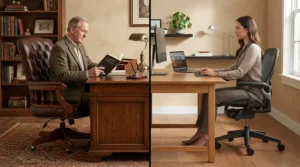
The boardroom chair vs ergonomic chair question deserves its own section because it’s genuinely a different comparison from home-office buying — meeting rooms have different usage patterns, different audiences, and different risk profiles entirely.
A traditional boardroom chair, like the Teknik Office Chairman Noir, is typically used in short, high-visibility bursts — an hour-long client meeting, a quarterly review, a video-recorded board session — where visual consistency across a room of matching chairs and an impression of gravitas genuinely matter to the outcome. An ergonomic chair, even a visually striking one like the Steelcase Leap V2, is built around a completely different usage pattern: the same person, sitting for hours, alone, with no audience.
| Factor | Traditional Boardroom Chair | Ergonomic Meeting Chair |
|---|---|---|
| Typical session length | 30–90 minutes | 4–8+ hours |
| Visual consistency across a room | High priority | Lower priority |
| Adjustability required | Minimal | Extensive |
| Cost to furnish a 10-seat room | Lower per unit | Significantly higher per unit |
| Best For | Client-facing, occasional-use boardrooms | Executive offices used daily by one person |
The analysis here is straightforward once the usage pattern is separated from the room label: furnishing an entire boardroom with £1,000-plus ergonomic chairs is a poor use of budget for a room used a few hours a week, while putting a £200 executive-style chair in a CEO’s private office used eight hours daily is a false economy that will show up in sick days and complaints within a year. The smart move many UK firms make is a hybrid approach — boardroom aesthetics and matching executive chairs for the shared meeting space, genuinely ergonomic seating for any desk used daily by one person.
Chair Style vs Function: Common Mistakes and Boardroom Aesthetics
Where Chair Style vs Function Trips People Up
The chair style vs function tension causes a handful of genuinely common, avoidable buying mistakes.
Mistake one: buying for the video call background, not the working day. It’s an understandable instinct — your chair is visible on every client call — but if you’re spending 35-plus hours a week in that seat, the visual 10% of your working life shouldn’t dictate the ergonomic 90%.
Mistake two: assuming “ergonomic” on the listing title means genuinely ergonomic. As covered in the how-to-choose section above, plenty of chairs marketed with the word carry none of the independent adjustability that actually defines the category — always check for adjustable lumbar and seat depth specifically, not just the word itself.
Mistake three: ignoring weight capacity ratings. Every chair on this list carries a rated maximum weight, and exceeding it — even by a modest margin — accelerates mechanism wear dramatically faster than the rating alone suggests, since most testing certifications like EN1335 apply meaningful safety margins that erode quickly once exceeded.
Mistake four: skipping the assembly-quality check in the first week. As covered in the practical guide above, loose bolts on budget executive chairs are extremely common and easily mistaken for a defective unit rather than a simple maintenance task.
Boardroom Aesthetics as a Legitimate Purchase Driver
None of this is to dismiss boardroom aesthetics as shallow. For roles where visible seniority genuinely correlates with commercial outcomes — client-facing consultancies, law firms, sales leadership — the traditional, leather-and-nailhead look of a chair like the Teknik Office Chairman Noir is doing a real job, just not an ergonomic one. The mistake isn’t choosing style; it’s choosing only style for a chair that will also carry the full ergonomic load of a working week.
Posture vs Prestige: The Long-Term Cost of Choosing Looks Over Support
The posture vs prestige framing gets at the real, quantifiable stakes behind this whole comparison, because the cost difference isn’t just upfront price — it compounds over years.
| Scenario (5-year period) | Executive Chair Route | Ergonomic Chair Route |
|---|---|---|
| Initial purchase | around £150 (HOMCOM/Amazon Basics) | around £1,400 (Herman Miller Aeron) |
| Expected replacements in 5 years | 1–2 (PU/bonded leather wears) | 0 (mesh doesn’t degrade the same way) |
| Total 5-year furniture cost | around £300–£450 | around £1,400 |
| Potential physiotherapy/GP visits for chair-related discomfort | Variable, but a documented risk per HSE MSD data | Lower documented risk with proper adjustment |
On pure furniture spend, the executive route wins comfortably — even replacing a HOMCOM chair once or twice across five years costs less than a single Aeron. But that comparison leaves out the genuinely hard-to-quantify column: the HSE explicitly links poor workstation seating to musculoskeletal disorders, repetitive strain issues and work-related upper limb disorders, and NHS guidance on back pain consistently identifies prolonged poor sitting posture as a contributing factor worth addressing at the furniture level before it becomes a medical one. Posture vs prestige isn’t really a question of which chair looks better in a photo — it’s a question of whether you’re willing to bet a lower up-front cost against a real, if hard-to-price, health risk over a multi-year horizon. For anyone sitting more than 30 hours a week, the honest analytical answer leans firmly toward paying the ergonomic premium once, rather than the executive route’s lower-but-repeated cost.
✨ Don’t Miss These Exclusive Deals!
🔍 Take your home office to the next level with these carefully selected chairs. Click through to check current pricing and availability, and give your back the upgrade it’s been asking for!
Safety, Regulations and Compliance for UK Office Seating
For anyone employing staff, or working from home under an employer’s remit, UK seating isn’t purely a personal comfort choice — it sits inside a genuine regulatory framework worth understanding.
The Health and Safety (Display Screen Equipment) Regulations 1992 place a legal duty on UK employers to carry out workstation risk assessments for habitual screen users, including remote and hybrid staff, covering exactly the furniture factors this article has walked through: lumbar support, seat height adjustability, and adequate leg clearance. This isn’t a box-ticking formality — the checklist explicitly flags furniture, alongside keyboards, screens and the wider work environment, as one of six core risk areas employers must document and act on.
For chairs specifically, look for compliance with BS EN 1335, the British and European standard covering office chair dimensions, stability, and durability testing — the SIHOO Doro C300 explicitly cites this certification, and it’s worth asking any manufacturer directly if it isn’t stated on the listing. TÜV certification, also held by the Doro C300, is a separate German safety-testing mark that’s become something of an informal quality signal across the European furniture market more broadly.
Practically, if you’re self-employed or working from home without an employer’s DSE assessment, running through the HSE’s own checklist yourself takes about ten minutes and covers everything from chair adjustability to monitor distance — a genuinely useful, free sanity check regardless of which chair you’ve landed on.
Frequently Asked Questions
❓ Is an ergonomic chair worth it over a cheap executive chair?
❓ Can an executive chair be ergonomic?
❓ What's the difference between a boardroom chair and a task chair?
❓ Do I need a mesh or leather chair for back pain?
❓ How much should I spend on an office chair in 2026?
Conclusion
There’s no single winner in the executive chair vs ergonomic chair debate, and honestly, anyone who tells you otherwise is selling something. What the research consistently shows is that the two categories are optimised for genuinely different jobs: an executive chair like the Teknik Office Chairman Noir is doing visual and social work, projecting seniority and polish in the moments other people are watching, while an ergonomic chair like the Steelcase Leap V2 or Herman Miller Aeron is doing quiet, cumulative biomechanical work across the thousands of hours nobody else ever sees.
The honest framework, stripped of marketing gloss, comes down to two questions: how many hours a week are you actually in this seat, and how much does anyone else’s perception of that seat matter to your work? Answer both honestly, and the right chair from this list — whether that’s the budget-friendly SIHOO M102C for a genuine ergonomic upgrade under £200, or the Herman Miller Aeron for a decade-long investment in your own spine — becomes considerably easier to see. Whatever you land on, set it up properly using the guide above, revisit the adjustments after your first fortnight of ownership, and remember that the best chair on paper is only as good as the ten minutes you spend actually configuring it to your own body.
Recommended for You
- Reclining Executive Chair: 7 Best Picks For UK Offices (2026)
- High Back Executive Chair For Tall Person: 7 Top UK Picks (2026)
- Executive Office Chair: 7 Best Premium Picks For UK (2026)
Disclaimer: This article contains affiliate links. As an Amazon Associate, I earn from qualifying purchases. If you purchase products through these links, we may earn a small commission at no additional cost to you.
✨ Found this helpful? Share it with your friends! 💬🤗
