
In This Article
What is an executive chair for heavy person use? It’s a high-backed, generously padded office chair built with a reinforced chair frame, a heavy-duty gas lift, a wider seat and a verified weight rating well beyond the 110kg (roughly 17 stone) at which many ordinary task chairs stop. Picture a standard boardroom chair that has spent a year in the gym: same authority, far more load-bearing muscle.

Here’s the uncomfortable bit most listings skip. A chair doesn’t fail politely. It creaks, then it sags, then the gas lift sinks mid-email, and suddenly your desk is at chin height and your lower back is filing a formal complaint. Plenty of mainstream UK task chairs are rated at 110kg, which suits some people and is a gamble for others. If you carry more weight, or you’re tall and broad, you need a heavy duty office chair designed from the base up. A normal chair with a bigger number printed on the box won’t do.
That’s what this guide sorts out. I’ve drawn on manufacturer spec sheets, UK supplier listings and independent reviews to shortlist seven options for the executive chair for heavy person shopper. Ratings run from 136kg to 230kg, from sensible budget buys to a premium ergonomic heavyweight. I haven’t sat in any of them, so you won’t find invented testing stories here. What you will find is honest spec analysis, real review themes where they exist, and plain-English advice. If you work at a desk every day, the HSE’s display screen equipment guidance is a useful backdrop, because an adjustable, stable chair is a workplace health matter rather than a luxury. Let’s find you something that holds up.
Quick Comparison: Best Executive Chair for Heavy Person Picks at a Glance
Before the deep dive, here’s the shortlist side by side. I’ve ordered it roughly from budget-friendly to premium, and every weight figure comes from supplier or manufacturer data. Treat it as a map, then read the individual write-ups for the catches the table can’t show.
| Chair | Weight rating | Best For |
|---|---|---|
| Teknik Goliath Heavy Duty Executive Chair | 170kg (27 stone) | Shared desks and 24-hour use |
| Dynamic Austin Heavy Duty Task Operator Chair | 200kg | A classic executive look at a high rating |
| Dynamic Texas HD Executive Chair | 222kg (35 stone) | Highest rating for the money |
| Dynamic Houston Heavy Duty Task Chair | 205kg (32 stone) | Warm sitters who want a mesh back |
| FlexiSpot C7 Max | 136kg (about 21 stone) | Adjustability for larger, not bariatric, builds |
| Secretlab TITAN Evo XL | 180kg (28 stone) | Tall, broad users who like modern styling |
| Steelcase Leap Plus | 230kg (36 stone) | Premium ergonomics and back support |
Looking at the comparison above, the Dynamic Texas delivers the biggest rating for the least outlay, while the Steelcase Leap Plus only earns its premium if you need both 200kg-plus capacity and serious ergonomic adjustment. The FlexiSpot C7 Max is the outlier. It’s the most adjustable chair here but also the lowest rated, so it suits people comfortably below its ceiling rather than those near it.
💬 Just one click — help others make better buying decisions too!😊
Top 7 Executive Chair for Heavy Person Picks: Expert Analysis
Every chair below gets the same treatment: what the specs mean in real life, who it suits, what the review picture looks like, and where it falls short. Where I couldn’t verify independent reviews, I say so rather than papering over the gap.
1. Teknik Goliath Heavy Duty Executive Chair — rated for 24-hour use
Most chairs are rated for a working day. The Teknik Goliath is specified for round-the-clock sitting, which makes it a natural fit for shared desks and shift handovers.
The supplier data sheet lists a 170kg (27 stone) rating, a 570mm-wide by 510mm-deep seat and an 800mm span across the arms. In practice, that seat gives broad hips room without the cushion sides pressing in. Arms low enough to slide under a 690mm desk also spare you the “perched at arm’s length” posture. Gas-lift height adjustment (490–560mm) and tilt tension control come as standard.
On paper this is a boardroom-shaped chair rather than a finely tuned ergonomic one. You get lots of padding but no seat-depth slide and no adjustable lumbar. It suits larger users up to roughly 150kg who sit mostly upright and want a conventional executive chair for heavy person comfort. Bonded leather isn’t full-grain, so treat it as a wear item and wipe it down regularly.
I couldn’t find enough independent reviews of this exact model to summarise honestly. Check verified-buyer comments on the retailer’s page rather than trusting a headline star rating.
Pros:
- ✅ Rated for 24-hour sustained use
- ✅ Wide 570mm seat with generous arm spacing
- ✅ Arms clear a 690mm-high desk
Cons:
- ❌ No adjustable lumbar or seat depth
- ❌ Lower rating than several rivals here
Supplier listings ran from roughly £470 to £750 at the time of research (check current price). That’s fair money for a 24-hour rating, though pricier per kilo of capacity than the Dynamic Texas.

2. Dynamic Austin Heavy Duty Task Operator Chair — 200kg in a compact executive shape
The Dynamic Austin packs a 200kg capacity into a cushioned, executive-style profile, with the kind of plain-spoken specification list that suggests fewer things to break.
Supplier data lists PU leather and PVC upholstery over UKFR foam, fixed loop arms, gas height adjustment, lock tilt and weight tension control. UKFR foam means the padding is built to UK fire-safety expectations for contract furniture. The weight tension control is the feature heavier users should actually use: wind it up until the backrest pushes back at you instead of flopping into recline. Fixed arms have no moving parts to snap, which helps durability, but they can’t adapt if your desk height is awkward.
Based on the spec comparison, this is a task-operator frame wearing an executive suit. It suits someone who wants a 200kg rating without paying for features they won’t touch. The listings I found don’t publish seat dimensions, so confirm the usable seat width before ordering. A figure around 52cm or more is a sensible floor for broad frames.
No independent customer reviews of the Dynamic Austin could be verified at the time of research, so I won’t pretend otherwise.
Pros:
- ✅ 200kg weight capacity rating
- ✅ Lock tilt with weight tension control
- ✅ Fixed arms mean fewer parts to fail
Cons:
- ❌ Seat dimensions not published in listings found
- ❌ Arms can’t be height-adjusted
Trade listings I found showed no public price and at least one showed it out of stock, so check current price and availability. Value depends on that number.
3. Dynamic Texas HD Executive Chair — 35-stone rating in a proper executive shape
If you want the look of the corner office and a rating that borders on bariatric, the Dynamic Texas is the one to beat on rating per pound spent.
Supplier data gives a 222kg (35 stone) rating, with some listings rounding to 225kg. The seat is 600mm wide by 530mm deep, the back stands 710mm tall, and there are reinforced seat and back panels. You also get a chrome five-star base, fixed padded arms, lock tilt and weight tension control. Crucially, one retailer states the gas lift is tested to 222kg. That’s far more reassuring than a vague “heavy duty” badge, because the cylinder is often the first thing to give.
The seat height starts at 530mm, higher than the Teknik Goliath‘s 490mm, so shorter users may need a footrest. The recommended usage is 8 hours a day, which suits a normal working day but not shift sharing.
I couldn’t verify independent customer reviews for this chair. The “superb value” line in supplier copy is marketing, not feedback.
Pros:
- ✅ 222kg rating with matching gas-lift testing
- ✅ Deep 600mm-wide seat
- ✅ Five-year mechanical guarantee listed
Cons:
- ❌ Fixed arms, no height adjustment
- ❌ Bonded leather and 8-hour usage guidance
Listings ranged from around £500 at the cheapest supplier I found to over £800 at list price. Check current price. At the lower end, this is the strongest capacity-for-money deal in the roundup.
4. Dynamic Houston Heavy Duty Task Chair — mesh back for warm sitters
Heavy users often run warm, and the Dynamic Houston answers that with a mesh backrest on a 205kg frame, which is rare in this weight class.
Supplier data lists a 32-stone rating (205kg), a 60cm-wide by 55cm-deep seat, and a 62cm-wide backrest. Seat height runs 47–57cm, and the armrests adjust. There’s also a lumbar pillow, tilt adjustment and a five-year warranty. The 55cm seat depth is generous, which supports long thighs, and adjustable arms let you drop to desk height instead of hunching. A reinforced structure is claimed in the supplier description.
Mesh trades luxury for airflow. You lose the plush boardroom feel but avoid the sweaty-back problem that leather-look chairs create in summer. As with any heavy duty office chair, confirm the rating applies to the whole chair and not just one component. A weight capacity rating means little if the base or gas lift is weaker than the headline figure.
No independent customer reviews could be verified for this model.
Pros:
- ✅ Breathable mesh backrest
- ✅ Adjustable arms and lumbar pillow
- ✅ Five-year warranty listed
Cons:
- ❌ Less executive polish than leather rivals
- ❌ Public pricing hard to find
Trade listings I found asked buyers to log in for pricing, so check current price with your supplier. Judge value once you have a figure.
5. FlexiSpot C7 Max — most adjustable chair on the list
The FlexiSpot C7 Max is the ergonomic specialist here, and it’s honest to say it sits at the lower end of the weight scale.
FlexiSpot’s UK site lists 136kg (about 21 stone) for the C7 Max, with the C7 Morpher higher at 163kg. Listings describe 5D adjustable armrests, adaptive lumbar support, a headrest and, on some versions, a retractable footrest. Tom’s Guide’s review notes a nylon wheel base. In practice, those adjustments mean you can match the chair to your desk instead of bending yourself around it. The rating is the catch. Applying a 15–20kg headroom rule, it suits people up to roughly 115–120kg.
Reviewers rate the chair well. Tom’s Guide named it a personal favourite, and TechRadar praised the related C7 Pro Max as especially good for bigger and taller users. If you need more headroom, look at those higher-rated siblings.
Pros:
- ✅ Highly adjustable arms, lumbar and headrest
- ✅ Strong independent reviews for the C7 family
- ✅ Comfortable mesh-and-cushion combination
Cons:
- ❌ Lowest weight rating in this roundup
- ❌ Nylon base limits true heavy-duty use
I couldn’t verify a current UK price, so check current price on FlexiSpot’s site or Amazon. It’s strong value for larger users well under the limit, and poor value near it.

6. Secretlab TITAN Evo XL — heavy-duty hardware with modern styling
Secretlab’s XL size is the rare gaming-style chair with hardware genuinely upgraded for heavier users, not just a longer backrest.
Secretlab’s manual and FAQ list a 180kg (395lb) rating for the XL against 130kg for Small and Regular. The XL gets a heavy-duty tilt mechanism, a Class 4 hydraulic piston and an aluminium wheelbase. Class 4 is the top of the usual gas-lift scale, and buying guides associate it with heavy-duty chairs. It’s recommended for 80–180kg users standing 181–205cm tall, with 4D armrests and adjustable lumbar support.
It isn’t a traditional executive chair, but it’s a credible alternative if you like the styling. Tall, broad users benefit most, since the XL is sized for that frame. Shorter heavy users may find it oversized.
Review themes are positive. TechRadar gave the Titan Evo 2022 four and a half stars for build and ergonomics, and Notebookcheck judged it comfortable for long work sessions. One XL review was based on a unit supplied by Secretlab, so weigh that accordingly.
Pros:
- ✅ 180kg rating backed by dedicated XL hardware
- ✅ 4D armrests and adjustable lumbar
- ✅ Sized for 181–205cm frames
Cons:
- ❌ Gaming-chair look in a formal office
- ❌ Pricier than trade executives rated higher
UK prices have typically fallen in the £470–£600 range depending on upholstery and promotions, so check current price. It’s good value if you want the styling and ergonomics.
7. Steelcase Leap Plus — premium ergonomics rated to 230kg
The Steelcase Leap Plus is the heavyweight champion of this list on both rating and engineering, and its price reflects that.
Steelcase’s European brochure lists support for users up to 230kg, against under 150kg for the standard Steelcase Leap. It has an 18% larger seat, a 12% larger back, a thicker and wider cushion, a high-pressure cylinder and a wider-diameter base. The LiveBack design flexes with your spine, and the seat glides forward as you recline. In practice, this is the chair for people who need ergonomic adjustment as well as capacity, particularly those managing back pain.
One executive-look caveat. Steelcase’s brochure says the leather Premium version isn’t available on the Plus, though some retailers list leather options, so check before ordering. I couldn’t find independent UK reviews of the Plus specifically. The standard Leap is widely treated as a benchmark for back support, and the Plus shares its design.
Pros:
- ✅ 230kg rating, the highest here
- ✅ Larger seat, back and reinforced base
- ✅ Separate upper and lower back adjustment
Cons:
- ❌ Premium four-figure territory
- ❌ Leather may not be offered on the Plus
Standard Leap listings in the UK ran from roughly £900 to nearly £1,950 depending on specification, and the Plus costs more, so check current price. It’s expensive but justifiable for a daily, decade-long desk life.
Top 7 Round-Up: Ratings, Build Highlights and Price Bands
Here’s the full picture in one table, with price bands drawn from the listings I found. Several prices couldn’t be verified, which the table says plainly.
| Chair | Rating | Build highlight | Price range | Best For |
|---|---|---|---|---|
| Teknik Goliath | 170kg | 24-hour usage rating | roughly £470–£750 | Shared desks |
| Dynamic Austin | 200kg | Lock tilt, tension control | check current price | No-frills executive look |
| Dynamic Texas | 222kg | Gas lift tested to 222kg | around £500–£800+ | Best rating per pound |
| Dynamic Houston | 205kg | Mesh back, adjustable arms | check current price | Warm sitters |
| FlexiSpot C7 Max | 136kg | 5D arms, adaptive lumbar | check current price | Larger, lighter builds |
| Secretlab TITAN Evo XL | 180kg | Class 4 piston, aluminium base | about £470–£600 | Tall, broad users |
| Steelcase Leap Plus | 230kg | Larger seat, high-pressure cylinder | premium four figures | Back-pain sufferers |
The Dynamic Texas and Steelcase Leap Plus bracket the capacity range, but they sit at opposite ends of the budget. If you want a middle path, the Secretlab TITAN Evo XL pairs real heavy-duty hardware with a mid-range price. Whichever you pick, favour the higher rating whenever two chairs cost about the same.

Setting Up Your Heavy-Duty Executive Chair: First-Day Checks and a 30-Day Plan
Heavy chairs are heavy to build. The Dynamic Texas weighs about 30kg and the Teknik Goliath roughly 23–26kg depending on the data sheet. Unbox on a hard floor, bend your knees and get a second pair of hands for the stairs.
On day one, work through these checks:
- Tighten every bolt by hand, then recheck after a week. New frames settle under load.
- Set the weight tension control first. Turn it until the backrest resists a firm lean without feeling stuck.
- Raise the seat until your feet sit flat and your knees land at a relaxed 90–100 degrees, the range one NHS trust seating guide recommends.
- Confirm the arms clear your desk. If not, lower the desk-side clearance or choose adjustable arms like the Dynamic Houston‘s.
Over the first month, treat your body as the test instrument. In week one, note any pressure points under the thighs. In week two, nudge the lumbar support up or down by a notch. The British Chiropractic Association’s desk-posture advice suggests sitting back with your shoulder blades touching the backrest, and avoiding sitting still for more than about 40 minutes.
For upkeep, wipe upholstery weekly, clear hair from castors monthly and re-tighten bolts every few months. Put a hard chair mat under the chair on carpet. One buying guide notes it keeps castors rolling cleanly and protects the gas-lift seal. One common mistake: rocking back on two castors. Even a reinforced chair frame prefers vertical loads.
Problem → Solution: Five Heavy-Chair Headaches and How to Fix Them
Even a well-chosen chair throws up problems. Here are the five most common, with fixes tied back to the chairs above.
- The chair sinks during the day. That’s usually the gas lift. Prefer chairs that state a cylinder rating, like the Dynamic Texas with its gas lift tested to 222kg. If a lift fails, replace it with one of the same class or higher, never a cheaper generic.
- The seat edge digs into your thighs. Depth is the culprit. The Dynamic Houston‘s 55cm seat suits longer legs, while the Teknik Goliath‘s 51cm suits shorter ones. A footrest can fix a seat that’s simply too high.
- Your back sweats. Bonded leather on the Teknik Goliath, Dynamic Austin and Dynamic Texas doesn’t breathe. Choose the Dynamic Houston or FlexiSpot C7 Max if you run warm.
- The chair creaks. Tighten the bolts first. If the frame visibly flexes under load, the chair is under-specified for you and should go back.
- The arms hit your desk. Check clearance before buying. The Teknik Goliath fits under 690mm, and adjustable-arm models like the Dynamic Houston and FlexiSpot C7 Max let you tune it.
Real-World Scenarios: Which Chair Suits Which Buyer?
Specs make more sense when they’re matched to real lives. Here are three typical buyer profiles.
The tall home worker. Say you’re 6ft 3, around 125kg, nine hours a day at a desk, with about £500 to spend. Choose the Secretlab TITAN Evo XL, because it’s sized for 181–205cm frames and rated to 180kg. If you’d rather have a traditional executive look, the Dynamic Texas gives you more rating headroom.
The shared reception desk. Several people up to about 150kg rotate through a desk that’s staffed in shifts. Choose the Teknik Goliath, because it’s specified for 24-hour use, which a chair rated for 8 hours can’t promise.
The lower-back sufferer. You’re around 140kg with a long history of back trouble and a flexible budget. Choose the Steelcase Leap Plus, because its separate upper and lower back adjustment and seat glide are built for changing postures. Also speak to your GP or an occupational health adviser, and ask your employer about workplace adjustments.
If you’re still stuck, use this quick filter. If you run warm, go Dynamic Houston. If you’re near or above 200kg, go Dynamic Texas or Steelcase Leap Plus. If you’re unsure, buy headroom.
✨ Don’t Miss These Carefully Selected Picks!
🔍 Take your home-office comfort to the next level with these seven reinforced seats. Click on any highlighted product name to check current pricing and availability. The right chair will help you build a workspace that actually supports you every single day!
How to Choose an Executive Chair for Heavy Person Comfort: 7 Steps
Short answer first: pick the rating, then check everything else holds up to it. Here are the steps in order.
- Start with the weight capacity rating plus headroom. Aim for 15–20kg above your weight, as one buying guide suggests, because chairs are happier well below their limit.
- Check usable seat width and depth. A usable width of roughly 52–58cm is typical for genuine big-and-tall chairs, and depth should leave a hand’s width behind your knees.
- Demand a stated gas-lift rating. If the listing never mentions the cylinder, that’s a red flag.
- Inspect the base material. Steel or aluminium beats nylon for heavy use, and plastic is a poor match for serious loads.
- Look for heavy-duty adjustment mechanisms. Tilt, recline and lumbar parts all need to bear the load, not just the frame. The NHS trust seating leaflet stresses adjusting the seat and back frequently to keep full back support, so make sure yours adjusts.
- Measure your desk. Arm width and arm height decide whether the chair tucks in.
- Match the usage-hours claim to your day. An 8-hour rating suits a normal shift, while 24-hour ratings suit shared use.
Weight Capacity Rating Explained: How Much Headroom Do You Need?
A weight capacity rating is a structural limit, not a comfort promise. It tells you the most the chair is designed to carry, but it says nothing about whether the seat is wide enough or the arms sit right. When you search for an office chair high weight capacity model, treat the number as step one rather than the finish line.
Converting kilograms to stone
It helps to translate ratings into the units you actually think in. 110kg is about 17 stone, 136kg about 21 stone and 170kg about 27 stone. Then 205kg is about 32 stone, 222kg about 35 stone and 230kg about 36 stone. If a listing quotes pounds, divide by 2.2 for kilograms.
Static versus dynamic load
Sitting down briskly delivers a momentary load higher than your static weight, and leaning back concentrates stress on the tilt mechanism. That’s why guides recommend a 15–20kg buffer. A 130kg user is better served by a 170kg chair than a 136kg one that’s technically sufficient.
Rating the whole chair
A good rating applies to the complete chair, not one component. A strong base on a weak gas lift is still a weak chair. Favour listings that state the cylinder rating separately, as the Dynamic Texas listing does, and be wary of vague “heavy duty” wording without numbers. Remember too that standard office chairs are often rated around 110–125kg, so a genuine heavy duty office chair should clear that comfortably.
Reinforced Chair Frame and Heavy-Duty Gas Lift: What Actually Holds You Up
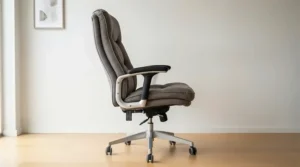
When you sit, three parts carry you: the frame, the base and the gas lift. If you’re shopping for a reinforced executive chair, those are the components worth interrogating.
The reinforced chair frame. A buying guide for heavy-duty seating recommends steel throughout, in a heavier gauge that doesn’t flex under load. Supplier copy for the Dynamic Texas mentions reinforced seat and back panels, and the Dynamic Houston claims a reinforced structure. Both are meaningful hints, though neither replaces a stated rating.
The base. Five-star bases with wider diameters spread load and resist tipping. Steelcase says the Steelcase Leap Plus uses a wider-diameter base than the standard Steelcase Leap, while the Secretlab TITAN Evo XL adds an aluminium wheelbase.
The heavy-duty gas lift. This is the part that fails quietly. A heavy-duty gas lift should have a stated rating, ideally tested to your weight with headroom. The Secretlab TITAN Evo XL pairs a Class 4 piston with its XL frame, and the Steelcase Leap Plus specifies a high-pressure cylinder. Both are better signals than a generic claim.
What the spec sheet won’t tell you is how long these components last. Warranty length is a rough proxy, so favour longer mechanical guarantees, like the five years listed on the Dynamic Texas and Dynamic Houston.
Heavy Duty Office Chair vs Gaming Chair vs Standard Executive Chair
Which type suits you depends on your build, your budget and your office dress code. A true heavy duty office chair is engineered around load. A gaming-style big chair borrows heavy-duty parts for the XL size, and a standard executive chair is optimised for looks over loads.
| Feature | Standard executive chair | Reinforced executive chair | Gaming-style big chair |
|---|---|---|---|
| Typical rating | around 110–125kg | 170–230kg | 130kg to 180kg by size |
| Base | often nylon | steel or reinforced | aluminium on XL |
| Gas lift | rarely rated | often stated | Class 4 on XL |
| Seat | standard width | wider, deeper | scaled by size |
| Best For | ordinary builds | Dynamic Texas, Teknik Goliath | Secretlab TITAN Evo XL |
The table shows that capacity climbs with specialisation, and that the Dynamic Texas and Teknik Goliath deliver the most rating for traditional looks. The Secretlab TITAN Evo XL stays competitive if you like the aesthetic and are tall. A standard executive chair makes sense only if you’re comfortably within its rating.
Long-Term Cost and Maintenance: What an Executive Chair for Heavy Person Use Really Costs
The sticker price isn’t the whole bill. A chair that sags in two years costs more than one that lasts ten, so it’s worth spreading the cost across working days. These bands are illustrative, assuming 250 working days a year.
| Price band | Illustrative lifespan | Cost per working day | Best For |
|---|---|---|---|
| Around £500 | 5 years | about 40p | Dynamic Texas, Teknik Goliath |
| Around £800 | 5 years | about 64p | Secretlab TITAN Evo XL at higher upholstery tiers |
| Around £1,500 | 10 years | about 60p | Steelcase Leap Plus, if it lasts |
Spread over time, a pricey chair that genuinely lasts a decade costs about the same per day as a mid-range chair replaced at five years. The catch is that longevity is only a promise until it’s proven, so favour long guarantees. Maintenance costs are small: a chair mat, an occasional castor replacement and a few minutes of bolt-tightening. Total ownership cost is dominated by whether you need to replace the chair early.
Safety, Regulations and Your Rights at Work
If you use a computer for a significant part of your working day, UK law takes your chair seriously. The Health and Safety (Display Screen Equipment) Regulations 1992 define a workstation to include the work chair, and the minimum requirements include an adjustable chair. Employers must assess workstations for habitual users, so ask for an assessment if you’re an employee.
For buying, ask suppliers whether weight ratings come from independent testing or a supplier declaration. Steelcase’s brochure references EN 1335-1:2020 for the Leap, the European standard for office work chairs, and it’s worth asking any supplier which standard applies. Upholstery matters too. The Dynamic Austin lists UKFR foam, and fire-retardant ratings are a normal part of UK contract furniture.
If you have a health condition, ask about workplace adjustments. This isn’t legal advice, so check the current rules or speak to your employer’s health and safety lead. And if a chair feels unstable or a part flexes under load, stop using it. A returned chair is cheaper than a fall.

FAQ
❓ Can a sinking gas lift be replaced on a heavy-duty chair?
❓ Is bonded leather good enough for an executive chair for heavy person use?
❓ What weight rating do I need if I'm 20 stone?
❓ Do heavy-duty office chairs come with longer guarantees?
❓ Will a heavy-duty chair damage my floor?
Conclusion
The right executive chair for heavy person comfort comes down to a short list of non-negotiables: a weight capacity rating with real headroom, a reinforced chair frame, a stated heavy-duty gas lift and a seat that actually fits. Everything else is preference.
If you want the most rating for your money, the Dynamic Texas is hard to beat. For shared or round-the-clock use, the Teknik Goliath is the safe pick, while the Dynamic Austin suits a simple executive look at 200kg. Warm sitters should look at the Dynamic Houston. If you’re tall and like modern styling, the Secretlab TITAN Evo XL is a credible choice. The FlexiSpot C7 Max is excellent for adjustability but only for larger users comfortably under its limit. For the best ergonomics and the biggest rating, the Steelcase Leap Plus is the premium route.
Remember that several prices and reviews couldn’t be verified, so check current price and read recent verified-buyer comments before you commit. Then set the chair up properly, take regular breaks, and treat the first 30 days as a fitting period.
✨ Ready to Sit Easy?
🪑 Pick the chair that matches your build, your desk and your day, then click through to check current pricing and availability. Your back will thank you for years to come!
Recommended for You
- Executive Office Chair With Headrest: 7 Best UK Picks (2026)
- Leather Executive Chair: 7 Best Picks, Honest Verdicts (2026)
- Executive Chair For Home Office: 7 Best UK Picks (2026)
Disclaimer: This article contains affiliate links. As an Amazon Associate, I earn from qualifying purchases. If you purchase products through these links, we may earn a small commission at no additional cost to you.
✨ Found this helpful? Share it with your friends! 💬🤗
