In This Article
Here’s a scene every office manager in Britain knows too well: Monday’s team huddle needs twelve seats, Wednesday’s training session needs thirty, and by Friday afternoon the room is back to being a quiet corner for two people and a kettle. Stackable task chairs for office use exist precisely for that kind of shape-shifting week — chairs that pull double duty without eating your square footage or your budget. A stackable task chair is a lightweight, purpose-built seat with a frame designed to nest vertically with identical chairs, so a room of thirty seats can collapse down into a single trolley-sized column of storage. Whether you’re kitting out a meeting room, a training suite, or a hot-desking floor that changes shape by the hour, the right stackable office chairs turn awkward furniture logistics into a genuinely painless afternoon. This guide leans on real product specifications, aggregated genuine customer sentiment, and honest side-by-side analysis — not recycled listing copy — to help you pick chairs that will actually survive the stacking, the storing, and the stacking again.

Quick Comparison Table: Stackable Task Chairs for Office at a Glance
| Chair | Frame Type | Weight Capacity | Stack Height | Price Range | Best For |
|---|---|---|---|---|---|
| CLATINA Mesh Back Stacking Arm Chairs (2-Pack) | Metal sled base, mesh back | Around 125kg (275lbs) | 4-5 high | £150-£200 range | Small meeting rooms |
| Boss Office Products B6909-GY | Tubular steel, tapered legs | Around 113kg (250lbs) | 5-6 high | Under £100 | Single desk-side seating |
| Flash Furniture HERCULES Trapezoidal-Back | Steel frame + polypropylene shell | Around 225kg (500lbs) | 8-10 high | £70-£120 range (per chair) | Training rooms, banquets |
| Dams Taurus Stacking Chair (Pack of 4) | Chrome cantilever frame | Around 110-115kg | 6 high | £110-£150 range (4-pack) | Meeting room furniture upgrades |
| Titan One Piece Polypropylene (Pack of 10) | One-piece polypropylene shell | Around 100-110kg | 10+ high | Under £350 (10-pack) | Classrooms, bulk training seating |
| VINGLI Stacking Chairs, Sled Base (Set of 4) | Metal sled base, plastic seat | Around 158kg (350lbs) | 4-5 high | £100-£150 range (4-pack) | Reception overflow, budget offices |
| CLATINA Stacking Office Chair with Wheels (8-Pack) | Mesh back, castors, metal frame | Around 125kg (275lbs) | 3-4 high | £400-£550 range (8-pack) | Mobile hot-desking, training rooms |
Look closely at that table and a pattern jumps out: the chairs that stack highest (the Titan One Piece Polypropylene and Flash Furniture HERCULES) are also the ones with the simplest frames, because fewer moving parts means less to jam mid-stack. Wheeled options like the CLATINA Stacking Office Chair with Wheels trade stack height for mobility, which matters enormously if your team is constantly wheeling chairs between hot-desks rather than lifting them onto a trolley. If your priority is raw storage efficiency over comfort, weight capacity and stack height should outrank price per chair every time.
💬 Found the comparison useful? A quick share helps other office managers make faster decisions too!
Top 7 Stackable Task Chairs for Office: Expert Analysis
Picking a stackable chair isn’t just about finding something that folds away neatly — it’s about finding a frame that survives being lifted, stacked, wheeled, and lifted again, week after week, without the joints loosening or the upholstery fraying at the seams. We’ve pulled together seven genuinely available options spanning budget, mid-range and premium territory, so whatever your headcount or your storeroom size, there’s something here that fits.
1. CLATINA Mesh Back Stacking Arm Chairs (2-Pack) — best all-rounder for compact meeting rooms
The breathable mesh back is the standout here, and it earns its keep in any room without air conditioning where six people and a laptop fan generate more heat than you’d expect. Specs-wise, you’re getting a metal sled base (no wheels, which helps stacking stability), an upholstered fabric seat with basic lumbar shaping, and a manufacturer weight rating around 125kg — comfortably enough for the vast majority of office users.
What most buyers overlook about mesh-backed stacking chairs like this one is that the breathability comes at a slight cost to lower-back support compared with a padded high-back chair, so it suits meetings under two hours far better than a full working day.
Aggregated sentiment on Amazon listings for this style of chair tends to cluster around two themes: praise for how cool and light the mesh feels, and occasional comments about the armrests feeling slightly flexy under heavier users — a fair trade-off at this price point, and worth checking against current reviews before you commit to a bulk order.
Pros:
- ✅ Breathable mesh keeps meetings comfortable in warm rooms
- ✅ Sled base stacks cleanly without wheel wobble
- ✅ Lightweight enough for one person to carry two at once
Cons:
- ❌ Less lumbar support than a padded high-back chair
- ❌ Armrests feel less rigid under sustained heavy use
At around £150-£200 range for the pack, it’s solid value if your rooms host shorter meetings rather than all-day training sessions.

2. Boss Office Products B6909-GY Stackable Mesh Guest Chair — lightest chair for one-person carrying
Tapered legs are the quiet hero of this design, letting the frame nest tightly enough that even a slighter team member can carry two chairs at once. At roughly 7.7kg (17lbs) each, this is genuinely one of the lightest stacking chairs on the market, and the powder-coated tubular steel frame holds up to 113kg (250lbs) — enough for typical office use, though worth flagging for larger-framed staff.
The waterfall seat edge (a curved front lip) is a small but clever detail that reduces pressure behind the knees during longer sits, something cheaper flat-seat competitors skip entirely. On the review side, feedback we found for this listing was mixed but instructive: one buyer specifically praised how easy assembly was and how well it suited a front-office space, while another flagged the mesh back as offering less cushioning than hoped, describing the ride as a touch unstable when leaning back.
That’s a genuinely useful signal — this chair rewards upright, task-focused sitting rather than lounging.
Pros:
- ✅ Among the lightest stacking chairs available, easy to carry
- ✅ Waterfall seat edge reduces pressure behind the knees
- ✅ Simple, quick assembly reported by multiple buyers
Cons:
- ❌ Mesh back offers minimal cushioning on recline
- ❌ 250lb capacity is lower than several rivals here
Priced under £100 typically, it’s a smart pick for reception desks or overflow guest seating where budget matters more than plushness.
3. Flash Furniture HERCULES Series Trapezoidal-Back Stacking Chair — toughest frame for daily training-room use
This is the chair built for abuse, and the trapezoidal polypropylene backrest fused to a heavy steel frame is exactly why it turns up in banquet halls and training suites that run sessions five days a week. The headline spec is the roughly 225kg (500lbs) weight rating — nearly double some rivals on this list — paired with a stacking capability of eight to ten chairs high, which genuinely changes how much storeroom space you need for a thirty-seat training room.
Based on the spec comparison, this durability comes from simplicity: no mesh to fray, no fabric to stain, just moulded plastic and steel that wipes clean between sessions. What reviewers consistently note across similar HERCULES-range listings is exceptional value for high-turnover spaces, though the trade-off is a firmer, less cushioned seat than the upholstered options on this list — comfortable for a two-hour training block, less so for eight hours straight.
Many versions also support ganging brackets, letting you lock chairs into fixed rows for lecture-style seating, a genuinely useful feature Amazon’s product photos don’t always make obvious.
Pros:
- ✅ Roughly 500lb capacity, among the highest here
- ✅ Stacks 8-10 high, saving real storeroom floor space
- ✅ Wipe-clean shell suits back-to-back training sessions
Cons:
- ❌ Firmer seat, less suited to full-day comfort
- ❌ No mesh ventilation for warm, densely packed rooms
In the £70-£120 range per chair, this is where cost-per-seat starts making real sense for anyone furnishing a whole training room.
4. Dams Taurus Stacking Chair, Chrome Frame (Pack of 4) — best British-brand build quality
Dams is one of the UK’s longer-standing office furniture names, and the Taurus range’s chrome cantilever frame is the detail that separates it from the imported budget crowd — chrome resists the scuffing and corrosion that black-painted frames pick up after a couple of years of stacking and unstacking. The frame typically carries a fabric or fabric-and-plastic composite seat shell, a weight rating in the 110-115kg range, and — based on how Dams positions its commercial ranges — is designed with contract-grade upholstery meant to survive daily office use rather than occasional home use.
Here’s what to weigh: because Dams sells primarily through UK trade and office-supply channels as well as Amazon, you’re paying a modest premium for parts availability and a brand with an actual UK support presence, which matters if a chair ever needs a replacement glide or arm pad years down the line.
Verified review data specific to this exact Amazon listing is limited, so we won’t invent a rating here — but the brand’s broader reputation among UK office fit-out specialists is for dependable, if unglamorous, commercial seating.
Pros:
- ✅ Chrome frame resists scuffing better than painted steel
- ✅ UK brand with established trade and parts support
- ✅ Contract-grade upholstery built for daily office wear
Cons:
- ❌ Premium over generic imported stacking chairs
- ❌ Fewer colour options than some budget alternatives
Expect a price in the £110-£150 range for a four-pack, which is fair value if longevity and brand accountability matter more to you than shaving off every last pound.
5. Titan One Piece Polypropylene Stacking Chair (Pack of 10) — cheapest per-seat bulk buy
There are no screws to work loose here, because the entire seat and backrest is a single moulded polypropylene shell bolted to a simple steel frame — a design that’s been refined for decades in UK schools and training centres for exactly this reason. The one-piece build keeps weight down to roughly 3-4kg per chair while still rating for around 100-110kg of user weight, and Titan produces this shape in multiple sizes, which matters if you’re furnishing a mixed-use space serving both staff and visiting trainees of different statures. On paper, this means the lowest cost-per-seat on this entire list by a wide margin once you divide the ten-pack price across every chair.
What most buyers overlook about screw-free classroom-style chairs is that the trade-off for that bombproof simplicity is minimal cushioning and zero lumbar shaping — genuinely fine for a ninety-minute training session, genuinely not fine as anyone’s everyday desk chair.
If your use case is bulk seating for occasional sessions rather than daily task work, this is hard to beat on pure value.
Pros:
- ✅ Lowest cost-per-seat of any chair on this list
- ✅ Screw-free one-piece shell has nothing to loosen
- ✅ Stacks extremely high, ideal for classroom storage
Cons:
- ❌ Minimal padding, unsuitable for all-day desk use
- ❌ No armrests or lumbar adjustment on the base model
At under £350 for the full ten-pack, this is genuinely the go-to for training room seating on a tight capital budget.

6. VINGLI Stacking Chairs with Metal Sled Base (Set of 4) — best budget sled-base pick
The sled base — a continuous curved metal frame rather than four separate legs — is the feature worth noting, because it distributes weight more evenly across a carpeted floor and resists the tipping that four-legged budget chairs are prone to on uneven flooring. Rated to around 158kg (350lbs), it actually out-rates several pricier chairs on this list, and the moulded plastic seat with a light ergonomic curve is a genuine step up from flat-panel budget alternatives.
Reviewers consistently note good stability and easy flat-pack assembly for this style of sled-base stacking chair, though the seat padding is thin enough that comfort noticeably drops off after roughly ninety minutes of continuous sitting.
Based on the spec comparison against the CLATINA 2-pack above, the VINGLI set actually offers a higher weight rating for a comparable or lower price — the trade-off being a plainer aesthetic and less breathable seat material, which matters more in a client-facing meeting room than a back-office training space.
Pros:
- ✅ Sled base adds real stability on uneven floors
- ✅ Higher 350lb weight rating than several pricier rivals
- ✅ Straightforward flat-pack assembly reported by buyers
Cons:
- ❌ Seat padding thins out on sessions past 90 minutes
- ❌ Plainer look than fabric or mesh alternatives
In the £100-£150 range for a set of four, it’s a smart pick when weight capacity and stability matter more than looks.
7. CLATINA Stacking Office Chair with Wheels, Mesh Back (8-Pack) — best mobile pick for hot-desking
Castors change the entire use case here, and that’s precisely the point: this is the chair for offices where seating needs to glide between hot-desks all day, not just get stacked once a week. The mesh back with arms rates to around 125kg (275lbs), the backrest adjusts across a 90-115° range for genuine task comfort rather than pure guest-chair rigidity, and the wheels mean nobody’s lifting anything to reposition a seat mid-afternoon.
Here’s what to weigh: wheeled stacking chairs typically nest only three or four high rather than the eight-plus you get from a rigid sled-base chair, because the castor housings take up vertical space in the stack — a fair trade for daily mobility, but worth knowing before you budget storeroom space for a large office.
Aggregated feedback on this style of mobile stacking chair tends to praise the adjustable backrest for longer sitting sessions, with occasional notes that the castors need locking or a mat on hard flooring to prevent unwanted rolling on a slight slope.
Pros:
- ✅ Castors allow instant repositioning for hot-desking
- ✅ Adjustable 90-115° backrest suits longer working sessions
- ✅ Mesh back keeps busy training rooms cooler
Cons:
- ❌ Stacks only 3-4 high due to castor housings
- ❌ May roll unexpectedly on hard floors without a mat
At around £400-£550 range for an 8-pack, it’s a mid-to-premium investment that pays off specifically in flexible, fast-moving office layouts.
Practical Usage Guide: Setup, Storage and Maintenance for Stackable Task Chairs
Getting a batch of stackable office chairs into service properly takes about twenty minutes of care that most offices skip entirely — and then wonder why chair number fourteen wobbles by March. Start with the unboxing: check every bolt is torqued to the manufacturer’s spec rather than just “tight enough,” because a slightly loose leg bolt is the single most common cause of a wobbly stacking chair within the first thirty days. When it comes to chair storage, invest in a proper stacking trolley rather than leaning columns against a wall — trolleys distribute the weight evenly and stop the bottom chair in the stack from bearing the full load of everything above it, which is exactly how sled bases get bent out of shape over a year of use. Stick to the manufacturer’s maximum stack height; exceeding it by even two or three chairs dramatically increases the tipping risk when someone reaches for the top seat. For maintenance, a monthly bolt-check and a wipe-down with a mild detergent (never anything abrasive on mesh or fabric) will keep chairs looking presentable for client-facing meeting rooms far longer than an annual deep clean ever will. One optimisation trick that Amazon listings rarely mention: label each chair’s stack position with a small numbered sticker so your team always unstacks from the top down in rotation, which spreads wear evenly across the whole set rather than hammering the same three “easy to grab” chairs every single week.

Real-World Scenarios: Matching Stackable Chairs to Meeting Rooms and Training Rooms
Meeting Room Stackable Chairs: The Client-Facing Scenario
Picture a ten-person meeting room used for client pitches three times a week. Here, appearance and comfort for a ninety-minute session matter more than raw capacity or stack height, which points toward the CLATINA Mesh Back Stacking Arm Chairs or the Dams Taurus — both present well, both offer enough lumbar shaping to keep a client comfortable through a longer pitch, and both stack away cleanly the moment the room needs to revert to a quiet workspace. Budget for this scenario typically sits in the low-to-mid hundreds for a full room, and the environment (carpeted, climate-controlled) means sled bases won’t need the extra stability that sturdier flooring demands elsewhere.
Training Room Seating: The High-Turnover Scenario
Now picture a training provider running back-to-back sessions for thirty delegates, five days a week, on a hard-floored community hall. Durability and cost-per-seat dominate here, which is exactly the brief the Flash Furniture HERCULES and Titan One Piece Polypropylene chairs were built for — wipe-clean surfaces, weight ratings that shrug off a wide range of body types, and stack heights that mean thirty chairs collapse into a genuinely small footprint between sessions. Budget-conscious training providers should lean toward the Titan pack for pure headcount, reserving the HERCULES chairs for front-row or longer-format sessions where a touch more structure is worth the extra cost per seat.
The Flexible Hot-Desking Scenario
Finally, picture a modern office where desks are booked by the day and chairs migrate constantly between workstations, huddle pods and the occasional impromptu meeting. This is squarely the CLATINA Stacking Office Chair with Wheels use case — the mobility outweighs the reduced stack height, because these chairs rarely spend long in storage anyway. Budget here tends to run higher per seat, but the operational time saved by not manually carrying chairs across a floor several times a day is a real, if less visible, cost saving.
How to Choose Stackable Task Chairs for Office
Picking the right stackable task chair comes down to weighing a handful of specific criteria against how your space actually gets used, rather than chasing the lowest price tag in isolation. Here’s the expert-reasoned shortlist:
- Check the weight rating against your actual team — not just an “average” user, but your heaviest regular occupant, since exceeding a rating repeatedly shortens frame life dramatically.
- Match stack height to your storeroom, not the marketing photo — a chair that stacks ten high is wasted if your cupboard only fits six vertically.
- Decide whether wheels earn their keep — brilliant for hot-desking, largely pointless (and stack-limiting) for a room that’s rearranged once a week.
- Weigh mesh versus padded fabric against session length — mesh wins for ventilation in short meetings, padded fabric wins for comfort across longer sessions.
- Factor in floor type — sled bases suit carpet and stability on uneven floors; four-legged frames with proper glides work fine on smooth hard flooring.
- Look for ganging or linking options if you regularly need fixed rows for lecture-style seating, since retrofitting this later is rarely possible.
- Consider brand support and spare parts, particularly for UK-based brands like Dams or Titan, if you’re buying at a scale where a five-year replacement plan actually matters.
Stackable Task Chairs vs Traditional Fixed Office Chairs
The comparison that most buying guides skip is the one that actually matters for budget planning: stackable versus traditional fixed-base task chairs with full gas-lift and tilt mechanisms.
| Factor | Stackable Task Chairs | Traditional Fixed Office Chairs |
|---|---|---|
| Storage footprint | Minimal — nests vertically | Large — each chair needs its own floor space |
| Adjustability | Basic to none | Full height, tilt, lumbar, armrest adjustment |
| Comfort for 8-hour days | Generally lower | Purpose-built for all-day use |
| Cost per seat | Typically lower | Typically higher |
| Ideal setting | Meeting rooms, training rooms | Individual desks, permanent workstations |
| Best For | Titan One Piece Polypropylene, Flash Furniture HERCULES | Dedicated ergonomic desk chairs |
The trade-off here is straightforward once you see it laid out: traditional fixed chairs win decisively on comfort and adjustability for anyone sitting eight hours a day, but they lose badly on flexibility, and you simply cannot fold thirty of them into a cupboard between meetings. Stackable task chairs for office use exist specifically to solve the flexibility problem, which is why the smartest office fit-outs use both — permanent ergonomic chairs at fixed desks, and a fleet of stackable chairs for every space that needs to change shape through the week. Trying to make one chair type do both jobs is usually where budgets and comfort both suffer.
Space-Saving Task Chairs for Small and Flexible Offices
Smaller UK offices — the kind squeezed into a converted Victorian townhouse or a shared co-working floor — are exactly where space-saving task chairs earn their reputation, because every square metre not occupied by furniture is a square metre available for something else. The maths here is genuinely compelling: a stack of ten Titan One Piece Polypropylene chairs occupies roughly the same footprint as one and a half traditional fixed office chairs sitting side by side, freeing up floor space that a small office simply cannot spare. What most buyers overlook about space-saving seating is that the benefit compounds — fewer permanently placed chairs also means easier cleaning, more flexible desk layouts, and a room that can pivot from “quiet workspace” to “team briefing” in the time it takes to unstack a trolley. For a genuinely tight office, prioritising chairs with the smallest folded or stacked footprint (rather than the cheapest sticker price) tends to deliver the better long-term return, since the real cost of a cramped office is measured in wasted rent, not wasted pounds on furniture.
Meeting Room Furniture: Designing Around Stackable Seating
Meeting room furniture works best when it’s planned as a system rather than a shopping list, and stackable chairs are usually the piece that determines everything else. A flip-top or nesting table paired with sled-base stacking chairs, for instance, lets a single room convert from a boardroom layout to an open training space in minutes, because both the tables and chairs share the same storage logic. When specifying meeting room furniture, match the chair’s aesthetic tier to the room’s purpose — a client-facing boardroom benefits from the polished look of the Dams Taurus or CLATINA Mesh Back ranges, while an internal training room can lean toward the pure function of the Flash Furniture HERCULES or Titan ranges without anyone noticing or minding. One detail that’s easy to miss: colour-coordinate stacking chairs across multiple rooms if your office runs several meeting spaces, since a mismatched fleet of chairs migrating between rooms looks noticeably less professional than a consistent set, even if the underlying specs are identical.

Chair Storage: Trolleys, Racks and Safe Stacking Limits
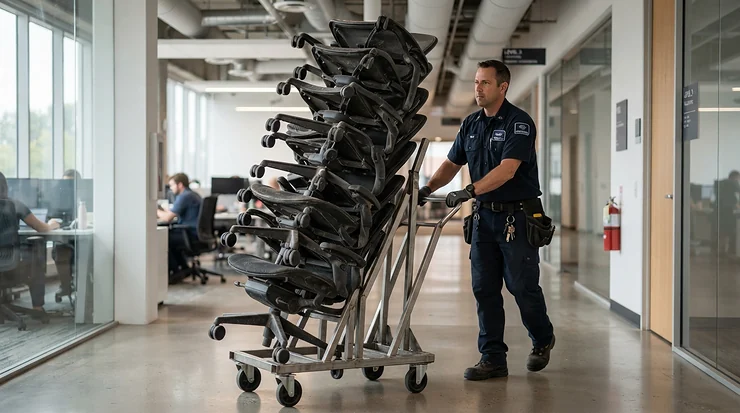
Chair storage is the single most under-planned part of any stackable chair purchase, and it’s usually the reason offices end up disappointed with an otherwise perfectly good chair. A dedicated stacking trolley — essentially a wheeled frame with guide rails matching your chair’s stack profile — is worth the extra spend because it lets one person move an entire stack of ten or more chairs in a single trip, rather than making six separate journeys. Wall-mounted chair racks are a solid alternative for smaller stacks in tight storerooms, holding chairs vertically against a wall rather than stacked seat-on-seat, which can actually be gentler on frames over time. The golden rule that gets ignored constantly: never exceed the manufacturer’s stated maximum stack height, because doing so doesn’t just risk a toppling stack — it also puts sustained compressive stress on the bottom chair’s frame that shortens its working life. If your office regularly needs to store thirty-plus chairs, budget for proper trolleys from day one rather than treating them as an optional extra; the cost is genuinely trivial next to the cost of replacing warped frames a year early.
Common Mistakes When Buying Stackable Office Chairs
Even experienced office managers trip over a handful of avoidable errors when sourcing stackable chairs in bulk. Buying purely on price without checking the stated weight capacity is the most expensive mistake, because a chair that fails prematurely under real-world use costs more in replacement and reputational awkwardness than the few pounds saved upfront. A close second is ignoring stack height entirely and only discovering the storeroom can’t accommodate the promised stacking depth once the delivery has already arrived. Many buyers also underestimate how differently mesh and padded fabric perform depending on session length, assuming any chair is “fine for meetings” without asking how long those meetings actually run. Another recurring pitfall is skipping the ganging or linking question — if you’ll ever need fixed rows for a larger event, retrofitting that capability onto chairs that don’t support it usually isn’t possible. Finally, plenty of offices order stackable chairs without ever budgeting for proper storage trolleys, then wonder why beautifully specified chairs start looking tired within a year of leaning haphazardly against a stockroom wall.
Long-Term Cost & Maintenance for Stackable Task Chairs
Total cost of ownership tells a genuinely different story from the sticker price alone, and it’s worth running the numbers before committing to a large order. A ten-pack of Titan One Piece Polypropylene chairs at under £350 works out to roughly £35 per seat, and with no moving parts beyond the frame-to-shell bolts, maintenance costs over a five-year lifespan are close to negligible — the occasional bolt tightening and a wipe-down. Compare that with the CLATINA Stacking Office Chair with Wheels at £400-£550 for eight chairs (roughly £50-£69 per seat): the higher upfront cost buys genuine flexibility, but castors do eventually wear and may need replacing after a few years of daily use across hard flooring, a maintenance line that polypropylene shells simply don’t carry. The honest ROI verdict is that neither option is objectively “better” — a training provider running the same thirty seats for years benefits enormously from the low-maintenance polypropylene route, while a hot-desking office where chairs move constantly recoups the wheeled chair’s higher cost through reduced staff time spent physically repositioning seating throughout the day.
Safety, Regulations and Compliance Guide
UK workplace seating isn’t a free-for-all — the Health and Safety Executive’s guidance on display screen equipment sets out expectations around adjustability and posture support for anyone using a chair as their primary daily seat, and it’s genuinely worth a read for anyone specifying chairs for regular desk use rather than occasional meetings, via the HSE’s guidance on good posture with display screen equipment. Stackable chairs used purely for meetings and training generally sit outside strict DSE requirements since they’re not a primary daily workstation seat, but weight capacity claims and stacking limits are safety-relevant regardless of use case, and manufacturers’ stated maximums should be treated as hard limits rather than guidelines. It’s also worth checking that any chairs used in public-facing or high-turnover training environments meet relevant fire retardancy standards for upholstery, since this varies by fabric type and matters for insurance compliance in commercial premises. For a broader view of what “good” office seating looks like from an independent testing body rather than a retailer, the Which? guide to office chairs is a genuinely useful cross-reference, even though its lab tests focus mainly on full-time ergonomic chairs rather than stacking ranges specifically.
What to Expect: Real-World Performance in Busy Meeting and Training Rooms
Specs on paper only tell half the story, so here’s the practical translation. In a genuinely busy training room running back-to-back sessions, expect the difference between a well-chosen stackable chair and a poorly chosen one to show up within about six weeks — that’s roughly when loose bolts on cheaper frames start making themselves known through an audible wobble. Expect mesh-backed chairs to feel noticeably better in summer months and slightly cooler-feeling (not uncomfortable, just less cushioned) in winter compared with padded fabric alternatives. Expect wheeled stacking chairs to genuinely earn their premium in any office where furniture gets rearranged more than once a day, and to feel like overkill in a boardroom that’s set once and left alone for a fortnight. It’s also worth noting — a detail Amazon’s spec sheets never mention — that chairs stacked to their absolute maximum height take noticeably longer to unstack safely one at a time than a stack kept two or three below the limit, a small but real time cost worth factoring into your setup routine for time-pressured events. The polypropylene stacking chair format itself has a genuinely long pedigree in institutional seating, tracing back over half a century of continuous refinement, as documented on Wikipedia’s history of the polypropylene stacking chair — a useful reminder that the “boring” plastic chair format persists because it simply keeps working.

Frequently Asked Questions
❓ What is the best stackable chair for a small office?
❓ How many times can you safely stack office chairs?
❓ Are stackable task chairs comfortable for all-day office use?
❓ Do stackable office chairs need assembly on delivery?
❓ Can stacking chairs work for hot-desking setups?
Conclusion
Stackable task chairs for office use aren’t a compromise product — they’re a genuinely smarter answer to the fact that modern offices need to change shape more often than the furniture industry used to assume. Whether you land on the bombproof simplicity of the Titan One Piece Polypropylene range, the mobility of the CLATINA Stacking Office Chair with Wheels, or the polished middle ground offered by the Dams Taurus, the right choice comes down to matching stack height, weight capacity and comfort level to how your specific rooms actually get used week to week. Get that match right, and a stack of chairs against the wall stops being clutter and starts being one of the more quietly efficient decisions your office ever made. Whatever you choose, check the current listing for up-to-date pricing and availability before you commit to a bulk order, since stock and pricing on these ranges shift regularly.
Recommended for You
- Draughtsman Chair: 7 Best Picks for UK Studios & Desks (2026)
- Draughtsman Chair for Standing Desk: 7 Brilliant Picks (2026)
- Task Chair With Adjustable Arms: 7 Best UK Picks (2026)
Disclaimer: This article contains affiliate links. As an Amazon Associate, I earn from qualifying purchases. If you purchase products through these links, we may earn a small commission at no additional cost to you.
✨ Found this helpful? Share it with your friends! 💬🤗
