In This Article
Your office chair promised “lumbar support”. Lovely phrase. Then you sat down, and the support landed somewhere near your kidneys, or your shoulder blades, or (if you’re working from a dining chair) nowhere at all. If that sounds familiar, removable lumbar support cushion alternatives to built-in support are the quickest and cheapest fix going, and the 2026 range is wider than it has ever been.

There’s a sensible reason to care beyond comfort. The HSE’s display screen equipment guidance treats a properly supportive chair as part of a safe workstation, and it has dedicated advice for home workers too. A chair that can’t be fine-tuned to your spine is a chair that needs help.
This guide covers seven real products that are widely sold to UK buyers. I haven’t hand-tested any of them, so everything here comes from published specifications and aggregated review themes. I’ve also said plainly where something couldn’t be verified.
You’ll get honest analysis of what each spec means in practice. We’ll look at contoured foam against rolls, how to fit a strap on lumbar cushion for office chair setups, and how a memory foam lumbar pillow for desk chair use behaves over months. Most importantly, we’ll cover how to choose the right spinal curve support for your body rather than the best-marketed one.
Quick Comparison: 7 Removable Lumbar Support Cushion Options at a Glance
| Product | Shape | Firmness | Approx. size | Price range* | Best For |
|---|---|---|---|---|---|
| Everlasting Comfort Lumbar Support Cushion | Contoured memory foam | Medium | 33 × 10 cm | £15–£25 | All-rounders on flat-backed chairs |
| Supportiback Lumbar Support Pillow | Contoured, firmer foam | Firm | 33 × 9 × 31 cm | £20–£30 | Posture-focused buyers who like firm support |
| POOTACK Lumbar Pillow Cushion | Wide memory foam | Not stated | Check listing | £15–£25 | Chairs where cushions slide down |
| iamcomfi Lumbar Support Cushion | Thick, compact foam | Soft but firm | 30 × 34 × 11 cm | £20–£30 | Smaller frames, targeted lower-back help |
| Everlasting Comfort Lumbar Support and Office Chair Cushion | Back plus seat set | Soft | 76 × 46 cm | £25–£40 | Hard seat and weak back together |
| QUTOOL Lumbar Support Pillow | Contoured, mesh cover | Check listing | Check listing | £15–£25 | Warm rooms and sweaty backs |
| The Original McKenzie Lumbar Roll | Firm foam roll | Standard or firm | ~28 × 12 cm | £20–£35 | Rehab-style, minimal-footprint support |
*Approximate ranges only. Prices vary, so check the current price before buying.
Looking at the table, the Everlasting Comfort Lumbar Support Cushion is the safe default for most people, while the Supportiback Lumbar Support Pillow suits anyone who finds soft foam useless. Buyers whose chairs eat cushions should look at the POOTACK Lumbar Pillow Cushion, and anyone with a rock-hard seat as well as a tired back should consider the combo set. The The Original McKenzie Lumbar Roll is the odd one out, since it trades cushioning for a firm, targeted nudge.
💬 Just one click — help others make better buying decisions too!😊
Top 7 Removable Lumbar Support Cushion Alternatives to Built-in Support: Expert Analysis
Each pick below follows the same pattern: what the specs mean in real life, who it suits, what reviewers keep saying, and where it falls short. Review sentiment is aggregated from published UK buyer’s guides and Amazon listings, never invented.
1. Everlasting Comfort Lumbar Support Cushion — the contoured foam benchmark
This is the model other contoured foam cushions get measured against, mostly because it gets the fundamentals right. It has a curved profile, medium firmness and straps that hold.
At roughly 33 × 10 cm and 760g, it’s a proper lump of memory foam. That 10 cm depth is what pushes your lower back forward into a gentle curve rather than just padding it. Medium firmness softens with body heat without bottoming out in the first hour, and the ventilated mesh cover unzips for washing.
Based on the spec comparison, it suits average-sized adults on chairs with a flat or slightly hollow backrest. What most buyers overlook is the depth. On a chair that already has a generous built-in curve, that thickness can tip you forward off the seat back.
Reviewers consistently praise how little it moves once strapped, and a UK buyer’s guide reports an average rating of around 4.3 out of 5 from a very large review pool. The recurring complaints concern value for money and whether the size suits their frame.
Pros:
- ✅ Contoured profile mimics the lumbar curve
- ✅ Breathable, washable mesh cover
- ✅ Adjustable straps stay put
Cons:
- ❌ Opinions split on size
- ❌ Bulky on chairs with built-in curves
Price: roughly £15–£25 range. Solid value for a first purchase, but check current price.

2. Supportiback Lumbar Support Pillow — firm, spine-aligning shape
Where plenty of cushions go soft, this one goes firm. That makes it the stronger choice if your main complaint is slumping rather than discomfort.
It measures about 33 × 9 × 31 cm and weighs around 470g, noticeably lighter than the Everlasting Comfort Lumbar Support Cushion. The fast-rebound, heat-responsive foam means it holds a curve rather than collapsing. The listing says it was developed with physicians, which is a marketing claim I can’t independently verify.
On paper, firmness is the point. Good spinal curve support should resist your weight rather than flatten under it, and firmer foam does that for longer. The breathable cover with a moisture-wicking finish should also help on warm afternoons.
It’s best for people who’ve given up on squishy pillows. If you want something that feels like an armchair, look elsewhere. Aggregated review themes are positive, with an average of about 4.3 out of 5 from over 6,000 UK reviews according to one UK guide. Reviewers like the support and padding, but opinions differ on how well it fits.
Pros:
- ✅ Firm foam holds its shape
- ✅ Lightweight and easy to move between chairs
- ✅ Breathable, moisture-wicking cover
Cons:
- ❌ Fit varies between body types
- ❌ Too firm if you prefer plush
Price: roughly £20–£30 range. Good value if firm is what you’re after.
3. POOTACK Lumbar Pillow Cushion — double straps that stop the slide
If your cushion creeps to the floor every time you stand up, the strap design matters more than the foam. This one’s whole pitch is that it stays where you put it.
It uses adjustable double straps, which spread the holding force across two points instead of one. That gives you far less rotation and slippage than a single band. The memory foam is described as keeping its shape rather than flattening, and the mesh cover is removable and machine washable.
Here’s what the spec sheet won’t tell you, but user reports suggest. It arrives vacuum-packed and thin, then expands over a day or so, so judge it after that. Some reviewers say the thickness eats seat space, and taller or broader users found it a touch small.
Aggregated sentiment is positive, with roughly 4.4 out of 5 from over 3,000 reviews according to a UK buyer’s guide. Several reviewers mention fewer aches on long drives and desk days. Reviewers also caution that it improves posture but won’t fix severe back pain on its own.
Pros:
- ✅ Double straps resist sliding
- ✅ Machine-washable mesh cover
- ✅ Foam keeps its shape over time
Cons:
- ❌ Can crowd smaller seats
- ❌ Not a cure for severe pain
Price: roughly £15–£25 range. Strong value for slippery chairs.
4. iamcomfi Lumbar Support Cushion — compact, targeted lower-back support
Small can be smart. At about 30 × 34 cm but a hefty 11 cm thick, this cushion concentrates support in the lumbar zone rather than spreading it across your whole back.
It weighs around 1kg, with high-density memory foam described as soft but firm. In practice, this feels like a firm base with a slightly forgiving surface. The removable zip cover helps with hygiene, and the adjustable straps mean you can lift it to different heights.
The compact footprint suits smaller frames and chairs with narrow backrests, such as dining or kitchen chairs pressed into home-office duty. The trade-off is thickness. That 11 cm profile pushes you forward noticeably, so if your seat is already shallow, you may lose thigh support.
Reviewers rate it around 4.4 out of 5 and often mention an immediate difference in posture and comfort. Common complaints are thin-feeling straps and, for some, excess thickness. One reviewer said it works well alongside other support cushions, which suggests it plays nicely in a layered setup.
Pros:
- ✅ Targeted support in the lumbar zone
- ✅ Works on office, dining and car seats
- ✅ Removable, washable cover
Cons:
- ❌ Straps feel thin to some users
- ❌ Thick profile shrinks seat depth
Price: roughly £20–£30 range. Good value, if the strap holds.
5. Everlasting Comfort Lumbar Support and Office Chair Cushion — back-and-seat combo
Sometimes the problem isn’t only your back. A hard seat tips your pelvis, and your lumbar region pays the price. This set tackles both ends at once.
It’s a larger package, at around 76 × 46 cm and 1.4kg. It combines a gel-infused memory foam seat pad with a contoured back cushion, both with breathable, washable covers. The foam is soft, so expect a plush feel rather than a firm shove.
My analytical take is that a combo set earns its place on unforgiving chairs, such as bare plastic, thin padding or old dining seats. Raising the seat also changes your eye and desk height slightly, so check your keyboard position after fitting it.
Aggregated reviews are positive, with about 4.3 out of 5 reported from over 160,000 reviews. Reviewers praise the comfort for lower back and tailbone, though some call it helpful but not a complete fix. One noted positioning it in a car takes effort, and another mentioned a sticker leaving residue on the fabric.
Pros:
- ✅ Supports back and seat together
- ✅ Gel-infused foam, breathable covers
- ✅ Lightweight enough to travel with
Cons:
- ❌ Sticker may leave residue
- ❌ Fiddly to position in cars
Price: roughly £25–£40 range. Worth it only if your seat is the problem.

6. QUTOOL Lumbar Support Pillow — breathable mesh for warm desks
If your back sweats against foam by lunchtime, this is the one to look at. Its whole design leans on airflow.
Listings describe high-density memory foam, a 3D breathable mesh cover, dual adjustable straps and a washable cover. The mesh matters more than it sounds, because trapped heat is a leading reason people abandon cushions in summer. Aggregator guides also credit it with fuller back coverage than a basic lumbar pad.
I couldn’t verify detailed UK-specific measurements or a reliable UK review count, so check the Amazon UK listing for exact dimensions and your backrest width before buying. That uncertainty is the reason it sits lower in this list, not a sign of poor quality.
Review sentiment from several buyer’s guides is generally favourable, with the strap system and breathable cover mentioned most. The usual caveat applies with any memory foam product. Cheap foam can soften over months, so use the returns window to judge whether it still supports you after a few weeks.
Pros:
- ✅ 3D mesh cover aids airflow
- ✅ Dual straps secure the fit
- ✅ Washable cover
Cons:
- ❌ UK-specific data harder to verify
- ❌ Memory foam may soften with time
Price: roughly £15–£25 range. Sensible budget pick for warm rooms.
7. The Original McKenzie Lumbar Roll — the firm roll physios recognise
This one is a different animal. Instead of a cushion, it’s a firm foam cylinder, a design with roots in physiotherapy that has been around for decades.
It measures about 11 in × 4.75 in (roughly 28 × 12 cm) and comes in standard or firm density. It has an adjustable strap, which contains latex, and a removable polyester cover. It’s light, at around 150g, and small enough to slip into a bag.
Honest analysis: a roll applies a narrow band of pressure, so placement matters enormously. Position it a few centimetres too high and it digs in. Get it right, and it holds the lumbar curve without the squashy collapse of cheap memory foam.
Reviewers who’ve switched from soft foam often say the roll keeps its shape better. One reviewer returned a memory foam cushion because it flattened, then found the roll worked for them. That’s one voice, not a verdict, and some find a roll too firm or intrusive at first. Availability on Amazon UK can vary, so check the listing.
Pros:
- ✅ Holds its shape under load
- ✅ Compact and light
- ✅ Removable cover
Cons:
- ❌ Feels intrusive at first
- ❌ Strap contains latex
Price: roughly £20–£35 range. Strong value for firm-support fans.
✨ Ready to Upgrade Your Chair?
🔍 Take your desk setup to the next level with these carefully researched options. Click on any highlighted product name to check current pricing and availability. A few minutes of strapping and adjusting could make your sitting days far more comfortable!
What Are Removable Lumbar Support Cushion Alternatives to Built-in Support?
Removable lumbar support cushion alternatives to built-in support are detachable pads, typically memory foam or a firm foam roll, that strap onto a chair’s backrest to fill the gap between your lower spine and the seat back. They let you add, adjust or swap support without replacing the chair.
Why the lumbar curve matters
Your lower back naturally curves inwards. NHS guidance from Cambridge University Hospitals on seating and ergonomics describes maintaining your natural “S” shaped spinal curves as a key part of sitting well, and suggests a lumbar roll or even a rolled towel as extra support. In other words, the principle behind these cushions is mainstream clinical advice, not a gadget fad.
Types at a glance
- Contoured foam cushions: curved pads that cover a broad lumbar area.
- Rolls: narrow, firm cylinders for pinpoint support.
- Seat-and-back sets: cushions that treat sitting as a whole-body problem.
- Inflatable or adjustable pads: pump-up options for fine tuning, though foam dominates the market.

How to Choose Removable Lumbar Support Cushion Alternatives to Built-in Support
Picking well is mostly about matching your chair, your frame and your tolerance for firmness. Work through these steps in order.
- Check your chair’s existing curve. If the backrest is flat or hollow, a thicker cushion will help. If it already bulges, choose something slimmer or you’ll be pushed forward.
- Match the height to your body. The support should sit in the small of your back, roughly above your hips. Taller people often need a cushion that can be strapped higher.
- Choose firmness for stability, not luxury. Soft foam feels nice for ten minutes and then collapses. Medium-to-firm usually keeps your spine supported for longer.
- Prioritise strap quality. A cushion that migrates downwards is worse than none. Double straps or adjustable elastic bands matter.
- Consider breathability. Mesh covers reduce heat build-up, which is a common reason people stop using cushions.
- Look for removable, washable covers. You’ll sweat on it, and it will need cleaning eventually.
- Buy somewhere with an easy returns policy. Fit is personal. Give yourself a fortnight to judge it.
Features That Actually Matter (And Those That Don’t)
Marketing language around back cushions is thick with superlatives. Here’s a straight sort.
Features worth caring about
Depth and firmness. These two numbers decide whether the cushion supports or merely decorates. A 9-10 cm profile in firmer foam usually gives usable lumbar lift, whereas a thin, soft pad does little.
Strap design. This is the least glamorous feature and the most important. A good adjustable cushion strap lets you set height and tension, then forgets about it.
Cover and cleaning. A removable cover changes how long a cushion stays pleasant to use.
Features that are mostly noise
- “Doctor-designed” and “physician-developed” badges. Without named clinical evidence, treat these as marketing.
- Exotic foam names. Whether it’s “cool gel”, “heat-responsive” or “Ergo-pur”, the question is whether it holds its shape over months.
- Multi-purpose claims. Cushions that claim to suit cars, planes, sofas and offices can be fine, but each environment fits slightly differently.
Removable Cushions vs Built-in Support: A Direct Comparison
Built-in lumbar support isn’t automatically better. It’s convenient, but it’s also fixed.
| Factor | Built-in support | Removable cushion |
|---|---|---|
| Adjustability | Limited to chair mechanism | Move, swap or restack freely |
| Cost | Included in chair price | Typically £15–£40 range |
| Fit for different bodies | Designed for the “average” user | Can be tailored to your frame |
| Portability | None | Moves between chairs and car |
| Maintenance | Usually can’t be cleaned separately | Removable covers, easy washing |
| Best For | People with a well-fitting ergonomic chair | Anyone whose chair doesn’t fit them |
The table shows the main trade-off. Built-in support wins on neatness, while removable options win on flexibility and cost. If your chair’s support is badly placed, a Supportiback Lumbar Support Pillow or Everlasting Comfort Lumbar Support Cushion can effectively override it without spending hundreds on a new chair.
When built-in still wins
A properly adjustable ergonomic chair, with height-adjustable lumbar support, can beat any add-on. If you already have one and it fits, you may not need a cushion at all.
How to Fit a Strap on Lumbar Cushion for Office Chair Setups (Your First 30 Days)
A cushion in the wrong place is a very expensive paperweight. Getting the fit right takes a few minutes now and a bit of patience later.
Day 1: set the height
Sit all the way back in your chair. Place the cushion in the small of your back, roughly at belt height. The HSE’s good posture guidance is a useful reference for the wider setup, including seat height and screen position.
Day 1: secure the strap
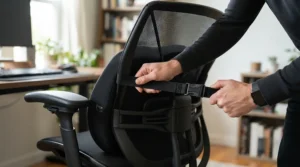
For a strap on lumbar cushion for office chair use, loop the elastic around the backrest and pull it snug but not tight. Over-tightening can pinch mesh backs or pull the cushion into an awkward angle.
Days 2–7: allow adjustment
Your muscles have been compensating for a poor curve, so the first few days can feel odd. Use the cushion in shorter blocks at first if it feels intrusive.
Weeks 2–4: fine tune
- Shift the cushion up or down by a couple of centimetres if you feel pressure points.
- Check your keyboard and screen height, since the cushion changes your seated position.
- Get up and move every half hour or so, because no cushion replaces movement.
Common mistakes in the first 30 days
Placing it too high, over-tightening the strap and abandoning it after two uncomfortable days are the big three.
What to Expect: Real-World Performance of a Memory Foam Lumbar Pillow for Desk Chair Use
Memory foam sounds magical. In practice, it behaves like a slow, temperature-sensitive sponge.
Week one
Expect the foam to feel firmer when cold and softer after you’ve sat for a while. A memory foam lumbar pillow for desk chair use will also take on your body shape gradually.
Months two to six
This is where quality shows. Better foam keeps its rebound, while cheaper foam can compress and lose its lift. Some reviewers describe cushions that flattened and stopped doing their job, which is the main reason a firmer roll like The Original McKenzie Lumbar Roll has loyal fans.
Heat and cleaning
Foam holds warmth. A mesh cover, like those on the QUTOOL Lumbar Support Pillow and POOTACK Lumbar Pillow Cushion, helps airflow. Wash covers according to the label and let foam air out rather than soaking it.
The honest limit
Aggregated reviews suggest cushions improve comfort for many people, but several note they aren’t a complete answer to back pain. Treat the cushion as one part of a setup.
Contoured Foam vs Rolls vs Seat Sets: Which Shape Suits You?
Shape matters as much as material, so it’s worth understanding the differences.
Contoured foam
Contoured foam spreads support across a wider area. That feels gentler and suits people who want a “whole lower back” cushion. The Everlasting Comfort Lumbar Support Cushion and iamcomfi Lumbar Support Cushion fall into this category, with the latter offering more concentrated lift.
Foam rolls
A roll concentrates pressure in a narrow band. That’s useful if you know exactly where your curve needs filling, but unforgiving if you place it badly. The The Original McKenzie Lumbar Roll is the classic example.
Seat-and-back sets
If your pelvis tilts backwards on a hard seat, the lumbar curve flattens regardless of the back cushion. The Everlasting Comfort Lumbar Support and Office Chair Cushion addresses both.
How to decide
- Soft chairs with decent backs: slim contoured foam.
- Hard or flat backs: thicker contoured foam.
- You like precision and firmness: a roll.
- Hard seat and sore tailbone: a combo set.
Problem → Solution: Fixing Adjustable Cushion Strap Headaches
Straps are where most cushions succeed or fail, so here are the common problems and fixes.
Problem 1: the cushion keeps sliding down
Fix: tighten the adjustable cushion strap slightly and position the strap higher on the backrest. Double straps, like those on the POOTACK Lumbar Pillow Cushion, spread the load and slip less.
Problem 2: the strap digs into a mesh chair
Fix: loop it around solid frame sections where possible, or add a thin piece of cloth beneath the strap to spread the pressure.
Problem 3: the cushion twists sideways
Fix: a single strap on a narrow cushion can rotate. Check that the cushion is centred and the strap sits flat before you lean back.
Problem 4: straps stretch with age
Fix: reviewers occasionally describe thin straps, such as on the iamcomfi Lumbar Support Cushion, losing grip. A small length of Velcro strap or a replacement band from a haberdashery is a cheap rescue.
Problem 5: the cushion pushes you too far forward
Fix: move it lower, switch to a slimmer cushion or shorten the seat depth if your chair allows.
Real-World Scenarios: Matching Cushions to Real Sitters
Case studies beat generic advice, so here are three realistic profiles.
The hybrid worker with a hard dining chair
You work from home three days a week on a dining chair with a flat back, and you’ve got a modest budget. A combination like the Everlasting Comfort Lumbar Support and Office Chair Cushion tackles seat and back together. Expect to spend in the £25–£40 range.
The contractor on a mesh office chair
Your employer’s chair has a mesh back that doesn’t follow your curve, and the office is warm. A breathable option like the QUTOOL Lumbar Support Pillow or POOTACK Lumbar Pillow Cushion keeps heat down, and double straps stop sliding.
The long-distance commuter and desk worker
You split time between car and desk, so you need something light and portable. The The Original McKenzie Lumbar Roll or Supportiback Lumbar Support Pillow moves between seats easily, and both hold shape. Budget about £20–£35 range.
What these scenarios share
Match the product to the problem, not the other way round. A good cushion on the wrong chair still disappoints.
Spinal Curve Support and UK Workplace Rules: What You Should Know
In Great Britain, the Health and Safety (Display Screen Equipment) Regulations 1992 apply to workers who use screens as a significant part of their job. HSE’s DSE guidance explains employer duties and includes workstation assessments.
What this means for you
If you have DSE-related discomfort, report it and ask for a workstation assessment. A cushion can be a quick fix, but your employer may also be able to supply a better-fitting chair or accessory following an assessment.
A balanced view on posture
It’s worth knowing that posture science isn’t as tidy as marketing suggests. An NHS Trust leaflet says there’s no strong evidence that one single “correct” posture exists, and it stresses moving and staying active. So treat spinal curve support as a way to sit comfortably, not as a magic correction.
Practical takeaway
Use a cushion to make sitting tolerable, then change position often. If pain persists, speak to a GP or physiotherapist rather than relying on products.
Common Mistakes When Buying Removable Lumbar Support Cushions
Even smart shoppers trip up here.
Mistake 1: buying the softest option
Soft feels lovely in a shop and collapses at your desk. Medium-to-firm usually lasts longer.
Mistake 2: ignoring chair depth
A thick cushion on a shallow seat leaves your thighs unsupported. Measure before you buy.
Mistake 3: placing it where it hurts
It’s tempting to put the cushion directly on the sore spot. Usually, the best position is slightly below the apex of your curve so it supports rather than pokes.
Mistake 4: expecting overnight miracles
Your muscles need time to adapt. Give it a couple of weeks before judging.
Mistake 5: skipping returns policies
Fit is personal, so a return window is your safety net.
Mistake 6: forgetting movement
A perfect cushion won’t rescue eight hours of stillness. Stand up, stretch and walk around regularly.
Long-Term Cost and Maintenance: Which Cushion Gives the Best Value?
Cost-per-use is a better measure than sticker price. A £25 cushion used daily for 18 months works out at roughly £1.40 per month.
| Product | Price range | Likely lifespan* | Rough cost per month | Best For |
|---|---|---|---|---|
| Everlasting Comfort Lumbar Support Cushion | £15–£25 | 12–24 months | £1–£2 | Everyday desk use |
| Supportiback Lumbar Support Pillow | £20–£30 | 12–24 months | £1–£2.50 | Firm-support fans |
| POOTACK Lumbar Pillow Cushion | £15–£25 | 12–24 months | £1–£2 | Slippery chairs |
| iamcomfi Lumbar Support Cushion | £20–£30 | 12–24 months | £1–£2.50 | Compact support |
| Everlasting Comfort Lumbar Support and Office Chair Cushion | £25–£40 | 12–24 months | £1–£3 | Hard seats |
| QUTOOL Lumbar Support Pillow | £15–£25 | 12–24 months | £1–£2 | Warm rooms |
| The Original McKenzie Lumbar Roll | £20–£35 | 18–36 months | £0.50–£2 | Firm, durable support |
*Lifespans are rough estimates based on foam type and typical use, not manufacturer guarantees.
The numbers show that all seven are inexpensive to own, so quality differences matter more than price gaps. The The Original McKenzie Lumbar Roll may last longest simply because dense foam resists flattening. The combo set costs more upfront, but it replaces two separate purchases if your seat is also a problem.
Maintenance tips
- Wash removable covers every month or two.
- Air out foam rather than machine washing it.
- Replace any cushion that no longer springs back.
Buyer’s Decision Framework: If This, Choose That
Use this simple checklist to narrow down your pick.
- If you need maximum value and a safe default, choose the Everlasting Comfort Lumbar Support Cushion, because its contoured profile suits most chairs.
- If you hate soft cushions, choose the Supportiback Lumbar Support Pillow or The Original McKenzie Lumbar Roll, because both hold their shape.
- If your cushion keeps slipping, choose the POOTACK Lumbar Pillow Cushion, because double straps resist movement.
- If you have a smaller frame or narrow chair, choose the iamcomfi Lumbar Support Cushion, because it concentrates support.
- If your seat is the real problem, choose the Everlasting Comfort Lumbar Support and Office Chair Cushion, because it treats seat and back together.
- If your office runs warm, choose the QUTOOL Lumbar Support Pillow, because its mesh cover prioritises airflow.
Priority order
Think of firmness, strap quality and fit as your top three. Colour, brand and badges can wait.
Frequently Asked Questions
❓ Can a strap on lumbar cushion for office chair damage a mesh backrest?
❓ How much should I spend on a lumbar cushion in the UK?
❓ Will a removable lumbar support cushion fit a gaming chair?
❓ How often should I replace a memory foam cushion?
❓ Can my employer provide a lumbar cushion for DSE work?
Conclusion
Built-in lumbar support is brilliant when it fits and a bit of a gamble when it doesn’t. That’s why removable lumbar support cushion alternatives to built-in support have become the sensible fix for so many UK desks, kitchens and commutes.
The big takeaway from the research is that fit beats fame. The Everlasting Comfort Lumbar Support Cushion is a dependable default, the Supportiback Lumbar Support Pillow and The Original McKenzie Lumbar Roll suit people who want firmness, and the POOTACK Lumbar Pillow Cushion is the one to try if cushions keep slipping. The iamcomfi Lumbar Support Cushion suits smaller frames, the QUTOOL Lumbar Support Pillow helps in warm rooms, and the Everlasting Comfort Lumbar Support and Office Chair Cushion deals with hard seats.
Whichever you choose, give it a fortnight, keep moving and don’t expect a cushion to fix everything. If pain persists, a GP or physiotherapist is a better next step than another product.
Recommended for You
- Office Chair With Lumbar Support For Night Shift Workers: 7 Best 2026
- Lumbar Support Chair For Slouching Posture Correction: 7 Best (2026)
- Mesh Back Chair For Home Office: 7 Best Cool Picks (2026)
Disclaimer: This article contains affiliate links. As an Amazon Associate, I earn from qualifying purchases. If you purchase products through these links, we may earn a small commission at no additional cost to you.
✨ Found this helpful? Share it with your friends! 💬🤗
