In This Article
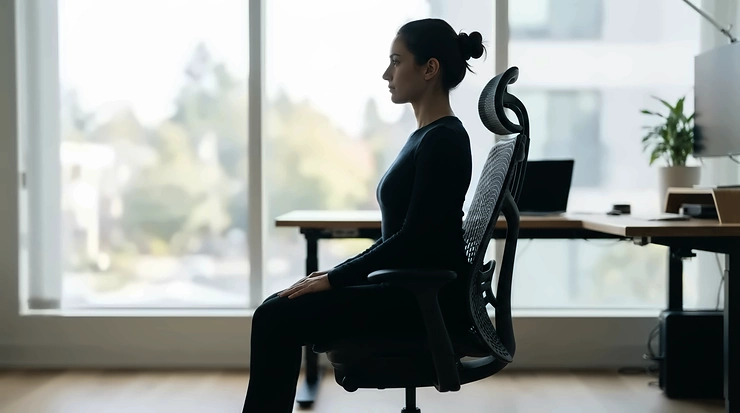
A lumbar support chair for slouching posture correction is a desk chair whose backrest is shaped, or adjustable, to fill the inward curve of your lower spine, so your pelvis stays supported and your torso stays stacked above it. It doesn’t force you upright; it makes sitting tall the easier option.

Here’s what nobody mentions when you start hunting for a lumbar support chair for slouching posture correction: slouching is rarely a discipline problem. It’s a geometry problem. Sit on a flat, shallow chair for three hours and your pelvis rolls backwards, your lower spine collapses into a C, and your head drifts towards the monitor like a moth to a lamp. Willpower lasts about twenty minutes. A backrest that fills the hollow of your lower back works all day, without nagging.
That’s the promise of a good ergonomic chair to stop slouching, and it fits what clinicians say about seating. A seating and ergonomics leaflet from Cambridge University Hospitals NHS Foundation Trust describes keeping the spine’s natural S-shaped curves as a key part of managing back pain. It also admits that sitting up straight can feel strange at first. Expect an adjustment period, not instant magic.
A quick word on how this guide works. Everything below comes from manufacturer specifications and published UK reviews. I haven’t sat in these chairs, so you won’t find invented test diaries or fabricated customer quotes, and where evidence is thin, I say so.
Lumbar Support Chair for Slouching Posture Correction: Quick Comparison Table
| Chair | Lumbar approach | Price range (check current price) | Best For |
|---|---|---|---|
| Sihoo M18 | Dual-adjust lumbar, mesh back | Under £200 | First “proper” chair on a tight budget |
| Sihoo M57 | Lumbar adjustable in height and depth | Around £190-£230 | Best all-round value |
| Boulies EP200 | Adjustable lumbar, padded contoured seat | Around £200 | People who dislike mesh |
| Sihoo Doro C300 Pro | Self-adaptive lumbar that follows movement | Roughly £300-£450 | Fidgeters and larger frames |
| Secretlab Titan Evo | Integrated 4-way lumbar | Roughly £420-£500 | Work-and-play desks |
| Steelcase Leap V2 | Adjustable height and firmness, flexing back | Roughly £900-£1,900 | Eight-hour sitters with back niggles |
| Herman Miller Aeron | PostureFit SL pelvic and lower-back support | Four figures new | Sit-forward typists |
Looking at the comparison above, the Sihoo M57 delivers the most adjustability per pound, but if you move around a lot, the Sihoo Doro C300 Pro‘s self-adaptive lumbar is worth the extra £100 or more. Budget buyers should note that the Sihoo M18 and Boulies EP200 trade some adjustability for a lower price. At the top end, the Steelcase Leap V2 and Herman Miller Aeron are long-term purchases rather than impulse buys.
💬 Just one click — help others make better buying decisions too!😊
Top 7 Picks: Lumbar Support Chair for Slouching Posture Correction, Analysed
Each chair below is judged on one question: does it make an upright sitting posture the path of least resistance? Specs matter only where they answer that question.
1. Sihoo M18 — dual-adjust lumbar under £200
Dual-adjustable lumbar is usually something you pay a premium for, and the Sihoo M18 offers it while staying under £200.
The brand’s UK listing describes a mesh back, a W-shaped seat cushion, dual-adjust lumbar support and a 126° recline. “Dual-adjust” means you can set both the height and the push of the lumbar pad. That matters because the hollow of your lower back sits at a different level on a 5ft 3in frame than on a 6ft 2in one. The 126° recline gives you a gentle lean-back option without turning the chair into a lounger.
Based on the spec comparison, this is the cheapest sensible route from a flat-backed dining or task chair to a backrest you can tune. What most buyers overlook is that a tunable pad only helps if you spend five minutes setting it. Leave it at the factory position and you’ve bought an expensive cushion. Mesh also means less padding, so heavier sitters should look further up this list.
Independent coverage is thinner than for its siblings, and much of the “best under £200” framing I found comes from the manufacturer’s own UK blog, so treat it with caution. I couldn’t verify aggregated customer ratings, so I won’t quote any.
Pros:
- ✅ Dual-adjust lumbar at an entry-level price
- ✅ Breathable mesh back suits warm rooms
- ✅ Gentle 126° recline for short breaks
Cons:
- ❌ Thin independent review coverage so far
- ❌ Mesh seat offers less cushioning
Price: under £200 at the time of research (check current price). Good value if you sit up to six hours a day and will actually adjust it.
2. Sihoo M57 — nine adjustments, genuinely tunable lumbar
Nine adjustment points plus a dual-adjustable lumbar is a rare spec sheet at this price, which is why the Sihoo M57 keeps turning up on UK shortlists.
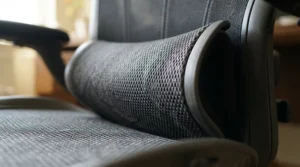
It pairs full mesh with a lumbar pad adjustable in height and depth, 3D armrests, a tilting headrest and a 126° recline. The armrests matter more for slouching than you’d think: if your forearms hang unsupported, your shoulders drag your upper back into a hunch. The headrest is comfort rather than correction, so don’t pay extra attention to it.
Here’s what to weigh: the Sihoo M57 uses a centre-tilt mechanism rather than a synchro-tilt, so seat and back tip together. If you recline a lot, you’ll miss the back-only movement of pricier chairs; if you mostly sit upright, you’ll never notice. Guides also disagree on warranty, with one quoting three years and another one year plus three on the mechanism, so read the live listing before buying.
Published UK guides repeatedly name it a budget pick to beat and report roughly 20-30 minutes from box to finished chair. I couldn’t verify aggregated Amazon star ratings, so check the current listing.
Pros:
- ✅ Lumbar adjusts in both height and depth
- ✅ Full mesh stays cool in box rooms
- ✅ Quick assembly widely reported
Cons:
- ❌ Centre-tilt rather than synchro-tilt
- ❌ Warranty terms reported inconsistently
Price: around £190-£230 depending on retailer (check current price). The strongest value-for-spec on this list.
3. Boulies EP200 — padded comfort for mesh sceptics
Not everyone wants mesh, and the Boulies EP200 is for people who miss the hug of a padded seat.
Boulies is better known for gaming seats, but this is its office crossover. UK guides describe a contoured, generously padded seat and backrest, adjustable lumbar, and a forward-tilted seat they credit with separating £200 chairs from cheaper ones. Forward tilt matters because Which?, summarising NHS advice, suggests your hip joint should sit higher than your knee. That angle makes an upright sitting posture less of a fight.
On paper it’s less adjustable than the Sihoo M57, so it suits people of fairly average build who value cushioning over a long list of levers. Padded seats also run warmer than mesh, which is worth knowing if your office is a south-facing spare room in July.
Coverage is limited to a handful of UK buying guides, which describe it as a sensible first “proper” chair with a more solid feel than the price suggests. I couldn’t verify aggregated customer ratings.
Pros:
- ✅ Padded, contoured seat feels familiar
- ✅ Adjustable lumbar on a budget
- ✅ Executive look suits living-room desks
Cons:
- ❌ Fewer adjustments than mesh rivals
- ❌ Padding can retain heat in summer
Price: around the £200 mark (check current price). Sensible value if mesh simply isn’t for you.
4. Sihoo Doro C300 Pro — lumbar that follows your movement
Most lumbar pads sit still. The Sihoo Doro C300 Pro uses a self-adaptive system that moves as you do.
Reported specs include dynamic lumbar support, 6D armrests, adjustable seat depth and headrest, a weight-sensing recline, a mesh build, a 300 lb (about 136 kg) capacity and a three-year warranty. Self-adaptive means the lumbar follows your spine as you lean back instead of leaving a gap. Seat depth adjustment lets you keep your back against the rest without the seat edge pressing behind your knees.
That combination suits people who fidget, shift and recline through the day, which is most of us. The trade-off, as one UK guide notes, is that you can’t manually override where the chair places the lumbar. If you like fixed, precise control, a manual pad like the Sihoo M57‘s is easier to dial in.
TechRadar’s review of the C300 Pro praised its lumbar support and adjustability. Reviews of the earlier standard C300 criticised armrests that move too freely, so check whether that complaint carries over. I couldn’t verify aggregated customer ratings.
Pros:
- ✅ Self-adaptive lumbar tracks your movement
- ✅ Seat depth and 6D arms suit varied builds
- ✅ High 300 lb weight capacity
Cons:
- ❌ Lumbar position can’t be manually overridden
- ❌ Heavy, at roughly 25 kg boxed
Price: promotions swing widely, so treat roughly £300-£450 as a ballpark and check current price. Strong features for a mid-range spend.
5. Secretlab Titan Evo — 4-way lumbar for work and play
Don’t let the gaming badge fool you: the Secretlab Titan Evo is the best-known argument that a gaming-brand chair can do office duty properly.
The lumbar is built into the backrest and adjusts up, down, in and out via side knobs. Add 4D armrests, a magnetic head pillow, up to 165° of recline and a Regular size aimed at roughly 170-189 cm. Because the lumbar is integrated rather than strapped on, it doesn’t drift when you stand up, so your settings stay put. The weight cuts both ways: Expert Reviews recorded 34.5 kg for the Regular, which means stability but a chair that rolls less smoothly than lighter rivals.
Here’s the catch for sloucher-prone sitters: the backrest is fixed. It doesn’t flex with you the way the Steelcase Leap V2 does, so you’ll rely on setting the lumbar well and varying your recline. For people who split their day between spreadsheets and games, that’s a fair bargain.
Expert Reviews and TechRadar both rate its comfort and lumbar system highly, though another reviewer notes that Secretlab chairs take some breaking in. I couldn’t verify aggregated Amazon ratings.
Pros:
- ✅ Integrated 4-way lumbar stays where you set it
- ✅ Sturdy build with generous recline
- ✅ Long warranty reported
Cons:
- ❌ Fixed, non-flexing backrest
- ❌ Heavy, with less smooth rolling
Price: roughly £420-£500 for standard sizes and finishes at the time of research (check current price). Good value if it replaces two chairs.

6. Steelcase Leap V2 — lumbar firmness you can actually tune
Lumbar support you can adjust in firmness as well as height is the quiet superpower of the Steelcase Leap V2.
Its LiveBack backrest changes shape with your spine, and the Natural Glide recline is designed to keep you facing your screen. The lumbar slides for height and adjusts for firmness, the arms move four ways, the capacity is about 23 stone (146 kg), and the commercial warranty is reported at 12 years. Firmness matters because a pad that’s too aggressive feels like a fist in your back, while one that’s too soft does nothing.
For an eight-hour sitter with a history of back niggles, this is the chair that most often turns up as the safe recommendation. The flexing back supports changing postures rather than locking you into one “correct” shape, which suits the idea that your best posture is your next one. Headrest availability varies by variant, so check the listing.
UK reviewers consistently describe it as a benchmark for back support and durability. The recurring criticisms are the price and a conservative, office-style look.
Pros:
- ✅ Lumbar height and firmness both adjustable
- ✅ Backrest flexes with your spine
- ✅ Long warranty and high weight capacity
Cons:
- ❌ Premium price when bought new
- ❌ Plain, office-style looks
Price: UK retailer listings run from just under £1,000 to nearly £2,000 depending on options (check current price). Refurbished examples cost far less, and that’s where the value verdict gets interesting.
7. Herman Miller Aeron — PostureFit SL for forward-leaners
The Herman Miller Aeron takes a different route: instead of a sliding lumbar pad, PostureFit SL tilts your pelvis so the spine stacks naturally.
Its signature 8Z Pellicle mesh has eight tension zones, twin pads support the sacrum and lower back, and three sizes (A, B and C) cover a wide range of bodies. The 12-year warranty is widely reported. Sizing is not optional: size A is recommended for roughly 1.47-1.75 m and 40-68 kg, and a correctly sized Aeron will outperform a bigger chair set up wrongly.
Pelvic-first support suits people who sit forward to type. If you recline often, the Steelcase Leap V2‘s mechanism may feel more intuitive. Mesh in general can sag with repeated use, according to Which?, so the Aeron’s durability reputation is part of what you’re paying for.
UK reviewers treat it as the chair every other chair is measured against. The common complaints are price and the absence of a headrest.
Pros:
- ✅ PostureFit SL supports pelvis and lower back
- ✅ Three sizes fit a wider range of bodies
- ✅ Cool, tension-zoned mesh seat and back
Cons:
- ❌ Four-figure pricing when new
- ❌ No headrest as standard
Price: four figures new (check current price). Refurbished examples are the smarter buy for most households.
Specs at a Glance: What the Numbers Mean
| Chair | Back material | Recline | Warranty (reported) | Best For |
|---|---|---|---|---|
| Sihoo M18 | Mesh | 126° | Check listing | Starter budgets |
| Sihoo M57 | Full mesh | 126° | Reported inconsistently | Value hunters |
| Boulies EP200 | Padded | Not confirmed | Check listing | Padded-seat fans |
| Sihoo Doro C300 Pro | Mesh, weight-sensing recline | Auto-balanced | 3 years | Movers and larger frames |
| Secretlab Titan Evo | Foam, leatherette or SoftWeave | Up to 165° | 5 years | Work-and-play desks |
| Steelcase Leap V2 | Upholstered LiveBack foam | Natural Glide | 12 years | Long-day sitters |
| Herman Miller Aeron | 8Z Pellicle mesh | Tilt-limited | 12 years | Sit-forward typists |
Warranty length tracks price almost perfectly, and that’s the story behind the cost-per-year maths later in this guide. The Steelcase Leap V2 and Herman Miller Aeron cost several times more up front but promise a decade or more. The Sihoo M57 and Sihoo M18 are closer to “replace in five years” purchases. I haven’t listed a rating column because I can’t verify aggregated customer scores for each Amazon listing.
How to Choose a Lumbar Support Chair for Slouching Posture Correction
Which? is blunt about the stakes: ergonomic chairs are designed to follow the natural shape of the spine, which is what prevents slumping. Its office chair buying guide also relays NHS-derived tips on lumbar support, seat height, curved seat edges and seat tilt. Here’s how to turn that into a shopping checklist.
- Prioritise lumbar height first. Support that lands above or below the hollow of your back is worse than none, so adjustability beats raw padding.
- Match seat height to your legs. Feet flat on the floor or a footrest, with hips slightly higher than knees.
- Check seat depth. You should be able to sit fully back with a couple of fingers’ gap behind the knees.
- Inspect the backrest curvature and height. It should reach mid-back and curve where you do.
- Match recline to your habits. Centre-tilt is fine for upright sitters; synchro-tilt suits reclining.
- Respect sizing and weight limits. Brands like Secretlab and Herman Miller publish height and weight guidance, so use it.
- Weigh warranty against price. A three-year chair and a twelve-year chair are different financial products.

Set-Up Guide: Building Upright Sitting Posture in Your First 30 Days
A great chair set up badly is just an expensive stool. Spend ten minutes on day one.
Day one: Sit all the way back so your hips touch the backrest. Raise or lower the lumbar until the pad meets the hollow of your lower back, roughly belt height. Set seat height so your feet are flat and thighs are roughly level. Bring armrests up until your shoulders relax. Pull the chair close to the desk, because leaning forward is how slouching starts. The free DSE workstation checklist from the Health and Safety Executive (HSE) is a handy tick-sheet for this.
Week one: Expect mild awkwardness. If the lumbar feels like a fist, wind it back a notch; if you can still collapse behind it, wind it forward. Put the top of your screen level with your eyes, about an arm’s length away.
Weeks two to four: NHS guidance for DSE users suggests avoiding static postures for around an hour, so stand up regularly. The 20-20-20 rule (every 20 minutes, look 20 metres away for 20 seconds) helps your eyes too.
Common mistakes in the first month: perching on the front edge, cranking the lumbar to maximum, and ignoring recline tension. Give it two weeks before judging.
Real-World Scenarios: Which Chair Fits Which Slouch?
The hybrid-working graduate (budget £150-£200, rented room, 4-5 hours a day). Choose the Sihoo M57 if you can stretch to it, or the Sihoo M18 if you can’t. You get a tunable lumbar without spending a weekend’s wages, and mesh keeps a small room comfortable.
The full-time remote developer (8+ hours, own home, budget up to £1,000). If you can buy refurbished, a Steelcase Leap V2 is the long-game answer, thanks to flexing back support and adjustable lumbar firmness. If you need to stay under £500, the Sihoo Doro C300 Pro follows your movement without manual fuss.
The work-and-play desk (6 hours work, 3 hours gaming, tall frame). The Secretlab Titan Evo suits mixed use, but check the sizing guidance carefully, because guessing wrong is the common regret.
The sit-forward designer (long keyboard sessions, tight posture habits). A correctly sized Herman Miller Aeron is built for exactly this, because PostureFit SL supports an anteriorly tilted pelvis.
If you’re unsure, the decision rule is simple: choose adjustability if you’re between sizes, choose self-adaptive if you fidget, choose a flexing back if you recline.
✨ Don’t Miss These Top Picks!
🔍 Take your workday posture to the next level with these carefully selected chairs. Click on any highlighted item to check current pricing and availability, and give yourself a backrest that actually supports the way you sit.
Backrest Curvature: The Shape That Actually Stops Slouching
Your lower spine curves inwards, and a good chair respects that. A flat back leaves a gap behind your lumbar region, so your pelvis tips backwards and your upper body folds into a C. That’s slouching in anatomical terms.
Three things define useful backrest curvature: how deep the curve is, how high its apex sits, and whether it holds its shape when you recline. Which? advises support at about belt level, which is a useful target for the apex.
Fixed versus adjustable matters here. Secretlab’s cheaper Titan Evo Lite, for example, is reported to use a fixed integrated lumbar curve rather than the standard Titan Evo’s adjustable 4-way system. A fixed curve is fine if it happens to match your spine, and a gamble if it doesn’t. Adjustable systems like the Sihoo M57‘s, or the Steelcase Leap V2‘s tunable firmness, let you find the match.
A quick self-test: sit back fully. If you can slide a fist between your lower back and the chair, the backrest curvature is too shallow or sits too low. If it shoves you forward off the seat, it’s too deep or too high.
Lumbar Roll vs Built-In Lumbar Support
A lumbar roll is a cylindrical cushion that sits in the small of your back. Which? notes that a lumbar roll or even a rolled-up towel can help when a chair lacks adjustable lumbar, and an NHS leaflet suggests a small pillow can add lower-back support.
| Option | How it helps | Typical cost | Best For |
|---|---|---|---|
| Lumbar roll on an existing chair | Adds a curve to a flat back | Typically under £25 | Cars, spare chairs, and tight budgets |
| Built-in adjustable lumbar | Height and depth fixed to your spine | Around £190-£230 | Sihoo M57 buyers |
| Self-adaptive lumbar | Follows you as you recline | Roughly £300-£450 | Sihoo Doro C300 Pro buyers |
| Standard flat-back chair | No lumbar support | Varies | Short stints only |
A lumbar roll is the cheapest experiment you can run, and it’s a smart way to test whether lumbar support helps before committing to a chair. Its weakness is drift: it slides when you stand, and it can’t fix a seat that’s too deep or too high. A chair with built-in lumbar solves both, and if you’ve tried a roll and loved it, that’s a strong signal to buy a chair that does the same job permanently.
Upright Sitting Posture: What the Evidence Really Says
“Sit up straight” is not as simple as it sounds. A University of Alberta MRI study of 22 volunteers, reported by Relias Media, compared sitting upright, slouching and a 135° reclined posture. The researchers found disc movement was lowest at 135°, and the lead author argued that a slight backward tilt with proper support may beat a rigid 90° posture. It’s a small study, so treat it as a prompt for caution rather than a verdict.
The NHS leaflet cited earlier takes a complementary line: keep the spine’s S-curves, avoid long unbroken sitting, and don’t expect poor habits to vanish in days. Taken together, the sensible takeaway is that upright sitting posture should be supported, not rigid. A chair that lets you shift between upright and slightly reclined, with lumbar support following you, is more realistic than one that demands a ramrod spine.
That’s why recline mechanisms matter alongside lumbar pads. The Steelcase Leap V2‘s Natural Glide and the Sihoo Doro C300 Pro‘s weight-sensing recline both aim at this idea. The Secretlab Titan Evo offers large recline range but a fixed back, so it relies on you choosing the angle well.

Posture Correcting Desk Chair with Lumbar Support: What the Label Really Promises
The phrase “posture correcting desk chair with lumbar support” sounds like medicine, but it’s marketing. No chair corrects your posture in the way a physio programme might; it removes the furniture-based reasons you slump.
So read the label sceptically. A genuine posture correcting desk chair with lumbar support has lumbar you can position, a seat you can size, and a backrest that holds you when your attention wanders. A decorative pillow strapped to a bucket seat doesn’t qualify, however it’s named.
Gaming chairs deserve a fair hearing. Cheap ones often have fixed bucket seats and cosmetic lumbar pillows, but the Secretlab Titan Evo has an integrated, adjustable 4-way lumbar that reviewers take seriously. The distinction is engineering, not branding.
Finally, pair any chair with movement. A good posture correcting desk chair with lumbar support lowers the effort of sitting well, but muscle fatigue, a poorly placed monitor and an hour of unbroken typing will still bring the slump back.
Ergonomic Chair to Stop Slouching: Features That Matter (and Those That Don’t)
An ergonomic chair to stop slouching succeeds or fails on a short list of features.
What matters:
- Lumbar adjustability. Height first, depth or firmness second.
- Seat depth and height range. These determine whether you can sit fully back with feet flat.
- Recline tension and tilt. These keep you supported as you lean back.
- Armrest position. Supported forearms stop shoulders pulling you forward.
What doesn’t:
- Headrests. Handy on calls and reclines, largely irrelevant for upright typing.
- Colour and trim. The Secretlab Titan Evo offers dozens, and none affects your spine.
- Headline adjustment counts. Nine adjustments you never touch are worth less than three you set properly.
Which? adds a practical wrinkle on materials: mesh stays cool but can sag with repeated use, while leather looks good yet can scratch or crack. If you sit long hours, quality of mesh tension matters more than the logo.
Common Mistakes When Buying a Chair for Slouching
- Buying on looks. A sleek chair with a flat back is still a flat-back chair.
- Ignoring sizing. The Herman Miller Aeron and Secretlab Titan Evo both publish size guides, and wrong sizing ruins otherwise good chairs.
- Treating a lumbar pillow as a cure. A strap-on cushion on a bucket seat rarely holds position.
- Assuming price equals fit. The best chair for you is the one you can adjust to your body.
- Skipping the return policy. Sit in it for a week if you can, and check how returns work before you buy.
- Never adjusting it. Factory settings suit nobody in particular.
Long-Term Cost and Maintenance
Spread the cost over its life and the numbers shift. Assuming five years of daily use, a chair around £200 works out at roughly 11p a day. A Secretlab Titan Evo at roughly £470 over its reported five-year warranty is about 26p a day. A Steelcase Leap V2 at roughly £1,000 over twelve years comes to about 23p a day, and less if you buy refurbished.
Cheap chairs aren’t false economy if they fit you, but one UK guide suggests chairs below £150 often last three to five years. Maintenance is simple: tighten bolts every few months, check the gas lift and recline tension, wipe mesh and upholstery regularly, and replace casters if they start to stick. Which? flags sagging as a mesh risk, so watch the seat edge for sags.
Refurbished Steelcase Leap V2 and Herman Miller Aeron chairs are widely recommended in UK guides because they’re built to outlast many warranties. For cheaper chairs, buy new, since the saving on used ones is small and you lose the guarantee.
Safety, Regulations and Workplace Rights in the UK
If you use a screen as a significant part of your job, UK law gives you protection. The Health and Safety (Display Screen Equipment) Regulations 1992 require employers to assess workstations for habitual users and reduce risks. The HSE’s Working with display screen equipment (DSE) guide explains what employers and employees need to do in plain English, and it applies to home-based work too when your employer assigns it.
In practice, ask your employer for a DSE assessment if you work at a screen for an hour or more at a time. NHS guidance for staff also points to Access to Work for people with disabilities or health conditions who need workplace support, so it’s worth asking about.
On product safety, Which? tests chairs against office-chair safety standards and marks down models with sharp edges, finger traps or missing fire-safety labels. Look for a fire-safety label on any chair you buy, and be wary of unbranded chairs that don’t list one.
FAQ
❓ How much should I spend on an ergonomic chair to stop slouching?
❓ Is mesh or padded better for upright sitting posture?
❓ Can my employer pay for a posture correcting desk chair with lumbar support?
❓ Do gaming chairs count as a lumbar support chair for slouching posture correction?
❓ Is a refurbished Steelcase or Herman Miller chair worth buying?
Conclusion
The best lumbar support chair for slouching posture correction is the one whose lumbar you can actually set to your spine, and then do set. For most people, that means a chair like the Sihoo M57, which pairs adjustable lumbar with a modest price. If you fidget through the day, the Sihoo Doro C300 Pro‘s self-adaptive lumbar suits you better. For mixed work-and-play desks, the Secretlab Titan Evo fits, and for long, back-sensitive days the Steelcase Leap V2 or a correctly sized Herman Miller Aeron earns its price over a decade. The Sihoo M18 and Boulies EP200 round out the list as sensible budget routes.
Whichever you choose, remember that a chair makes good posture easier rather than automatic. Set it up properly, give yourself two weeks to adjust, and stand up regularly. Your spine will thank you in 2030.
Recommended for You
- Mesh Back Chair For Home Office: 7 Best Cool Picks (2026)
- Full Mesh Chair For Long Hours: 7 Best Cool Picks (2026)
- Mesh Office Chair With Lumbar Support: 7 Best UK Picks (2026)
Disclaimer: This article contains affiliate links. As an Amazon Associate, I earn from qualifying purchases. If you purchase products through these links, we may earn a small commission at no additional cost to you.
✨ Found this helpful? Share it with your friends! 💬🤗
