
In This Article
A mesh back office chair with adjustable lumbar support is a task chair whose backrest is a tensioned, breathable fabric net rather than foam, paired with a lumbar pad or system you can move, tilt or tune to fit the inward curve of your lower back. It trades heat and bulk for airflow and fit.
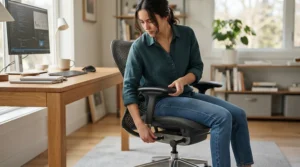
Why does that matter? Your lower spine curves inward, and a flat, unforgiving backrest lets it collapse into a slump by mid-afternoon. NHS-published seating and ergonomics guidance from Cambridge University Hospitals notes that poor sitting posture can aggravate back and neck pain. It even suggests a rolled-up towel at the base of your back for extra support. A well-built mesh back office chair with adjustable lumbar support does that job without the towel.
Mesh is the other half of the story. It doesn’t trap heat like foam, it doesn’t squeak like leather, and it flexes with you. One holds, the other hugs.
So here’s the plan. Below are seven real chairs, from sub-£200 workhorses to the £1,100-plus icon everyone argues about. Each is judged on how its lumbar support works, what the mesh does and who should buy it. You’ll also get a plain-English guide to mesh tension, the much-abused phrase “tension-free backrest”, and whether an airflow backrest really keeps you cooler in a British heatwave (or a radiator-heavy winter).
A quick word on method. This guide draws on published specifications, UK retailer listings and professional reviews. I haven’t sat in these chairs, and I won’t pretend otherwise. Prices are ranges at the time of research, and they move, so check current price and availability on Amazon UK before you commit.
Quick Comparison: 7 Mesh Back Office Chairs with Adjustable Lumbar Support at a Glance
| Chair | Price range (at time of research) | Lumbar approach | Best for |
|---|---|---|---|
| SIHOO M18 | Under £200 | Manual, height and depth | Tight budgets, first ergonomic chair |
| SIHOO M57 | Around £190–£310 | Manual, up/down and in/out | Full-mesh seat and back, warm rooms |
| SIHOO Doro C300 | Roughly £230–£350 | Self-adaptive | Hands-off support on long days |
| FlexiSpot C7 | Around £270–£380 | Manual, adjustable | Taller users on a mid budget |
| FlexiSpot C7 Morpher | Around £700–£800 | Adaptive (AirLumbar) | Lower back focus, deep recline |
| Ergohuman Elite G2 | Around £700–£1,050 | Automatic split-back | Eight-hour-plus days, sliding seat |
| Herman Miller Aeron | Around £1,100–£1,400 | PostureFit SL pads | Buy-once, decade-long use |
Looking at the comparison above, the SIHOO M18 delivers the best entry point under £200. If you’d rather not fiddle with a lumbar pad at all, the SIHOO Doro C300 justifies the extra £50–£150 with support that follows you around. Budget buyers should note that the SIHOO M18 gives up fine-tuned armrests and a self-adjusting back for its low price. At the top end, the Ergohuman Elite G2 and Herman Miller Aeron are really warranty-and-frame purchases. You pay for years of use, not just the first month’s comfort.
The real fork in the road is manual versus adaptive lumbar. Manual chairs reward people who know exactly where their back wants support. Adaptive chairs reward people who wriggle, recline and change posture all day. Most buyers are the second type and don’t realise it.
💬 Just one click — help others make better buying decisions too!😊
Top 7 Mesh Back Office Chairs with Adjustable Lumbar Support: Expert Analysis
Each pick below is analysed from specs, UK listings and professional reviews. Availability on amazon.co.uk varies by model and seller, so verify the listing before ordering.
1. SIHOO M18 — best budget lumbar adjustment
The standout here is a lumbar pad that moves up and down and in and out, at a price under £200. Sihoo lists a dual-adjustable lumbar, a 126° recline, a headrest and a 330 lb (roughly 150 kg) capacity. Height adjustment parks the pad in the small of your back rather than your ribs. Depth adjustment decides how firmly it pushes forward. A 126° recline is generous at this price, though you’ll want it locked upright for typing.
Based on the spec sheet, this suits anyone swapping a dining chair or a fixed-lumbar bargain seat for their first properly adjustable one. What the spec sheet can’t tell you is how the mesh ages over years, so treat the 3-year warranty as your safety net. Review roundups and Sihoo’s own UK guide praise the lumbar adjustability, breathable back and sturdy build. Most of those pages are retailer or affiliate content, so read them as directional. I couldn’t find an independent lab-style UK test of this exact model.
Pros:
- ✅ Lumbar adjusts in both height and depth
- ✅ Breathable mesh back with included headrest
- ✅ 3-year warranty at a budget price
Cons:
- ❌ Only 2D armrests limit fine-tuning
- ❌ Little independent testing to lean on
Price: under £200 at the time of research. For adjustable lumbar plus a headrest, that’s strong value.

2. SIHOO M57 — full-mesh seat and back
The SIHOO M57 goes all-mesh, with a waterfall-edged mesh seat, adjustable headrest, 3D armrests and a lumbar that, per listings, slides roughly 4.8 cm vertically and 3 cm in and out. That vertical travel is enough for most torsos within its recommended 150–180 cm height range. Taller users may find the pad sitting low. Tilt-tension control lets you set how hard the backrest pushes back, which matters more than it sounds. Published recline figures vary between about 120° and 126°, so check the listing.
On paper, it’s the pick for people who run warm or work in a south-facing spare room. TechRadar’s verdict was “functional but unspectacular”: decent lumbar and ergonomics, but too little to separate it from cheaper chairs at its £309.99 list price. A UK buyer’s guide from Gadget Scout names it a best-value mesh pick at around £190. Both can be true. The chair is the same, and the price decides the verdict.
Pros:
- ✅ Lumbar moves vertically and in/out
- ✅ Full-mesh seat and back for airflow
- ✅ Adjustable headrest and 3D armrests
Cons:
- ❌ Recommended height tops out near 180 cm
- ❌ Price swings widely between promotions
Price: around £190–£310. Buy near the bottom of that range, or look at the SIHOO Doro C300.
3. SIHOO Doro C300 — lumbar that follows you
The standout is support that follows your movement instead of demanding fiddling. Sihoo specifies a self-adaptive lumbar system, weight-sensing recline, 4D armrests, an adjustable headrest and a 136 kg capacity. Tom’s Guide lists recline stops at 92°, 100° and 112°. Weight-sensing recline means no tension knob to hunt for. The adaptive lumbar glides as you shift, which suits fidgeters and people who alternate between typing and leaning back.
Adaptive isn’t the same as adjustable, though. You give up the ability to dial in an exact pad height, so if your back is fussy, a manual chair may suit you better. T3’s verdict praised the lumbar support, comfort and versatility but said the adjustments could be better and the price a touch high. Tom’s Guide found the headrest takes some fiddling to place.
Pros:
- ✅ Self-adaptive lumbar needs no tuning
- ✅ Weight-sensing recline, no tension knob
- ✅ All-mesh design at a mid price
Cons:
- ❌ Headrest takes patience to position
- ❌ No exact manual lumbar height
Price: roughly £230–£350. Good value at the lower end, a little steep at the top.
4. FlexiSpot C7 — manual lumbar for taller users
The FlexiSpot C7 is notable for its recommended 165–190 cm height range, which suits taller sitters other budget chairs ignore. FlexiSpot lists manually adjustable lumbar, a 2D headrest and 3D armrests, with mesh and foam seat variants. Choose the mesh version if airflow is the aim. Manual lumbar is a feature, not a flaw: you set it once and it stays exactly there.
Expert Reviews found it comfortable and supportive at a reviewed price of £380, but said the adjustments could be simpler. In practice that means budget a calm half hour for setup rather than five minutes. Based on the spec comparison, it’s a sensible mid-range pick for someone tall, with a settled posture, who values precision over automation.
Pros:
- ✅ Suits users around 165–190 cm tall
- ✅ Manual lumbar holds your chosen setting
- ✅ Judged comfortable and supportive by Expert Reviews
Cons:
- ❌ Controls can feel fiddly at first
- ❌ Price varies noticeably with promotions
Price: around £270–£380. Verify you’re ordering the mesh version.
5. FlexiSpot C7 Morpher — adaptive lower back support
The FlexiSpot C7 Morpher is built around AirLumbar adaptive support and a dynamic backrest that follows your movement. FlexiSpot lists a 143° recline, 4D armrests, a 3D headrest and a 160–195 cm recommended height. A deep recline range encourages the posture changes that desk workers tend to avoid. The adaptive lumbar is the draw for anyone whose lower back complains after two hours.
FlexiSpot reports that IndyBest named it “Best for Lumbar Support” for 2026. That’s the brand’s own account, and I couldn’t find a broad pool of independent UK reviews to cross-check it. Treat it as promising rather than proven. On specs it’s a strong, tall-friendly all-rounder, but you’re paying a premium for the adaptive system.
Pros:
- ✅ Adaptive AirLumbar follows your movement
- ✅ Deep 143° recline for posture changes
- ✅ Wide 160–195 cm recommended height range
Cons:
- ❌ Premium price versus manual-lumbar rivals
- ❌ Limited independent reviews found
Price: around £700–£800. Worth it if adaptive lumbar is your priority.

6. Ergohuman Elite G2 — sliding seat, split-back lumbar
The standout is an automatic split-back lumbar system paired with a sliding seat (394–450 mm depth). A single lever controls seat height, depth and tilt per the listing, and the tilt has three lock positions. The retailer lists certification to the BS 5459-2 office-chair standard for 24-hour use by people up to 150 kg. Warranty is laddered: 10 years on the frame, 5 on mechanism and arms, and 3 on castors, gas lift and mesh.
In this price band you’re buying the frame and the warranty ladder. The seat-depth slider matters more than it sounds, because it lets very different body heights share one chair. I couldn’t verify independent aggregated reviews, and much available text is retailer copy. Be cautious with big words like “orthopaedic” and judge it on adjustability instead.
Pros:
- ✅ Sliding seat suits different leg lengths
- ✅ Split-back lumbar adapts automatically
- ✅ 10-year frame warranty
Cons:
- ❌ Mesh covered for only 3 years
- ❌ Lead times varied by colourway
Price: around £700–£1,050. Discounts are common, so compare retailers.
7. Herman Miller Aeron — buy-once mesh icon
The Herman Miller Aeron is defined by 8Z Pellicle mesh, with eight zones of varied tension, and PostureFit SL, two pads supporting the sacrum and lower lumbar. The warranty is 12 years, and John Lewis lists it as made in the UK. It comes in sizes A, B and C. Seat depth is fixed by size rather than adjustable, so size selection matters.
The PostureFit pads are firm and tension-adjustable but fixed in height. One year-long review describes them as an acquired taste, and notes the mesh hadn’t sagged. If you prefer a softer feel or constant tweaking, a cheaper chair offers more tuning. John Lewis customers averaged around 4 out of 5 across a couple of dozen reviews at the time of research. This is a durability bet, not a feature-count winner.
Pros:
- ✅ Eight-zone Pellicle mesh distributes pressure
- ✅ 12-year warranty
- ✅ Separate sacrum and lumbar support pads
Cons:
- ❌ Seat depth fixed by size
- ❌ PostureFit pads feel firm initially
Price: around £1,100–£1,400, depending on size, options and retailer.
Top 7 Comparison: Standout Spec vs Watch-Out
| Chair | Standout spec | Watch-out | Best for |
|---|---|---|---|
| SIHOO M18 | Dual-adjust lumbar under £200 | 2D armrests only | First ergonomic chair |
| SIHOO M57 | Full-mesh seat and back | Price swings; height tops near 180 cm | Warm rooms |
| SIHOO Doro C300 | Self-adaptive lumbar, weight-sensing recline | Headrest fiddly | Movers and reclined workers |
| FlexiSpot C7 | 165–190 cm height range | Controls take learning | Tall, settled sitters |
| FlexiSpot C7 Morpher | AirLumbar and 143° recline | Premium price | Lower back focus |
| Ergohuman Elite G2 | Sliding seat, 24-hour rating | Mesh warranty only 3 years | Long shifts, shared use |
| Herman Miller Aeron | 8Z Pellicle, 12-year warranty | Fixed seat depth | Decade-long ownership |
Reading the table, the SIHOO M18 and SIHOO M57 are the safest budget bets, but the SIHOO Doro C300 is where adaptive support becomes affordable. If you’re tall, the FlexiSpot C7 and FlexiSpot C7 Morpher are the only picks with published ranges reaching 190 cm and above. The Ergohuman Elite G2 and Herman Miller Aeron make sense mainly if you’ll keep the chair for a decade.
✨ Don’t Miss These Exclusive Deals!
🔍 Take your home office to the next level with these carefully selected chairs. Click on any highlighted product to check current pricing and availability on Amazon UK. Your lower back will thank you by Friday afternoon!
Set Up Your Chair in 10 Minutes: A Practical Guide for the First 30 Days
Even the best mesh back office chair with adjustable lumbar support performs badly when set up wrongly. Here’s the routine that listings never give you.
Minute 1–3: height and distance. Set seat height so your forearms sit roughly horizontal to the keyboard, as the TUC’s guidance on preventing aches and pains from display screen equipment recommends. Pull the chair close to the desk. If the armrests stop you, lower or remove them.
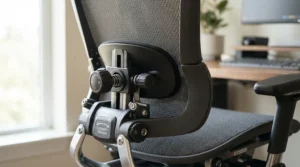
Minute 4–6: lumbar height. Sit all the way back, then slide the pad until it fits the natural hollow of your lower back. Too high and it pokes your ribs. Too low and it props your pelvis awkwardly.
Minute 7–8: lumbar depth and tension. On a manual chair like the SIHOO M57 or FlexiSpot C7, wind the depth until you feel gentle contact, not a shove. On a chair with recline tension, set it so you can lean back without effort but aren’t catapulted forward.
Minute 9–10: armrests and headrest. Elbows should rest lightly, not hold your shoulders up.
The first 30 days. Recheck lumbar position after a fortnight, because your body adapts. Vary backrest tilt through the day, as the TUC advises, rather than locking it rigid. Wipe or vacuum mesh gently. Common mistakes are leaving the tilt locked, perching on the front edge, and never revisiting settings.
Which Chair Fits Which Life? Three Real-World Scenarios
These are illustrative profiles, not real customers, but they show how to match chair to circumstances.
Scenario 1: the hybrid worker. Three days at a spare-room desk, 168 cm tall, budget under £250. The SIHOO M18 is the economical start, while the SIHOO M57 suits warm rooms and sits comfortably within its 150–180 cm range. Used about 20 hours a week, a 3-year warranty covers the chair’s likely working life.
Scenario 2: the full-time remote developer. Eight-plus hours daily, 185 cm, £400–£800 budget, forever shifting between upright typing and leaning back. The FlexiSpot C7 Morpher fits the height range and adaptive support. The FlexiSpot C7 is the cheaper manual option if posture is settled.
Scenario 3: the shared desk. Two people, 160 cm and 190 cm, long shifts, one chair. The Ergohuman Elite G2‘s sliding seat and 24-hour rating are built for this. The Herman Miller Aeron is a second option, though you’d need to pick a single size to suit both.
The pattern: budget and height narrow the field, and movement habits decide manual versus adaptive.
How to Choose a Mesh Back Office Chair with Adjustable Lumbar Support
Start with the regulator’s baseline. The HSE’s guide to working with display screen equipment is the UK reference, and chair requirements centre on adjustable seat height, adjustable backrest height and tilt, and lumbar support that suits the individual. Then work through these steps:
- Check lumbar travel against your height. Around 5 cm of vertical movement suits mid-height users. Tall users should look for a chair with a published height range like the FlexiSpot C7‘s 165–190 cm.
- Choose manual or adaptive. Manual gives precision. Adaptive gives movement-following. Be honest about whether you stay still or wriggle.
- Inspect the mesh and its warranty. Mesh can slacken over years. Check how long the mesh itself is covered, not just the frame.
- Match seat depth. A sliding seat, as on the Ergohuman Elite G2, matters when you share a chair or have very long or short legs.
- Confirm recline and tilt locking. You want a recline you’ll use and a lock for typing.
- Check weight rating and test marks. Look for a stated capacity and a recognised office-chair standard.
Breathable Mesh Chair with Lumbar Adjustment: Manual, Adaptive or Fixed?
Not every breathable mesh chair with lumbar adjustment adjusts the same way, and the difference is bigger than spec sheets imply.
Manual systems, such as on the SIHOO M18, SIHOO M57 and FlexiSpot C7, let you set height (and sometimes depth) once. They reward people who know exactly where their back wants support, but they’re awkward if the chair is shared.
Adaptive systems, on the SIHOO Doro C300, FlexiSpot C7 Morpher and Ergohuman Elite G2, shift as you move. They suit anyone who recline-and-leans through the day.
Pad-based systems, like the Herman Miller Aeron‘s PostureFit SL, use firm pads that stabilise rather than follow.
Fixed plastic curves are the ones to avoid. If you’re sitting still and upright, manual wins on precision. If you move, adaptive wins on comfort. The HSE baseline asks for lumbar support that suits the individual user, which is easier with any of the first three.
Mesh Tension Explained: Why It Matters for Your Spine
“Mesh tension” means two different things, and conflating them causes bad purchases.
Fabric tension is how tightly the mesh is stretched across the frame. Too taut and it feels like sitting on a drum. Too slack and you sink, tipping your pelvis backwards. The Herman Miller Aeron‘s 8Z Pellicle uses eight zones of varied tension so different parts of your body meet different firmness. The Ergohuman Elite G2 listing also refers to mesh tension zones.
Recline tension is how hard the backrest pushes back when you lean. The SIHOO M57 has tilt-tension control, the SIHOO Doro C300 senses your weight instead, and the Ergohuman Elite G2 has a recline-tension lever per its listing.
Mesh does wear, and that’s why mesh warranty length matters. The Ergohuman Elite G2 lists 3 years on mesh versus 10 on the frame. A simple test in a showroom: press your palm on the backrest, and it should spring back evenly with no soft spots.
Tension-Free Backrest: Marketing Phrase or Real Benefit?
There’s no recognised standard for a tension-free backrest. Sellers use the phrase loosely, so judge chairs by features, not slogans.
It might mean a backrest that needs no tension adjustment, which describes weight-sensing or adaptive designs. It might mean a mesh with enough give that it doesn’t fight your spine. Or it might simply mean a back that follows movement.
In practice, the SIHOO Doro C300‘s weight-sensing recline and the FlexiSpot C7 Morpher‘s movement-following backrest come closest to the idea. The Herman Miller Aeron is deliberately the opposite: structured, with tension-adjustable pads.
Beware of one trap. “Tension-free” can quietly mean “soft”, and soft isn’t the same as supportive. That NHS-published seating leaflet emphasises support for the natural curve of the back, not squishiness. If a seller promises a tension-free backrest, ask what mechanism delivers it. A weight-sensing recline or adaptive lumbar is a real feature. The phrase alone is not.
Airflow Backrest: Does Mesh Really Keep You Cooler?
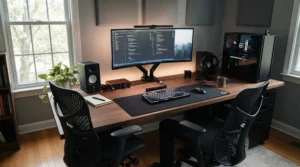
An airflow backrest lets air and body heat pass through the fabric rather than trapping it against your back. Herman Miller describes the Herman Miller Aeron‘s Pellicle as doing exactly that, and it’s the core logic of every mesh chair here.
For warm rooms, summer afternoons or a south-facing spare bedroom, an airflow backrest is a genuine comfort gain over foam or leather. The SIHOO M57‘s full-mesh seat and back extend that logic to the seat as well.
British reality complicates it. In a chilly converted garage or draughty box room in winter, some people find mesh feels cooler than padding. A light cardigan solves it. Zips, belt buckles and keys can snag mesh, so be mindful. For cleaning, the Herman Miller Aeron‘s listing recommends a soft, dry cloth, and gentle vacuuming suits most mesh. The takeaway: if you run warm, an airflow backrest is a smart choice. If you run cold, check how your room behaves in January.
Ergonomic Mesh Desk Chair for Lower Spine: Matching Chair to Your Back
If your lower back is the weak link, an ergonomic mesh desk chair for lower spine support should do three things well.
First, the lumbar pad must sit in your natural hollow, which the TUC guidance describes as the right target for lumbar height. Second, the seat must let you sit all the way back, which depends on seat depth and height. Third, the backrest tilt should let you vary position through the day.
The match: the SIHOO M18 and SIHOO M57 suit people who know their hollow and want a set-and-forget pad. The SIHOO Doro C300 and FlexiSpot C7 Morpher suit those whose back needs support in several positions. The Ergohuman Elite G2 and Herman Miller Aeron suit long, relentless sitting days.
A chair is not a treatment. If you have persistent or worsening back pain, speak to your GP or a physiotherapist. The best chair in the world won’t replace regular breaks and movement.
Mesh Back Office Chair vs Padded Alternatives
| Mesh back | Foam-padded | Leather/executive | |
|---|---|---|---|
| Heat build-up | Low, air passes through | Higher, foam traps heat | Higher, non-breathable |
| Lumbar adjustability | Common on mid-range and up | Often fixed or add-on | Often fixed |
| Upkeep | Wipe or vacuum | Fabric can stain | Conditioning needed |
| Ageing risk | Mesh may slacken | Foam may flatten | Surface may crack |
| Best for | SIHOO M57, Herman Miller Aeron | Cooler rooms, softer feel | Meeting rooms, style |
Mesh wins on heat and on adjustable lumbar availability, which is why this style dominates ergonomic guides. The trade-off is that mesh can feel firmer and can slacken over years, so mesh warranty length matters. Padded chairs feel cosier at first but tend to flatten and warm up. For a daily-use desk, a mesh back office chair with adjustable lumbar support is the more defensible choice.
Long-Term Cost & Maintenance: What Each Chair Really Costs Per Year
Sticker price misleads. A better lens is illustrative cost per year of warranty cover, which is not a promise of lifespan.
| Tier | Chairs | Price range | Warranty horizon | Illustrative cost per year | Best for |
|---|---|---|---|---|---|
| Budget | SIHOO M18 | Under £200 | 3 years | Under roughly £70 | Occasional or first-time users |
| Entry-mid | SIHOO M57, SIHOO Doro C300 | £190–£350 | 3 years | Roughly £65–£115 | Daily home workers |
| Premium | Ergohuman Elite G2 | £700–£1,050 | 10-year frame | Roughly £70–£105 | Long shifts, shared desks |
| Icon | Herman Miller Aeron | £1,100–£1,400 | 12 years | Roughly £90–£115 | Decade-plus ownership |
The surprise is that premium chairs can cost about the same per year as mid-range ones, if you’ll genuinely keep them for a decade. Many people won’t, and mesh and gas-lift parts often carry shorter cover than the frame, as on the Ergohuman Elite G2‘s 3-year mesh warranty. Maintenance is cheap: wipe, vacuum, check bolts, and replace the gas lift when it eventually sinks. If you move house often or change setups, the cheaper chairs carry less regret.
Safety, Regulations and Compliance: What UK Law Expects
In Great Britain, the Health and Safety (Display Screen Equipment) Regulations 1992 (amended in 2002) require employers to assess workstations for habitual screen users and reduce the risks. Council guidance on homeworking states that the same duties apply to home-based staff, and that a self-bought chair should still be adjustable in height, with an adjustable backrest and adequate lumbar support.
That’s useful if you’re asking your employer for a chair. Whether they pay for a specific model depends on their policy, so ask early and keep your DSE assessment on record.
When reading spec sheets, look for a stated weight capacity and a recognised office-chair test standard, such as BS 5459-2 (listed for the Ergohuman Elite G2 by its retailer). Marketing terms like “BIFMA tested” refer to a US standard and aren’t a substitute for UK checks. If a seller won’t tell you what a chair was tested against, that tells you something too.
Frequently Asked Questions
❓ Is a mesh back office chair with adjustable lumbar support good for lower back pain?
❓ How high should I set lumbar support on a mesh office chair?
❓ Do mesh office chairs sag over time?
❓ How much should I spend on a mesh office chair in the UK?
❓ Can I get my employer to pay for a chair when working from home?
Conclusion
The short answer is that your back, budget and habits pick the winner. If you want adjustable lumbar for the least money, the SIHOO M18 is the entry point under £200, and the SIHOO M57 adds a full-mesh seat for warm rooms. If you’d rather never touch a lumbar dial, the SIHOO Doro C300 and FlexiSpot C7 Morpher offer adaptive support at mid and upper-mid prices. Taller sitters should look at the FlexiSpot C7 for its 165–190 cm range. For long shifts and shared desks, the Ergohuman Elite G2‘s sliding seat is hard to beat on paper, and the Herman Miller Aeron remains the buy-once option for anyone who’ll keep a chair for a decade.
Remember the three ideas that cut through the marketing. Mesh tension is two things, fabric and recline. A tension-free backrest is a phrase, not a standard, so look for the mechanism. And an airflow backrest is a joy in July and worth testing in January.
Verify every price range and availability on Amazon UK before ordering, and give any new chair a proper 30-day settling-in period.
✨ Ready to Sit Smarter?
🪑 Compare the picks above, check current pricing and availability on Amazon UK, and give your lower back the support it deserves. Click any highlighted chair name to see today’s options!
Recommended for You
- Removable Lumbar Support Cushion Alternatives To Built-In Support 2026
- Office Chair With Lumbar Support For Night Shift Workers: 7 Best 2026
- Lumbar Support Chair For Slouching Posture Correction: 7 Best (2026)
Disclaimer: This article contains affiliate links. As an Amazon Associate, I earn from qualifying purchases. If you purchase products through these links, we may earn a small commission at no additional cost to you.
✨ Found this helpful? Share it with your friends! 💬🤗
