
In This Article
By mid-afternoon, a bad chair stops being furniture and becomes a grudge. An office chair with 4D lumbar support for lower back relief has a lumbar pad that moves in four directions: up, down, in and out. Height lines the pad up with your waist, while depth decides how firmly it presses into your lordotic curve, the gentle inward arc of the lower spine. Think tailor-made suit, not off-the-peg.

Most chairs give you one lever at best: a pad that slides up and down, then sits stubbornly flat. A proper 4D adjustable lumbar support chair adds the second axis. That matters because a 5’4″ student and a 6’2″ project manager share neither a waist height nor a curve depth. Below you’ll find seven real options UK buyers can find, from sub-£100 mesh seats to a premium benchmark above £900.
One caveat first. Brands use “4D” loosely, sometimes for the armrests and sometimes for the lumbar pad. Secretlab says 4-way, Sihoo says height and depth, and Steelcase says height and firmness. I’ve read each listing, spec sheet and published review closely, and I flag where a chair is a near-miss rather than a true match. I haven’t sat in these chairs, so everything here is analysis of real specifications and reported reviewer feedback, not hands-on testing. Prices are ranges at the time of research, so check current price before buying.
Quick Comparison: 7 Chairs with Adjustable Lumbar Support
Here’s the whole field on one screen before we dig in.
| Chair | Lumbar adjustment | Price range | Best For |
|---|---|---|---|
| ProperAV Extra Mesh | Up/down and forwards/backwards | Under £80 | Occasional home use |
| Vinsetto 4D Lumbar Support Ergonomic Desk Chair | Up/down and forwards/backwards | £80–£100 | Students on a tight budget |
| Sihoo M57 | Height and depth | Around £300–£330 | A first “proper” ergonomic chair |
| FlexiSpot C7 | Height, plus modest depth tuning | Around £350–£400 | Set-and-forget home workers |
| Sihoo Doro S100 | Dual self-adjusting panels | Around £250–£350, varies | People who hate fiddling |
| Secretlab Titan Evo | Height and depth via side dials | From the mid-£400s | Hybrid work and gaming |
| Steelcase Leap V2 | Height and firmness | From around £900 | Persistent lower back pain |
Looking at the table, the real step-change in true two-axis adjustment comes at the Sihoo M57 and above, while the two budget chairs prove the feature has reached the sub-£100 bracket. The Sihoo Doro S100 and Steelcase Leap V2 are deliberate outliers: one automates the support, the other trades depth for firmness control. If you’re unsure where you fit, the sections below match chair to body and budget.
💬 Just one click — help others make better buying decisions too!😊
Top 7 Office Chairs with 4D Lumbar Support for Lower Back: Expert Analysis
I’ve ordered these from cheapest to dearest, so you can stop reading when your budget runs out.
1. ProperAV Extra Mesh — cheapest way to try 4D lumbar
The headline here is simple: a lumbar pad that moves both up/down and forwards/backwards for less than a takeaway for four. A UK retailer listing describes the pad’s two-axis travel, a rotating and height-adjustable headrest, a mesh back and flip-up arms.
In practice, two-axis lumbar at this price lets you discover what your back actually likes before spending serious money. The flip-up arms are a quiet bonus in small rooms, because the chair tucks under a desk instead of blocking a doorway. On paper, though, the listing I found mentions no seat-depth slide, so tall users may find the seat short.
This one suits students, occasional home workers and anyone setting up a spare-room desk. I couldn’t find independent professional testing of this exact model, so treat marketplace star ratings with caution and read the verified-purchase comments about wobble and foam firmness.
Pros:
- ✅ Lumbar pad moves on two axes
- ✅ Flip-up arms save space
- ✅ Lowest entry cost on this list
Cons:
- ❌ No independent expert testing found
- ❌ No seat-depth adjustment listed
Price range: under £80 at the time of research. For light use, that’s a low-risk experiment; for eight-hour days, look higher up.

2. Vinsetto 4D Lumbar Support Ergonomic Desk Chair — budget pick with tension control
Vinsetto’s selling point is a lumbar pad that, per the Argos listing, moves up/down and forwards/backwards, helping relieve low back pressure. The same listing mentions a headrest that rotates and moves, adjustable tilt tension, a 43–51cm seat height range, a padded seat and a mesh back.
Here’s what that means day to day. The tension control lets you set how readily the backrest reclines, which matters because a springy chair for a light person feels like a rocking horse. The 43–51cm seat range suits most average-height adults, though anyone approaching six feet may want more headroom.
Compared with the ProperAV Extra Mesh, you pay a little more for a more established high-street retail presence, which can make returns simpler. Again, I couldn’t verify a substantial pool of independent reviews for this exact model, so be sceptical of glowing marketplace averages and check the returns policy.
Pros:
- ✅ Pad adjusts in height and depth
- ✅ Adjustable tilt tension
- ✅ Headrest rotates and moves
Cons:
- ❌ Little independent testing available
- ❌ No seat-depth slide listed
Price range: roughly £80–£100. Decent value if you want 4D lumbar on a student budget.
3. Sihoo M57 — best-value true height-and-depth lumbar
The Sihoo M57 earns its place because the lumbar pad genuinely adjusts in height and depth. A Sihoo listing on a European retailer describes a double lumbar pad with both axes, and a review of the chair measured roughly 5cm of height and 3cm of depth travel. Add 3D armrests, a headrest with up to 10cm of height and 45° of tilt, and an aluminium base.
Those 3cm of depth matter more than they sound. Move the pad in by a centimetre and the pressure on your lower back changes noticeably, which is exactly what lumbar depth control is for. Based on the spec comparison, it suits anyone roughly 5’4″ to 6’0″ who wants the feature without a four-figure invoice.
Reviewers are broadly positive, with a catch. Windows Central praised the lumbar support and easy assembly, while TechRadar found it solid but pricey against cheaper rivals. Another reviewer flagged a long build and warned that taller users might struggle.
Pros:
- ✅ True height and depth lumbar adjustment
- ✅ Adjustable headrest and 3D armrests
- ✅ Aluminium base for durability
Cons:
- ❌ Armrests could use more padding
- ❌ Taller users may outgrow it
Price range: around £300–£330. A strong mid-range starting point.
4. FlexiSpot C7 — fully adjustable, if you can find the switch
The FlexiSpot C7 is the “does everything” option: adjustable lumbar support, seat-depth adjustment, an adjustable headrest and arms that move in height and depth. A US retailer listing for the C7 series mentions roughly 3cm of lumbar depth tuning on top of the height adjustment, so it sits close to a genuine 4D system.
The practical catch is access. Expert Reviews, which tested the C7 at around £380, found it comfortable and supportive but “confusing”, noting that the lumbar height switch sits in an awkward spot behind the mesh. That’s a nuisance on day one and irrelevant once you’ve set it, so this chair suits people who adjust once and forget.
Buyers wanting simpler controls could consider the FlexiSpot C7 Max, where Tom’s Guide found five levels of lumbar and headrest adjustment easy to change.
Pros:
- ✅ Lumbar, seat depth and headrest all adjust
- ✅ Breathable mesh for warm rooms
- ✅ Established UK reviewer coverage
Cons:
- ❌ Lumbar height switch is awkward to reach
- ❌ Controls take time to learn
Price range: around £350–£400. Good value if you’ll tolerate a learning curve.
5. Sihoo Doro S100 — automatic lumbar for the non-fiddlers
I’m including the Sihoo Doro S100 as a deliberate contrast. Its lumbar is not manual 4D; instead, two independent panels on springs move with you. Sihoo adds 4D armrests, a 2.5cm seat-depth range and a five-level backrest height.
Analytically, that makes it the answer for people who dislike adjusting things. Rather than setting a fixed depth, the panels follow your posture changes. The trade-off is less control over exactly where pressure lands, which matters if your lower back needs a specific position.
Reviews are mixed. Tech Guided rated the dual panels as the standout feature at its price, and a German review found it solid in its class but noted weaker finishing. TweakTown was more critical, citing weak armrests, a small design and comfort fading over time.
Pros:
- ✅ Self-adjusting lumbar panels follow movement
- ✅ 4D armrests and seat-depth adjustment
- ✅ Breathable mesh back and seat
Cons:
- ❌ Not true manual depth control
- ❌ Mixed reviews on long-term comfort
Price range: around £250–£350, with notable variation, so check current price. Worth considering only if automatic beats adjustable for you.
6. Secretlab Titan Evo — dial-adjustable lumbar with gaming-chair swagger
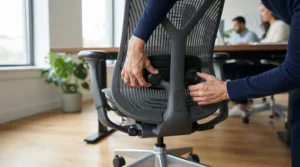
The Secretlab Titan Evo is the best-known “4-way” system on the list. Its L-ADAPT lumbar is built into the backrest and, per Secretlab, adjusts for height and depth via two side dials, so there’s no strap-on pillow to slip out of place. Alongside that come 4D magnetic armrests, 85° to 165° of recline, cold-cure foam and a five-year warranty.
Reviewers like the result. Tom’s Hardware called it a firm chair that supports your back well, while SeatedLab noted it holds one shape once set, which suits people who stay in one posture. Sizing matters: the XL is aimed at roughly 5’11” to 6’9″, the Regular at 5’7″ to 6’2″.
The drawbacks are real. Seat depth isn’t adjustable according to published specs, and upholstered chairs can feel warmer than mesh in summer.
Pros:
- ✅ Lumbar height and depth via simple dials
- ✅ Three sizes cover short to very tall users
- ✅ Five-year warranty
Cons:
- ❌ Seat depth is not adjustable
- ❌ Can run warmer than mesh
Price range: from the mid-£400s upwards, depending on size and upholstery. Strong for tall users and hybrid workers.
7. Steelcase Leap V2 — the premium benchmark for lower back pain
The Steelcase Leap V2 is not a height-and-depth chair, so call it a near-miss with a pedigree. Its lumbar adjusts for height and firmness, paired with LiveBack technology that flexes with your spine, a Natural Glide mechanism, adjustable seat depth and 4D arms. Steelcase backs it with a 12-year warranty and a 400lb capacity.
What the spec sheet won’t tell you, but reviewers note, is the break-in period. Cleveland Heart reports one to two weeks before it feels right, and SeatedLab flags a firm seat that won’t suit plush lovers. Still, for persistent lower back trouble, reviewers consistently rank it near the top.
Availability varies, so check the current Amazon UK listing and authorised sellers before buying.
Pros:
- ✅ Lumbar height plus firmness control
- ✅ Flexing back follows your spine
- ✅ 12-year warranty
Cons:
- ❌ Premium price
- ❌ Firm seat and break-in period
Price range: from around £900 upwards. Expensive, but the cost per working day is modest over a decade (more on that below).
How to Set Up Your Lumbar Depth Control and Height in 10 Minutes
A superb chair set up badly is just an expensive stool. Follow this order, because each step affects the next.
- Seat height first. Feet flat, thighs roughly level.
- Seat depth next, if your chair has it. Leave about two fingers of space behind your knees.
- Recline tension. The backrest should follow you without flopping.
- Lumbar height. Slide the pad so it meets the hollow just above your belt line.
- Lumbar depth. Start with the pad almost flat, then add one notch per day. You want a gentle hug, not a shove.
- Armrests last. Elbows at roughly 90° with relaxed shoulders.
The aim, as an NHS trust seating leaflet puts it, is to keep your spine’s natural S-shaped curves while changing position regularly. Common first-30-day mistakes include cranking the depth too high on day one, setting the pad too high (it should support the lower back, not the ribs), and never revisiting the setup. Re-check whenever you change desk, shoes or monitor, because your lumbar depth control setting that felt perfect in trainers may feel wrong in boots.
Which Chair Fits Which Person? Three Real-World Scenarios
These are hypothetical profiles built from the specs above.
The student on a tight budget. Imagine a 24-year-old postgraduate working four hours a day in a rented room, with £100 to spend. The Vinsetto 4D Lumbar Support Ergonomic Desk Chair or ProperAV Extra Mesh gives two-axis lumbar and space-saving arms, which is plenty for part-time desk time. The compromise is durability and finish.
The tall hybrid worker. Picture a 6’2″ employee at the desk three days a week, around £450 to spend. The Secretlab Titan Evo in XL offers dial-adjustable height and depth, and the size range suits long frames. The Sihoo M57 is cheaper but the height warnings make it riskier.
The long-term back-pain sufferer. Consider a 52-year-old with recurring flare-ups and either a bigger budget or an employer willing to fund a DSE-led purchase. The Steelcase Leap V2 is the benchmark, with the FlexiSpot C7 as a cheaper compromise.
✨ Ready to find your fit?
🔍 Compare the chairs above, check the current price and availability on Amazon UK, and match the lumbar system to your body rather than to the brand name. Your lower back will thank you by Friday.
Common Lower Back Problems and the Lumbar Fix for Each
Matching symptom to setting is where most owners go wrong, so here’s a quick troubleshooting guide.
- Ache after 90 minutes: The pad is probably too low or too shallow. Raise it to the belt line and add one depth notch.
- A hard spot jabbing your spine: The pad is too deep. Wind it back, since a Secretlab Titan Evo or Sihoo M57 can go firmer or flatter in seconds.
- Slumping by late afternoon: A fixed shape tires you. Try the self-adjusting Sihoo Doro S100, or take a standing break every 30 minutes.
- Numb thighs: This is a seat-depth issue, not a lumbar one. The FlexiSpot C7 and Steelcase Leap V2 let you shorten the seat.
- Sweaty back: Choose mesh, such as the FlexiSpot C7 or Sihoo M57, over upholstery.
If pain persists, radiates down a leg or wakes you at night, see a GP. A chair is a tool, not a diagnosis.
Lordotic Curve, Height and Depth: How a 4D Lumbar System Actually Works
Your lower spine curves inward, which anatomists call the lordotic curve. Sitting tends to flatten it, and a flat lower back loads the discs differently from a gently curved one. A lumbar pad’s job is to hold a comfortable curve, not to force a perfect one.
Height and depth do different jobs. Height positions the support where your curve is deepest, which varies with torso length. Depth sets pressure: closer to your back means firmer contact, further away means a lighter touch. A chair with lumbar height and depth adjustment lets you tune both, while height-only systems can’t compensate for a shallow or pronounced curve. That’s why lumbar depth control is the feature to look for on the spec sheet, rather than the vague word “ergonomic”.
How to Choose an Office Chair with 4D Lumbar Support for Lower Back
Use this order of priority when shopping.
- Confirm the axes. Look for explicit wording like “height and depth” or “up/down and forwards/backwards”, not just “adjustable lumbar”.
- Check the size range. Match the chair’s recommended height to yours.
- Look for seat-depth adjustment. It prevents thigh pressure and complements lumbar settings.
- Prefer easy-to-reach controls. Awkward switches mean you’ll never adjust them.
- Inspect the warranty. Five to twelve years signals confidence in the mechanism.
- Check returns. Most of us need a week to judge a chair, so a generous return window is worth more than a free headrest.
If you’re a chair with lumbar height and depth adjustment shopper on a budget, the Sihoo M57 is the cheapest verified route. Otherwise, the Secretlab Titan Evo is the next rung.
Features That Actually Matter (And Those That Don’t)
Worth paying for: two-axis lumbar, seat-depth adjustment, tilt tension, and a mechanism you can reach while seated.
Nice but optional: headrests (useful for reclining, ignorable for upright typing), 4D armrests (helpful if you share the chair), and fancy upholstery.
Mostly marketing: “gaming” stitching, RGB nonsense, and superlatives like “revolutionary” on listings. The Vinsetto 4D Lumbar Support Ergonomic Desk Chair and ProperAV Extra Mesh show you can get lumbar movement without any of this.
One more filter: an adjustment is only as good as its range. Three centimetres of depth, as on the Sihoo M57, is enough to change feel; a token one-centimetre nudge is not.

Common Mistakes When Buying an Office Chair with Lumbar Support
The first mistake is believing lumbar support cures back pain. An NHS trust leaflet on posture argues there is no single correct posture and no strong evidence that avoiding “bad” postures prevents low back pain. Read that as a nudge towards movement, not a reason to skip adjustability: a comfortable, varied sitting position still beats a rigid one.
The second is buying on the word “4D” alone, since it may refer only to the armrests. The third is ignoring body size, because a Regular Secretlab Titan Evo will not suit a 6’5″ frame. The fourth is skipping the setup, leaving the pad wherever the factory placed it. And the fifth is buying a chair for eight hours without a trial period.
4D Lumbar vs Fixed and Dynamic Lumbar Support
| Feature | Fixed lumbar | Dynamic (self-adjusting) | 4D height-and-depth |
|---|---|---|---|
| Adjustment | None or height only | Automatic | Manual on two axes |
| Pressure control | Low | Moderate | High |
| Effort required | None | None | One-off setup |
| Best For | Budget seats | Sihoo Doro S100 | Sihoo M57, Secretlab Titan Evo |
Fixed lumbar is fine if the factory curve happens to match yours, which is hit-and-miss. Dynamic systems suit restless sitters who shift constantly, but they give you less say over where pressure lands. For anyone with a specific problem area, the 4D approach gives you the most control, provided you invest ten minutes in the setup.
Long-Term Cost and Maintenance
A pricier chair can cost less per working day. Spread over a typical 250-day year, a chair at the Steelcase Leap V2 level works out at roughly 30p a day across a 12-year warranty, though a warranty is not a guaranteed lifespan. A Sihoo M57 over a three-year warranty comes to about 40p, and a budget chair replaced every two years can approach 16p a day while delivering less support. Treat these as rough estimates built on assumptions, not promises.
| Tier | Typical range | What you get | Best For |
|---|---|---|---|
| Budget | Under £100 | Basic two-axis lumbar | ProperAV Extra Mesh, Vinsetto 4D Lumbar Support Ergonomic Desk Chair |
| Mid-range | £250–£400 | True adjustment, better build | Sihoo M57, FlexiSpot C7 |
| Premium | £450+ | Longer warranty, refined mechanisms | Secretlab Titan Evo, Steelcase Leap V2 |
The jump from budget to mid-range buys the most improvement per pound, since you gain proper mechanisms and testing coverage. Beyond that, you’re paying for durability and refinement. Maintenance is light: tighten bolts every few months, wipe mesh, and re-check your lumbar setting whenever your desk or posture changes.
UK Rules and Standards: DSE, Employers and Your Chair
If you use a screen habitually for work, the Display Screen Equipment Regulations apply, and employers have duties around workstation assessment. HSE’s guide to working with display screen equipment covers chair adjustability, back support and the ability to change position. Employers often fund a chair when an assessment recommends it, so ask before you pay out of your own pocket.
Look for chairs tested to the European EN 1335 office-chair standard, which some retailer listings mention. Post-Brexit, check UK conformity marking where relevant. Finally, if you work from home, keep an assessment note: it helps if you ever need to justify a purchase or a referral.
FAQ: Office Chair with Lumbar Height and Depth Adjustment
❓ Is a 4D lumbar support chair worth it for lower back pain?
❓ How much should I spend on an office chair with adjustable lumbar support in the UK?
❓ Can I add 4D lumbar support to a chair I already own?
❓ What is the cheapest chair with lumbar height and depth adjustment?
❓ How long does it take to get used to a new lumbar setup?
Conclusion: Choosing Your Office Chair with 4D Lumbar Support for Lower Back
The right answer depends on your body, your budget and how you sit. If you want the cheapest experiment, the ProperAV Extra Mesh or Vinsetto 4D Lumbar Support Ergonomic Desk Chair will show you what two-axis lumbar feels like, with the caveat that independent testing is thin. For a well-reviewed true height-and-depth system, the Sihoo M57 is the sweet spot, while the FlexiSpot C7 adds seat-depth and headrest adjustment if you can live with fiddly controls.
If you’d rather not adjust anything, the Sihoo Doro S100 automates the support, though reviews are mixed. Tall users and hybrid workers should shortlist the Secretlab Titan Evo, and anyone with persistent lower back trouble should weigh the Steelcase Leap V2, even though its lumbar is height-and-firmness rather than true depth.
Whichever you choose, set it up properly, move regularly and see a GP if pain lingers.
✨ Your back deserves better than a kitchen chair!
🪑 Pick the model that matches your body, click through to check the current price and availability on Amazon UK, and start sitting smarter today.
Recommended for You
- Mesh Back Office Chair With Adjustable Lumbar Support: 7 Best (2026)
- Removable Lumbar Support Cushion Alternatives To Built-In Support 2026
- Office Chair With Lumbar Support For Night Shift Workers: 7 Best 2026
Disclaimer: This article contains affiliate links. As an Amazon Associate, I earn from qualifying purchases. If you purchase products through these links, we may earn a small commission at no additional cost to you.
✨ Found this helpful? Share it with your friends! 💬🤗
