In This Article
If you’ve ever perched on a standard-issue office chair with your knees somewhere near your ears and your feet dangling like a toddler’s on a dining chair, you already know the problem. Most chairs are built around an “average” body that, frankly, doesn’t describe a huge number of us. An ergonomic office chair for tall person needs isn’t a luxury — it’s the difference between finishing a workday upright and finishing it with a lower back that feels like it’s been in a rugby scrum.
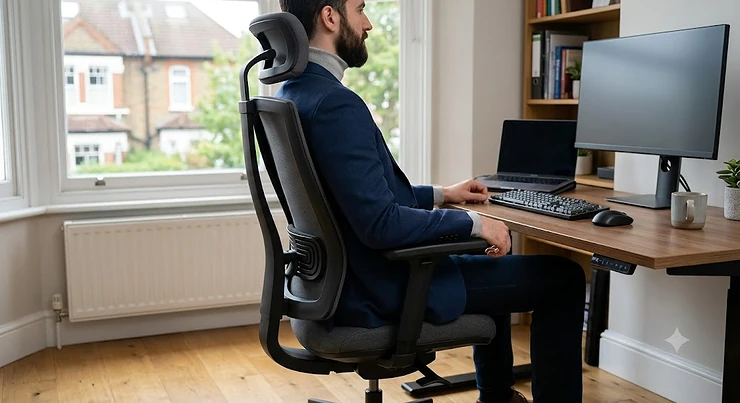
What is an ergonomic office chair for tall person needs? In short, it’s a chair engineered with a taller seat height range, a deeper (and ideally adjustable) seat pan, a genuinely high backrest, and an extended gas lift cylinder, so someone over roughly 6’1″ can sit with hips and knees level and feet flat on the floor, rather than compromising their posture to fit furniture designed for someone six inches shorter.
This matters more than most people realise. Sit for eight hours a day in a chair that’s too short or too shallow, and you’ll gradually load up your lumbar spine, your hip flexors, and the backs of your knees in ways that add up over months, not days. The good news is that the market has quietly matured — there are now genuinely excellent options across every budget, from sub-£200 mesh chairs with proper headrest height adjustment right up to chairs that Scandinavian ergonomists have spent five years redesigning. We’ve dug through real specs, real UK pricing, and real aggregated review sentiment to find seven chairs actually worth your money in 2026, and we’ll walk through exactly how to judge seat depth for tall users, extended gas lift range, and everything else that a spec sheet alone won’t tell you.
According to NHS guidance on back pain, poor posture and prolonged awkward sitting positions are among the most common contributors to lower back discomfort — which is precisely the risk a badly-fitted chair creates for taller frames.
Quick Comparison Table: Best Chairs at a Glance
Before we dig into the full analysis, here’s the short version for anyone in a hurry.
| Chair | Seat Height Range | Best For | Price Range |
|---|---|---|---|
| Herman Miller Aeron (Size C) | 42-57cm | Premium buyers, 6’3″+ | £1,300-£1,600 range |
| Steelcase Gesture | 40.6-53.3cm | Multi-device workers | £1,000-£1,300 range |
| RH Logic 220 XL | 39.7-52cm | Deepest seat adjustment | £900-£1,200 range |
| Secretlab Titan Evo XL | 46-55.5cm | Gamers who also work | £500-£650 range |
| SIHOO Doro C300 | 47-55cm | Best all-round value | £230-£280 range |
| FlexiSpot C7 | 49-57cm | Budget with headrest | £260-£380 range |
| Duramont Ergonomic Chair | ~46-56cm | Tightest budget | £150-£220 range |
Looking at the spread above, there’s a clear split between the three premium chairs at the top — all engineered from the ground up with tall or “big and tall” specific configurations — and the four mid-to-budget options that achieve genuinely respectable seat height and depth ranges through clever mechanical design rather than sheer size. If your priority is long-term durability and warranty coverage, the top third of this table earns its price tag; if you’re outfitting a home office on a tighter budget, the bottom half still gets the fundamentals right.
💬 Found one that looks right for you? A single click on any chair name above takes you to check its current price and availability.
Top 7 Ergonomic Office Chairs for Tall People: Expert Analysis
We’ve deliberately spread this list across budget, mid-range, and premium tiers, because “best” depends heavily on what you’re prepared to spend and how many hours you’re actually sitting each day.
1. Herman Miller Aeron (Size C) — the tall-frame benchmark since 1994
The Aeron’s Size C isn’t a marketing gimmick — it’s a genuinely different shell, built for people between 160-198cm tall and up to 159kg. Expanding on that, the seat height runs from 42cm to 57cm, with a seat depth around 47-50cm depending on which generation you find, giving taller users thigh support that actually reaches the back of the knee instead of stopping short. The PostureFit SL lumbar system, a real mechanical adjustment rather than a foam pad, lets you dial in pelvic tilt support independently of backrest recline, which matters enormously once your torso is longer than the chair’s designers first assumed.
Based on the spec comparison, this is the chair for someone who sits eight-plus hours daily and treats furniture as a long-term investment rather than a disposable purchase; its 12-year warranty reflects that positioning. Reviewers consistently report that the 8Z Pellicle suspension mesh remains supportive for years without the sagging that cheaper mesh chairs develop, though several also note the seat firmness takes a week or two to adapt to.
Pros:
- ✅ Three-size system genuinely fits 6’3″+ frames properly
- ✅ 12-year warranty reflects serious build confidence
- ✅ PostureFit SL gives real, adjustable lumbar shape
Cons:
- ❌ No standard headrest option on the base model
- ❌ Firm suspension seat takes real time to adjust to
At the time of research, expect a price in the £1,300-£1,600 range depending on finish and reseller. For a chair you’ll likely keep for a decade, that cost-per-year math tends to work out favourably against replacing a cheaper chair every three years.
2. Steelcase Gesture — most adjustable arms in the class
What most buyers overlook about the Gesture is that its tall-friendliness comes from the arms and seat slider rather than sheer seat height alone. Its seat height range of roughly 40.6-53.3cm isn’t dramatically taller than average, but a seat depth adjustment spanning 40-47.6cm, paired with 360-degree arms that rotate through nearly every angle a human elbow can manage, means taller users can compensate for longer femurs and longer forearms simultaneously.
Here’s what to weigh: Steelcase built the Gesture after studying more than 2,000 people using tablets, phones, and multiple monitors, and it shows in how naturally the arms move to support whatever device you’re holding. The 181kg weight rating and flexible seat-edge design mean pressure doesn’t concentrate behind the knees the way it does on shallower budget chairs. One independent reviewer measured the practical upper comfort limit around 6’4″, so extremely tall users (6’6″+) may want to pair it with the optional headrest.
Pros:
- ✅ 360-degree arm movement fits almost any working posture
- ✅ Seat depth slider compensates for longer thighs
- ✅ 181kg weight capacity with a lifetime warranty
Cons:
- ❌ Optional headrest costs extra on top of chair price
- ❌ Comfort ceiling softens noticeably above 6’4″
Prices typically sit in the £1,000-£1,300 range at authorised UK dealers; always check current pricing since Steelcase runs frequent trade promotions.
3. RH Logic 220 XL — Scandinavian seat-depth specialist
The RH Logic 220 XL is a familiar sight in UK ergonomic assessment reports, and for good reason: its seat depth adjusts across a genuinely wide range, with the standard chair moving between 38-48cm and the XL seat variant extending to around 50cm, paired with a taller “4B” gas lift specifically built for mid-to-tall users. The high backrest, with its inflatable lumbar air cell, lets you pump up or release lower back support on demand rather than relying on a fixed foam curve.
What the spec sheet won’t tell you, but UK posture specialists note, is that the frictionless tilt mechanism keeps your feet planted on the floor through the full recline range — a detail that matters disproportionately for tall users, since longer legs amplify any forward seat-edge movement during recline. The optional height, depth, and angle-adjustable neckrest is a genuinely rare feature at this tier, aimed at anyone who wants headrest height precision rather than a generic pillow.
Pros:
- ✅ Seat depth adjustment among the widest in this list
- ✅ Optional neckrest adjusts height, depth and angle
- ✅ 10-year warranty with genuinely replaceable parts
Cons:
- ❌ Neckrest is a paid extra, not included as standard
- ❌ Assembly and adjustment learning curve is steeper
Expect a price in the £900-£1,200 range depending on fabric and options chosen; this is a chair usually bought through ergonomic specialists rather than general retail, so allow extra time for delivery.
4. Secretlab Titan Evo XL — built specifically for 6’9″ frames
Unlike most “gaming chairs” that quietly borrow office-chair language, the Titan Evo XL is explicitly sized for users between 181-205cm tall and 80-180kg — numbers that put it squarely in tall-and-broad territory. The seat height runs roughly 46-55.5cm from floor to seatbase, and the frame uses genuinely longer hydraulics rather than simply padding out a standard-size shell, which is why it comfortably outperforms many “one-size” office chairs once you’re past six foot.
Reviewers consistently report that the 4-way L-ADAPT lumbar system and cold-cure foam hold their shape far longer than typical gaming-chair foam, which tends to compress within a year. The magnetic memory-foam headrest pillow is a genuinely useful touch for headrest height flexibility, since it can be repositioned rather than fixed to one spot. On paper this means you’re paying gaming-chair aesthetics for what is, underneath, a legitimately tall-specific ergonomic frame.
Pros:
- ✅ Explicitly rated for 181-205cm height range
- ✅ Cold-cure foam resists long-term compression
- ✅ 4-way adjustable lumbar tracks natural movement
Cons:
- ❌ Aesthetic leans gaming rather than corporate office
- ❌ Fabric variants run warmer than mesh alternatives
Pricing typically falls in the £500-£650 range for the XL size, making it one of the more accessible genuinely tall-specific chairs on this list.
5. SIHOO Doro C300 — best value auto-lumbar mesh chair
The SIHOO Doro C300 has become something of a sleeper hit among UK home-office buyers, and the reason is straightforward: a self-adaptive lumbar system that tracks your movement without any manual pumping or levers, paired with a seat height range of roughly 47-55cm and a height-, depth-, and angle-adjustable headrest with an auto-lock function. That headrest detail matters — cheap chairs often bolt on a fixed pillow, but this one genuinely follows the neck’s actual position.
Based on the spec comparison against premium rivals, the C300 punches well above its price bracket on adjustability, if not outright material longevity. The 4D armrests move in sync with the backrest recline, keeping your forearms supported even when leaning back, a feature usually reserved for chairs three times the price. Reviewers consistently note the breathable mesh keeps things notably cooler than foam-seated competitors during long summer sessions, though the maximum load of 136kg and seat width around 51.5cm mean very broad-framed tall users should double-check fit before buying.
Pros:
- ✅ Auto-adaptive lumbar needs zero manual adjustment
- ✅ Headrest adjusts height, depth and angle with auto-lock
- ✅ 4D armrests move in sync with backrest recline
Cons:
- ❌ 136kg weight limit rules out heavier tall frames
- ❌ Seat width may feel snug for broader builds
At the time of research, this sits in the £230-£280 range, making it arguably the strongest value pick across this entire list.
6. FlexiSpot C7 — self-adapting lumbar on a budget
The FlexiSpot C7 sits just above the SIHOO on price but adds a genuinely useful extra: a recommended height range of 165-190cm alongside a seat height adjustment of 49-57cm, which is unusually tall for a chair at this price point. What most buyers overlook is that its self-adaptive lumbar support moves dynamically as you shift position, rather than staying locked at one fixed curve — a feature independent reviewers have singled out as rare below the £400 mark.
Here’s what to weigh: the C7’s adjustable headrest, 3D or 4D armrests depending on variant, and adjustable seat depth around 45.5-51.5cm mean nearly every contact point can be tuned individually. Reviewers consistently describe the adjustment mechanisms as slightly less intuitive than premium rivals — expect to consult the manual at least once — but rate the finished, dialled-in comfort level highly once everything’s set. The optional retractable footrest is a genuinely unusual addition for anyone who likes to recline fully during a break.
Pros:
- ✅ Tall-friendly 49-57cm seat height for the price tier
- ✅ Self-adaptive lumbar moves dynamically with posture
- ✅ Optional retractable footrest for deep recline breaks
Cons:
- ❌ Adjustment controls are not always intuitive at first
- ❌ Pricier than most other budget-tier competitors
Expect a price in the £260-£380 range depending on seat material (foam or mesh) and whether the footrest is included.
7. Duramont Ergonomic Chair — cheapest genuine tall-friendly pick
If your budget is the primary constraint, the Duramont Ergonomic Chair remains one of the few genuinely sub-£220 options that doesn’t simply ignore taller users. Its seat depth of around 20 inches (roughly 51cm) and an adjustable head support are unusual inclusions at this price, and the 4D lumbar support adds and removes cushioning depth as well as height, which is more adjustment than most rivals in this bracket offer at all.
What the spec sheet won’t tell you, but genuine buyer feedback suggests, is that this chair particularly suits people around the 6-foot mark rather than significantly taller users — one verified reviewer specifically describing themselves as six-foot-tall and satisfied with the fit, while noting the seat firmness runs on the harder side. The reinforced aluminium base and 330lb (roughly 150kg) weight rating are solid for the price, and the rollerblade-style casters glide smoothly across most flooring types without the squeak some budget chairs develop within months.
Pros:
- ✅ Adjustable head support rare at this price point
- ✅ 4D lumbar adjusts both height and cushioning depth
- ✅ Reinforced base rated to roughly 150kg
Cons:
- ❌ Best suited to around 6 feet, not much taller
- ❌ Seat cushioning firmer than mesh-based rivals
Typically priced in the £150-£220 range, this is the sensible entry point if you’re testing whether a proper ergonomic chair even makes a difference before committing to a bigger spend.
Practical Usage Guide: Setting Up Your Tall Office Chair
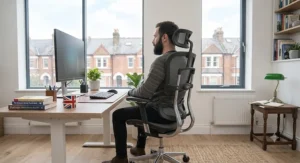
Buying the right chair is only half the job — set it up wrong and you’ll lose most of the benefit. Start with the extended gas lift: raise the seat until your knees sit at roughly the same height as your hips, or fractionally below, with feet flat on the floor. Taller users often instinctively set the seat too low because it “feels” more stable, which then forces the knees upward and rounds the lower back.
Next, dial in seat depth before anything else. With your bottom pushed fully back into the seat, there should be a two-to-three-finger gap between the front edge of the seat and the back of your knee. If the seat is too deep even at its shortest setting, the front edge will dig into your calves; if too shallow, your thighs go unsupported. This is precisely why seat depth for tall users deserves more attention than seat height alone — it’s the spec most commonly ignored during a rushed purchase.
The HSE’s guidance on posture at a workstation recommends exactly this sequence — chair first, then desk and screen height — since adjusting a desk around a badly-set chair simply relocates the problem rather than solving it.
In the first 30 days, resist the urge to leave every adjustment at factory default. Recline tension, armrest height, and lumbar depth all need individual tuning, and what feels “fine” in week one often reveals itself as wrong by week three, once fatigue patterns set in. A common mistake is setting armrests so high that shoulders hunch upward — they should sit low enough that your elbows rest at roughly 90 degrees without lifting your shoulders at all.
Maintenance is simple but easily neglected: check the gas lift cylinder annually for slow sinking (a sign it needs replacing), keep castors clear of hair and carpet fibres, and re-tighten any bolts that loosen after the first few weeks of regular use, particularly on flat-packed budget chairs.
Real-World Scenarios: Which Tall Office Chair Fits You?
If you’re a 6’5″ software developer working 9-hour days from a home office, seat depth and lumbar precision matter more than price — the Herman Miller Aeron (Size C) or Steelcase Gesture will earn back their cost over years of daily use, particularly if you already have back discomfort.
If you’re a 6’2″ student or early-career professional sharing a desk or renting accommodation, the SIHOO Doro C300 offers the adjustability of a much pricier chair without the long-term commitment, and its lighter weight makes it easier to move between flats.
If you’re 6’6″ and split your time between gaming and remote work, the Secretlab Titan Evo XL solves a genuine dual-purpose problem: most true ergonomic chairs look starkly corporate, while most gaming chairs ignore genuine spinal support, and this one was engineered for your exact height bracket from the outset.
If you’re setting up a small business office on a tight budget but still want at least one properly tall-friendly chair for a 6’1″-6’3″ team member, the FlexiSpot C7 or Duramont Ergonomic Chair both deliver real adjustability without derailing the furniture budget.

Problem → Solution: Common Issues Tall People Face With Office Chairs
Problem: Knees higher than hips. This happens when the seat can’t rise high enough for your leg length. Solution: prioritise chairs with an extended gas lift and a seat height ceiling above 55cm, such as the FlexiSpot C7 or Herman Miller Aeron (Size C).
Problem: Seat edge digging into the back of the knee. Usually caused by insufficient seat depth adjustment. Solution: look specifically for a seat depth range extending past 48cm, which the RH Logic 220 XL and Steelcase Gesture both offer.
Problem: Neck craning forward by end of day. Often a sign the headrest sits too low or isn’t present at all. Solution: choose a chair with genuine headrest height, depth, and angle adjustment, like the SIHOO Doro C300, rather than a fixed decorative pillow.
Problem: Lower back pain despite an “ergonomic” label. Frequently caused by fixed lumbar curves that don’t match individual spine shape. Solution: an inflatable or dynamically adjustable lumbar system, as found on the RH Logic 220 XL or FlexiSpot C7, adapts far better than static foam.
Problem: Shoulders hunching from high armrests. Solution: choose 4D or fully height-adjustable armrests and reset them at roughly elbow height, a feature well handled by the Secretlab Titan Evo XL and Steelcase Gesture.
How to Choose an Ergonomic Chair for a Tall Person
- Check the maximum seat height first. Anything topping out below 53cm will likely leave 6’2″+ users with knees higher than hips.
- Confirm seat depth adjustment range, not just seat depth. A fixed 47cm seat depth suits some tall users but not others — adjustability matters more than a single large number.
- Look for genuine headrest adjustment, meaning height, depth, and ideally angle — not a fixed pad glued to the top of the backrest.
- Verify the weight rating separately from the height rating. Tall doesn’t always mean lighter, and a mismatched weight limit shortens gas lift lifespan considerably.
- Read the warranty length as a proxy for confidence. Premium chairs offering 10-12 years typically reflect genuinely tested mechanisms.
- Consider armrest range last, not first. It’s easy to fixate on armrests, but seat height and depth solve the majority of tall-specific discomfort on their own.
- Test the recline mechanism’s effect on foot position. Chairs that let the seat edge drift too far forward during recline undo any benefit from correct seat depth.
For a broader independent view beyond this article, Which?’s home office chair buying guide is a useful cross-check, since its testing panel scores chairs on adjustability and lumbar support using a standardised process rather than manufacturer claims alone.
Tall Office Chair vs Standard Office Chair
A standard office chair typically tops out around 51-52cm of seat height and offers little to no seat depth adjustment, because it’s engineered around population averages rather than the taller end of the distribution. A genuine tall office chair, by contrast, is built with an extended gas lift cylinder as standard — not an optional accessory — alongside a deeper seat pan and, in the better examples, an adjustable seat slide mechanism.
| Feature | Standard Office Chair | Tall Office Chair |
|---|---|---|
| Seat height range | ~40-51cm | ~46-57cm |
| Seat depth adjustment | Rare or fixed | Usually adjustable |
| Backrest height | Medium | High/extended |
| Headrest | Often absent | Frequently included |
| Best For | Average-height users | 6’1″+ users |
The practical difference shows up within weeks rather than months: a standard chair forces a taller user into a compromised posture that feels fine initially but compounds into hip and lower-back fatigue by the second or third month of daily use. Chairs purpose-built for taller frames, such as the RH Logic 220 XL or SIHOO Doro C300, remove that compromise entirely by matching the furniture to the body rather than the reverse.
💬 Which type fits your setup? Compare a couple of the options above side by side before deciding.
High Back Chair for Tall Person: Why Backrest Height Matters
A high back chair for tall person use isn’t just about looking imposing behind a desk — backrest height directly determines how much of your upper spine and shoulder blades receive support during recline. Shorter backrests, common on budget task chairs, stop supporting the spine somewhere around the mid-back for anyone over roughly 6 feet, leaving the shoulders and neck to fend for themselves during long calls or reading sessions.
Reviewers consistently note that chairs like the Herman Miller Aeron (Size C), with its 61cm backrest height in Size C guise, and the RH Logic 220 XL, with its genuinely tall high-back option, allow a full recline without the shoulders drifting past the top of the padded area. What the spec sheet won’t tell you is that backrest width narrows toward the top on well-designed high-back chairs specifically to free the arms for movement — a detail worth checking if you frequently reach overhead or twist to grab something from a shelf.
Seat Depth for Tall Users: The Most Overlooked Spec
Seat depth for tall users is arguably the single most under-discussed spec on any office chair listing, largely because manufacturers advertise seat height prominently while burying depth figures in a downloadable PDF. Longer femurs need a longer seat pan, full stop — but a seat that’s simply “bigger” without adjustment can be just as uncomfortable for a tall-but-slim frame as a too-shallow seat is for a tall-and-broad one.
The chairs that handle this best in our list, the RH Logic 220 XL and Steelcase Gesture, use a sliding seat pan mechanism rather than a fixed dimension, letting the same chair suit a 6’1″ user and a 6’6″ user with genuinely different proportions. Based on the spec comparison, anywhere between 45cm and 52cm of adjustable seat depth covers the vast majority of tall body types; anything narrower than that range is worth double-checking against your own measurements before buying.

Headrest Height: Do You Actually Need One?
Headrest height adjustment sparks genuine disagreement among ergonomics specialists. Some argue that a headrest encourages passive neck posture and shouldn’t be necessary if the backrest and lumbar support are correctly configured; others point out that anyone who reclines significantly to look at a raised monitor, or takes regular short breaks reclined, benefits considerably from height, depth, and angle-adjustable neck support.
For tall users specifically, the calculation shifts slightly: because chairs are so often designed around shorter backrests, a tall person reclining even moderately can find their head extending well past the top of the backrest with nothing behind it at all. In that specific case, headrest height adjustment stops being optional and starts being the only thing preventing neck strain. The SIHOO Doro C300 and Secretlab Titan Evo XL both handle this well through repositionable headrests, while the RH Logic 220 XL‘s optional neckrest offers the most precise angle control on this list.
Common Mistakes When Buying an Ergonomic Chair for a Tall Person
The most common mistake is buying by height range alone and ignoring weight rating entirely — a chair rated for someone 6’4″ but only 90kg will wear out its gas lift and tilt mechanism prematurely under a heavier tall frame. A close second is assuming “one size fits all” marketing claims without checking the actual seat depth adjustment range, since many chairs marketed generically as “tall-friendly” simply raise the gas lift without touching the seat pan at all.
Another frequent error is skipping the return window on chairs bought online, particularly premium models, without actually sitting in them for several consecutive days first — initial impressions in a showroom rarely match how a chair feels after six hours of real work. Finally, plenty of buyers fixate on armrest features while neglecting backrest height, even though for genuinely tall users the backrest is usually the spec doing the most heavy lifting.
Long-Term Cost & Maintenance for Tall-Frame Office Chairs
| Chair | Price Range | Warranty | Est. Cost-Per-Year* |
|---|---|---|---|
| Herman Miller Aeron (Size C) | £1,300-£1,600 range | 12 years | Lowest long-term |
| RH Logic 220 XL | £900-£1,200 range | 10 years | Low long-term |
| Secretlab Titan Evo XL | £500-£650 range | Up to 5 years | Moderate |
| SIHOO Doro C300 | £230-£280 range | 2 years | Higher if replaced often |
*Assuming the chair is used for its full warranty period without early failure; actual value depends on your usage hours and how well you maintain the mechanism.
Interpreting the table above, the premium tier looks expensive on day one but often works out cheaper per year of ownership than replacing a budget chair every two or three years once a gas lift sags or a mesh back stretches out. That said, for anyone unsure whether a fully ergonomic setup even suits their working style, starting with a lower-commitment option like the SIHOO Doro C300 or Duramont Ergonomic Chair is a genuinely sensible way to test the waters before a bigger spend.
Maintenance costs are modest but real: gas lift cylinders typically cost £15-£30 to replace on chairs where this is possible, and most premium brands sell spare casters, armrest pads, and lumbar components individually, extending usable life well past the printed warranty in many cases.
Safety, Regulations & Workplace Compliance for Tall Workers
Under the Health and Safety (Display Screen Equipment) Regulations, UK employers are required to carry out a workstation assessment whenever a new employee starts, a workstation changes, or a worker reports discomfort — and chair fit is explicitly part of that assessment. For remote and hybrid workers, this obligation extends to home workstations too, meaning a genuinely tall-friendly chair isn’t just a personal comfort choice but potentially a compliance requirement for employers with taller staff.
Reviewers and posture specialists consistently flag that BIFMA and BS5459-2 testing standards, which several chairs on this list carry, indicate the chair has been independently load- and durability-tested rather than simply rated by the manufacturer’s own marketing copy. When assessing a workstation for a taller employee, it’s worth checking not just the chair but the desk height and monitor position together, since a perfectly adjusted chair still won’t fix posture if the desk itself sits too low.
Frequently Asked Questions
❓ Do tall people need a special office chair?
❓ What seat height is best for a 6'4' person?
❓ Is an extended gas lift the same as a tall chair?
❓ How do I know if seat depth is right for my height?
❓ Are gaming chairs a good alternative for tall people?
Conclusion
Choosing the right ergonomic office chair for tall person needs really comes down to three numbers most people never check properly: maximum seat height, seat depth adjustment range, and backrest height. Get those three right, and the rest of the adjustability — armrests, tilt tension, headrest angle — becomes a matter of personal preference rather than genuine physical necessity.
Across the seven chairs we’ve compared, there’s a workable option whatever your budget looks like. The Herman Miller Aeron (Size C) and Steelcase Gesture sit at the top for anyone treating this as a long-term investment in daily comfort, the RH Logic 220 XL and Secretlab Titan Evo XL offer genuinely tall-specific engineering at a more accessible price, and the SIHOO Doro C300, FlexiSpot C7, and Duramont Ergonomic Chair prove that a proper fit doesn’t require a four-figure budget. Whichever you choose, prioritise trying the seat depth and headrest height adjustments in person or during a return window before committing — the numbers on a spec sheet only tell half the story until your own body sits in the chair.
✨ Ready to stop compromising your posture for furniture that was never built with you in mind? Check current prices on the chair that best matches your height and budget today! 🪑
Recommended for You
- Ergonomic Office Chair for Back Pain: 7 Picks Tested for 2026
- Ergonomic Office Chair For Long Hours: 7 Best Picks (2026)
- Ergonomic Office Chair With Lumbar Support: 7 Best Picks (2026)
Disclaimer: This article contains affiliate links. As an Amazon Associate, I earn from qualifying purchases. If you purchase products through these links, we may earn a small commission at no additional cost to you.
✨ Found this helpful? Share it with your friends! 💬🤗
